A once-thriving, vibrant community in southern Christian County — connected in the country’s earliest days with an 18th century land scandal involving a Founding Father and signer of the U.S. Constitution, a governor, a secretary of state, and a future U.S. president — is virtually unknown today.
The community of Noah’s Spring once straddled the Kentucky-Tennessee state line, its rich, tapestried and eclectic history permanently interrupted in 1942, when the federal government bought out hundreds of landowners in Christian and Trigg counties in Kentucky, as well as Montgomery and Stewart counties in Tennessee, to establish what was expected to be a temporary Army camp for the duration of World War II.
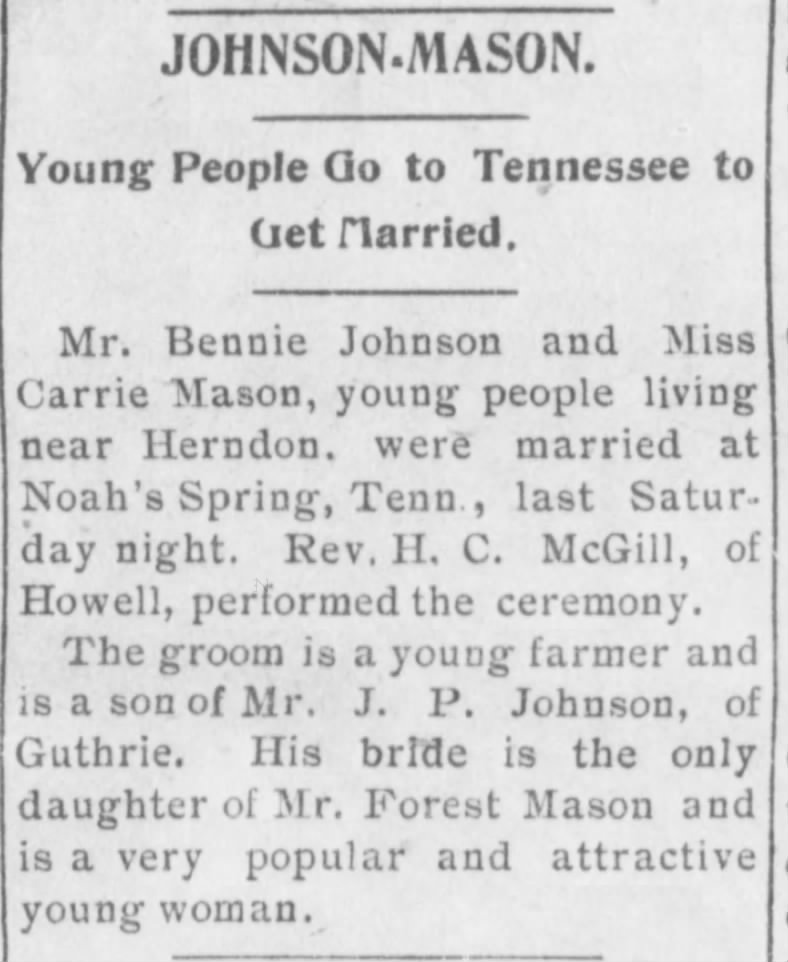
During Noah’s Spring’s almost 150-year history, it counted among its occupants and visitors people from Christian County and Montgomery County alike, as well as countless visitors from further reaches for agricultural fairs, church picnics, revivals and baptisms, social picnics, barbeques, dances, political events, marriages and secret elopements.
A small group of local citizens (including the writer of this article) recently visited the site, now quietly observing the passage of time and events relatively undisturbed except for the nearby passing of military vehicles and personnel.

Noah’s Spring is an actual natural spring, emerging from the karst topography that makes up southern Christian and northern Montgomery counties, noted for the prevalence of caves, sinkholes and underground waterways.
It sits just inside Tennessee, no more than 25 yards from the state line. Water flows from it into the Noah’s Spring Branch and from it into the Little West Fork of the Red River. The name seems to have come from a large rock formation, which to early white explorers and settlers apparently looked like a place where Noah took rest after the Biblical flood receded. The surrounding area is mildly rugged with a number of sinkholes in the near vicinity and trees covering the landscape.
Entry into recorded history
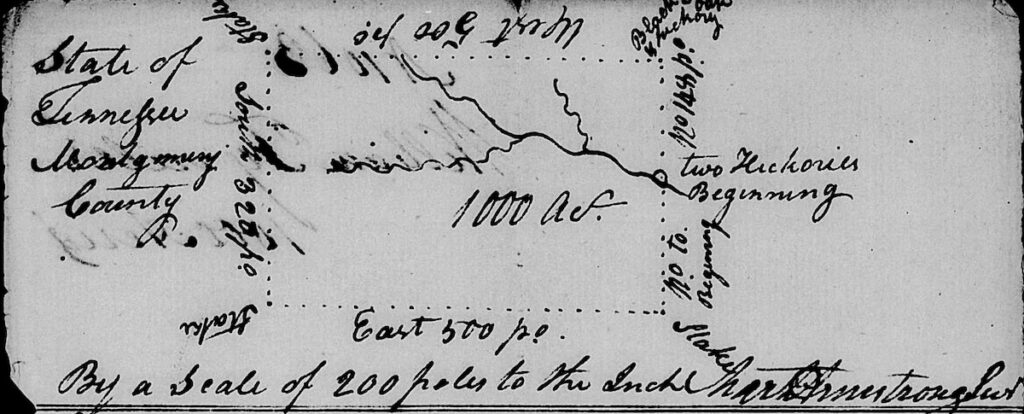
Noah’s Spring first appears by that name in records on Jan. 21, 1797, as a 1,000-acre Revolutionary War land grant, entered in the name of soldier James Johnston and surveyed for William Tyrrell.
Land grants were issued by former colonies such as North Carolina, poor in funds after the Revolution but rich in lands, to pay Continental soldiers for their time spent in the war effort. Virginia did likewise with its land in Kentucky.
Land warrants issued to soldiers often were surveyed for and settled by the soldier himself, but it was also common for former soldiers to sell the land warrant for monetary gain and remain in North Carolina, or migrate elsewhere with family. It did not take long for individuals to work out schemes to defraud the newly formed nation and her patriot soldiers of the best lands, and William Tyrrell is noted amongst those who benefitted the most from one of the largest and most consequential scams.
Glasgow Land Fraud
The so-called Glasgow Land Fraud was named for James Glasgow, North Carolina secretary of state from 1776 to 1798, and the highest-ranking official involved in the scandal. Glasgow’s son-in-law Stockley Donelson (brother of Rachel Donelson Jackson, wife of the future president, Andrew Jackson), William Tyrrell and others were involved in obtaining fraudulent land warrants.
Tennessee Gov. John Sevier and William Blount, a Founding Father and signer of the Constitution, as well as governor of the Southwest Territory (the designation given in 1790 to the land that would become the state of Tennessee on June 1, 1796) were among a number of prominent men connected to fraudulent land claims.
Sevier and Blount were both implicated — Sevier for improperly obtaining land under an earlier land law after a newer one had superseded it, and after some land record books which would have proved his actions disappeared; and Blount for being complicit in a plot to destroy evidence in the case, having conducted a meeting between conspirators in his Knoxville home.
Neither Sevier nor William Blount were ever charged, but both suffered political embarrassment over the matter. Blount’s brothers John and Thomas Blount were charged, indicted, and tried, but ultimately found not guilty.
Fraudulent land warrants involved in the Glasgow scandal were obtained in several different ways. In some cases, land speculators and agents created fake military warrants or warrants in the names of soldiers who had already received land, or altered legitimate warrants to include larger land tracts. In other cases, warrants were created in the names of dead or nonexistent soldiers.
Many of the tracts of land included the complicity and sign-off of either James Glasgow himself or one of his associates, including Nashville land office manager and surveyor Martin Armstrong, a former Revolutionary War military officer who had laid out the original town survey map of Clarksville, Tennessee, and facilitated its rise to prominence as a tobacco port.
In the case of William Tyrrell and his nephew, William Tyrrell Lewis, they were overheard at Tyrrell’s Nashville lodging house-tavern defrauding both the government and former Continental officers by intoxicating the men and then enticing them to sign fake land warrants.
Andrew Jackson, then a Nashville attorney and Tennessee congressman, reported evidence of the fraud to North Carolina Gov. Samuel Ashe in late 1797, and the ensuing investigation and trial sent Glasgow to prison and resulted in the renaming of Glasgow County, North Carolina, to its present name of Greene County. It also led directly to the establishment of the North Carolina Supreme Court. The massive number of cases, involving hundreds of thousands of acres, was more than the earlier court system in the state was equipped to handle.
Despite being one of the biggest beneficiaries of the illicit scheme, and having been directly involved in a plot to destroy evidence by burning fraudulent warrants and the North Carolina state house which held them, Tyrrell was never brought to trial.
An 1802 sale advertisement in The Tennessee Gazette announced an upcoming court-ordered auction of “500 acres … including a certain spring, called and generally known by the name of Noah’s Spring …,” noting it was part of an original 1,000 acre tract. The Noah’s Spring original survey, which included the names of soldier James Johnston and of William Tyrrell, was included in the court records and investigation, suggesting the Noah’s Spring tract was suspected and may have been one of those originally fraudulently granted.
Noah’s Spring Church
A Baptist church was organized near Noah’s Spring in about 1820. The first noted pastor was an Elder Warfield, likely William C. Warfield, an early Baptist minister and grandson of William Christian for whom Christian County was named. Records make it clear that though the spring itself was in Tennessee, the church was located on the Kentucky side of the line. Early membership included the Poole, Clardy, Giles, Atkinsons and Rives families from the area.
During this time frame, the Second Great Awakening, a period of substantial upheaval in religious ideas and doctrine, was sweeping the nation. It had begun in 1799 in nearby Logan County at the historic Red River Meeting House, and out of this movement emerged the Disciples of Christ, known today simply the Christian Church (Disciples of Christ).

Under the leadership of Elder James A. Lindsey, Noah’s Spring church was one of the earliest and therefore pivotal Baptist churches to divide over disagreements in church doctrine and teachings, choosing to follow the teachings of Alexander Campbell and become early Disciples of Christ. In about 1827 the members who wished to remain Baptist formed Olivet Baptist Church and built a new building at Garrettsburg, a few miles north of Noah’s Spring in Christian County. Olivet Baptist will celebrate its 200th birthday next year.
The Christian Church was known for its abolitionist views, and this may have impacted the decision in 1833 by Lindsey and a number of Noah’s Spring Church members to migrate to central Illinois, as much of South Christian was the largest slaveholding area in the county, and their views may have made them subject to discomfort or worse. The church could have continued to house worship services from time to time after that point, but no record of any active congregation there past 1834 has been found.
A community and social hub
Given its natural beauty, water source and proximity to the local communities of Garrettsburg and LaFayette in Kentucky, as well as Jordan Springs and Rose Hill in Montgomery County, Noah’s Spring was a popular destination for a wide variety of social, business and religious activities.
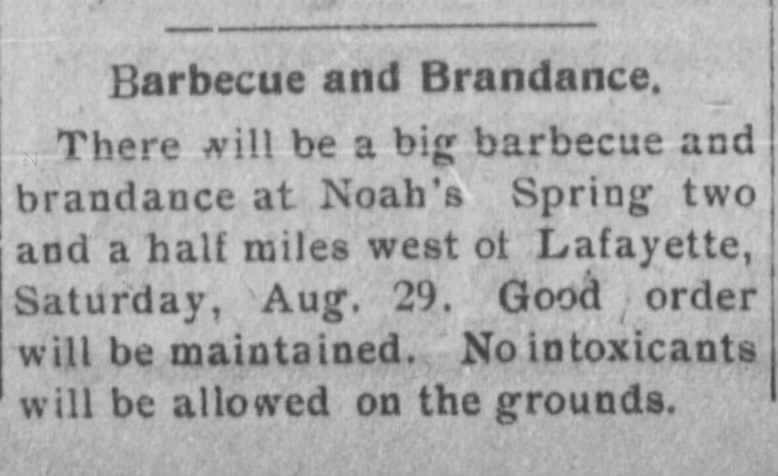
Montgomery County newspapers from the 1850s (there are no extant newspapers from Christian County that early) note several marriages having been solemnized there, as well as picnics and “bran dances.” Bran dances were popular in the area well into the 20th century and were held either indoors or out, and bran — the husk of cereal grains such as wheat or oats — was sprinkled on the floor or ground to keep the dust down and make the surface a bit slipperier and more conducive to dancing.
A newspaper from Maysville, recalled in an 1887 article that during the presidential election of 1856, John W. Stevenson (who later became Kentucky’s governor) was an “elector at large,” or member of the electoral college, for the state. While traveling the Bluegrass by buggy to meet constituents, a “grand old-fashioned barbeque” was held at Noah’s Spring, where Stevenson spoke to a crowd estimated at 5,000.
An August 1874 edition of the Clarksville Leaf-Chronicle Weekly advertised that 13 Granges from Tennessee and Kentucky would soon be holding an agricultural fair for farm implement manufacturers to showcase their wares and speakers to share agricultural advances and knowledge.
On July 18, 1879, the Leaf-Chronicle Weekly reported that 120 Black citizens had been baptized at Noah’s Spring about two weeks earlier (no details regarding which churches or towns’ citizens were involved), and a snippet from The South Kentuckian, a Hopkinsville newspaper, one year later in July 1880 described that a “protracted meeting,” likely a revival, had just closed in Garrettsburg (presumably at Olivet Baptist) and that baptisms had been performed at the Spring. The same publication noted a month later that the Garrettsburg Shooting Club had reorganized and would be meeting other such clubs at Noah’s Spring for competitions.
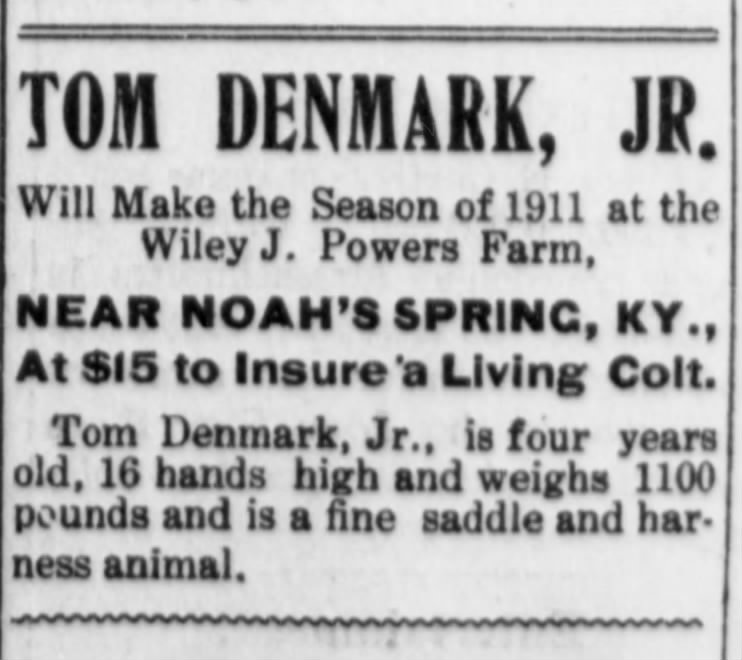
Other 1880s newspaper entries report youth gatherings for picnics and croquet games there. An 1889 story from the Leaf-Chronicle Weekly noted the presence of “several old Indian mounds in the neighborhood of Noah’s Spring,” and that several young men had been engaged by the Smithsonian Institution to collect artifacts from the Noah’s Spring area. Apparently the only find was an old logging chain. The Hopkinsville Kentuckian estimated that 1,000 people attended a barbeque and bran dance at Noah’s Spring in August 1892.
At least three murders occurred at Noah’s Spring. The deaths of Edward White, in 1903, and William Henry Hillard, in 1908, both resulted from fights fueled by drinking at barbeques, according to newspaper reports. And in 1907, Jack Allen was charged with killing his estranged wife, unnamed in the newspaper coverage.
Social events at the Spring continued to be detailed in various newspapers until the government buyout of the land in 1942.
Newspaper accounts mention the presence of at least two stores at Noah’s Spring. Mack Rives was set to open one in November 1889, and Luke Bagby’s store at Noah’s Spring was robbed in 1915 and 1923. No records have been found for other businesses in the vicinity, but doubtless there were some.
After the land now encompassed by Fort Campbell was bought from landowners in 1941 and 1942, Noah’s Spring families, like other now-erased communities, moved elsewhere, often into the surrounding communities in both Kentucky and Tennessee.
Some family cemeteries were relocated as well, those in Christian County predominantly to Flat Lick Cumberland Presbyterian Church cemetery near Herndon, and Powell Cemetery at LaFayette. Army activity and time have erased or eroded essentially all traces of the former community.
Standing at Noah’s Spring
On a recent warm March afternoon, a small group of us went for a prearranged visit to Noah’s Spring. The excursion included Pastor Mike Bullard of Olivet Baptist Church, his son Isaac, three members of the Cultural Resources Management office from Fort Campbell, Christian County Historian William T. Turner, and me.
Sun rays shone through the yet-leafless tree limbs as we pulled up on the gravel of State Line Road and emerged from our vehicles into the historic neighborhood of Noah’s Spring — once bustling and filled with the sounds of fiddle music and baptismal hymns and the scents of barbecuing pork — now quiet and serene and far more reminiscent of its earlier wilderness persona.
Large sinkholes lay just off the north side of the road, and the Fort Campbell guides indicated that the spring lay just a few yards to the south. Turner, now 85 and having yearned to see the ancient spring for more than 40 years, expressed a strong desire to venture down the wooded slope to the spring itself.
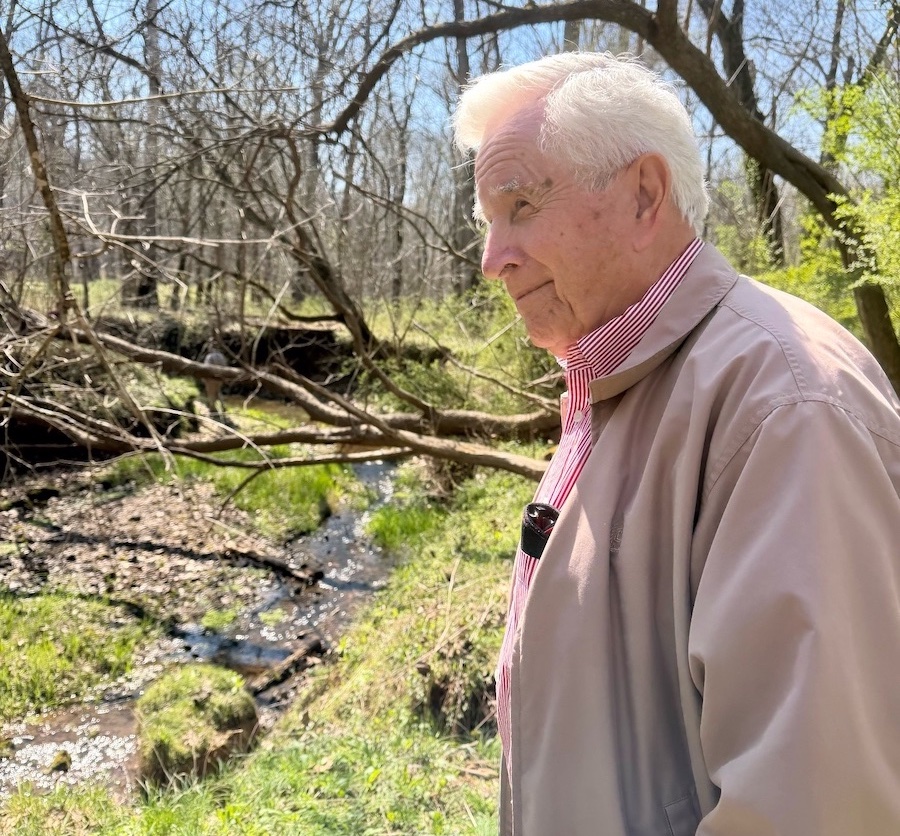
So off we went, picking our way amongst tree roots and downed branches and dead leaves.
The sight was profoundly moving, as though we had been transported back more than 200 years and were seeing what the explorers and hunters in the 1780s and ‘90s in this part of Kentucky and Tennessee must have seen.
We were transfixed.
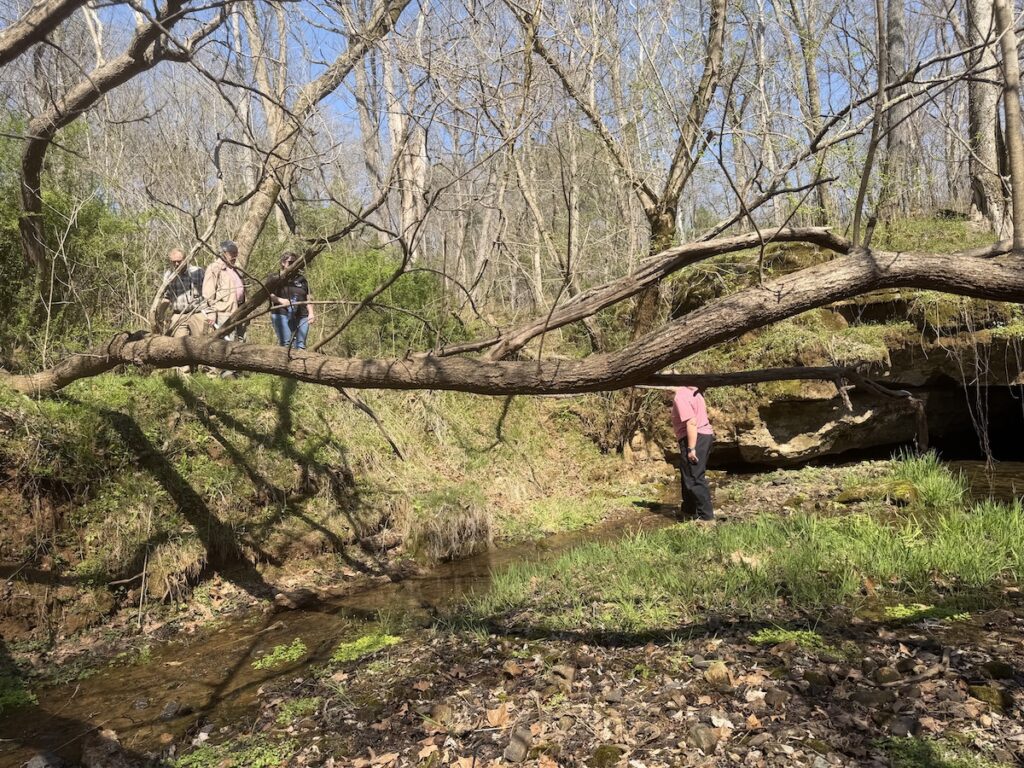
Water flows from beneath a small cave, over which is a large rocky formation, doubtless the seat whereupon Noah took his rest in the stories of the early residents. The stream flows southward for a few feet over smooth-worn creek rock and rounds a curve, joined there by another spring-flow, and fills a large and doubtless deeper pool of water, before eventually flowing off to the south and toward the Noah’s Spring Branch (also called the Flat Lick Branch or Flat Lick Fork in the earliest records).
Bullard, whose grandmother knew the location from her pre-Fort Campbell youth and had shown him the spring when he was a child, spoke of the countless baptisms the water had seen, and of feeling a closer connection with past residents, referring to the experience as “transcendental.”
His son, Isaac, expressed being struck by how much time passage affects places that were once populated.
“Despite serving as a venue for all those ceremonies, it still sits empty as if nothing was there,” he told me. “Almost never to be found. Since I attend the church at its new location down the road, I couldn’t help but wonder what it would look like in 100 years.”
Turner voiced a deep personal satisfaction at having finally visited a long-sought spot, and of it being a “deeply moving” experience. Several in the group expressed feeling as if the residents, visitors, and days of Noah’s Spring’s past were just out of sight and touch, but nearby.
For me, it was an almost spiritual connection, as if time’s layers had peeled back for us and we stood in an earlier era.
I have often wondered what my native Flat Lick area of Christian County looked like before human habitation and agriculture transformed it, and assumed my reaction was based on likely having finally seen a glimpse of that.
It may have been a bit more.
In followup research after the visit, I discovered that the land on the Kentucky side, where the Noah’s Spring Church stood, once belonged to my paternal fifth great-grandfather, George D. Griffey (1787-1860) and his wife, Sarah Rives Griffey (born about 1790), and likely belonged to her father, Miles Rives (born before 1765 and died in 1821), my sixth great-grandfather and an area pioneer, before them.
The Noah’s Spring tract itself once belonged to their son William (1818-1878), my fourth great uncle.
I was standing on the homeland of my ancestors. The circle had come fully round.

Yvette Smithson Holmes, a native of southern Christian County, is an avid researcher of local history and genealogy. A graduate of Western Kentucky University, she previously worked in nursing. She is married to Bradley Holmes. They have five adult children and a granddaughter.