(Editor’s note: This column first ran in The Sunday Brew newsletter. If you are interested in articles like this, see them first by signing up for the newsletter.)
To be a student of Hopkinsville history means that you will occasionally have a longing for something that disappeared from our town’s landscape years before you arrived on the scene. And you will wish you could have known many of the people who lived and worked in these places.
Hotel Latham is one of the unique Hopkinsville landmarks that most of us living today never witnessed. Constructed in the early 1890s, the massive Renaissance Revival structure of buff-colored bricks with a red tile roof stood at Seventh and Virginia streets. It was destroyed by fire on Aug. 4. 1940.
The hotel’s influence on Hopkinsville resurfaces often. As Grace Abernethy wrote in a Brick & Mortar Monthly column, “Historic buildings leave their fingerprints on a community’s psyche. They quietly instill a sense of continuity, identity and place over the years. Every historic building is a unique accumulation of the stories that have played out in and around it.”

Smaller landmarks surrounded Hotel Latham — a fact made clear to me last week when I read through a collection of brief profiles written in the 1930s to highlight the lives of immigrants who had settled in Hopkinsville.
One of them — an Italian named Frank DeGeorge — ran a fish market that stood across the street from Hotel Latham. One of his newspaper advertisements boasted of “Oysters! Oysters! Oysters! … The Largest and Best Oysters in Town.” The ad also listed for sale “Red Snappers, Red Snapper Steak, Spanish Mackerel, Channel Cat, Buffalo and Gulf Salmon.” (It’s worth noting that no place in Hopkinsville today has all of those under one roof.)
DeGeorge’s story and 28 others were part of a series that Charles Meacham, a journalist and former Hopkinsville mayor, wrote for the Kentucky New Era.
So while I sometimes wish for a moment to travel back in time to see and touch the Hotel Latham, I would also want to walk across the street to hear Mr. DeGeorge’ voice and to smell the fresh fish he was selling. I’d want to ask him about Sicily and how he decided to come to the United States — and to Hopkinsville of all places.
Published nearly a century ago, the newspaper’s immigrant profiles were the inspiration for a Supper Club presentation Thursday evening at the Pennyroyal Area Museum. Put on monthly, Supper Club is a collaboration of the Museums of Historic Hopkinsville-Christian County and the local Human Rights Commission. It’s designed to bring people together to share different cultures and experiences through food.
I wasn’t able to attend last week’s Supper Club, which featured former chef Matthew Brown, who prepared several dishes unique to the countries represented in Hopkinsville immigrant series. One of the recipes Brown shared was a nod to Frank DeGeorge.
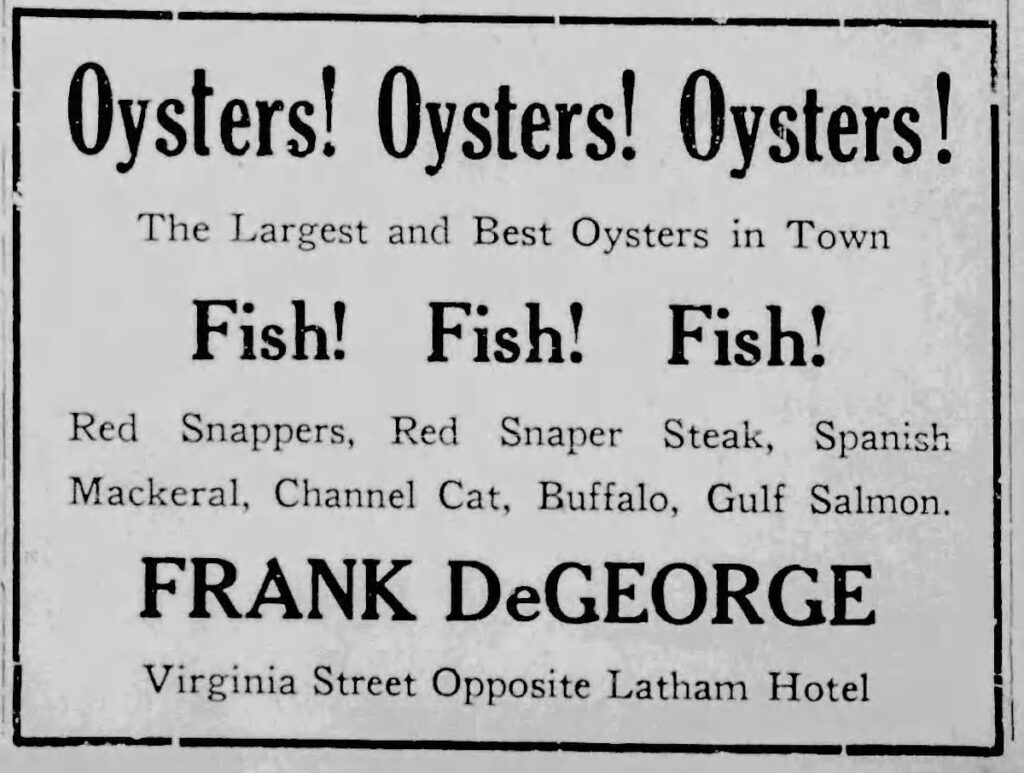
But I’m sharing the DeGeorge profile that Meacham wrote below, along with the recipe that Brown chose and prepared as a nod to the Italian immigrant’s heritage.
You can read all 29 profiles by Meacham here. Our thanks to Alissa Keller, museum executive director for transcribing and sharing these with Hoptown Chronicle.
The immigrants included are:
- Edward Curtis Sr. — England
- David D. McMath — Scotland
- Charles Datillo — Italy
- Nancy Ray Wilson — China
- George A. Stahos — Greece
- Jake Sabel — Russia
- Frank DeGeorge — Sicily
- John Francis Donnelly — Ireland
- Lottie Bohn — Poland
- Sam Klein — Latvia
- Ellen (Mrs. F. W.) MacRae — Finland
- W.C. Bones — England
- David and Jathet Nussbaumer — Switzerland
- Wolf Geller — Ukraine
- Sam Pascal — Roumania
- Snow Babies (Nell Waddell and Burgess Wood Gaither Jr.) — Alaska
- May Buchanan Holmes — Japan
- Henry Vallier — French Canadian
- Nita Jauckens — Mexico
- Harry Wise — Austria
- John Saturley — England
- Thomas W. Smith Jr. — Sweden
- Peggy Smith — Brazil
- D.H. Erkiletian — Armenia
- Peter Grandison — Scotland
- Mrs. D.E. Everett — Germany
- Pete Chrysostom — Greece
- Volney F. Ward — Canada
- Dan M. Evans — Wales
And all of Brown’s recipes from Supper Club are available here.
FRANK DeGEORGE, SICILY
Frank DeGeorge was born on the [island] of Sicily, a province of Italy, and came to America as a youth in 1902. In 1910 he came to Hopkinsville and made a place for himself in the business circles of the city.
Born on an island of the sea, he brought with him a love of fish and for years he has conducted a fish market as a line of his business and has supplied his adopted city with the best that could be obtained.
For 23 years, he has been a successful business man here. Several years ago he was married to a young lady of Cadiz (Trigg county, not Spain), and two children have come to bless their home.
Mr. DeGeorge’s place of business is on Virginia street, opposite the Hotel Latham, where he can always be found on his job, for the city has few more energetic and industrious business men that Frank DeGeorge. He knows all about fish and greets his customers with a smile that doesn’t wear off.
(DeGeorge’s profile ran in the Kentucky New Era on Feb. 5, 1934.)
SICILIAN BAKED FISH
1.5 cups cherry tomatoes, halved
1 small, red onion, sliced
5 cloves garlic, halved
1 cup Castelvetrano olives
1/4 cup capers
1/4 cup white wine, such as Pinot Grigio
1/4 cup extra virgin olive oil, plus extra for drizzling the fish
1/4 teaspoon red pepper flakes
Salt and black pepper as desired
Halibut fillets (but you can use any fish you like)
Preheat your oven to 425 degrees.
In a baking dish, add the tomatoes, onions, garlic, olives, capers, wine, oil, red pepper flakes and salt and pepper as desired. Toss until everything is well coated in oil. Bake for 15 minutes.
In the meantime, drizzle the fish with extra virgin olive oil and season the fillets with salt and pepper. Add them to the baking dish and bake for an additional 15 minutes.
Enjoy, everyone.

Jennifer P. Brown is co-founder, publisher and editor of Hoptown Chronicle. You can reach her at editor@hoptownchronicle.org. Brown was a reporter and editor at the Kentucky New Era, where she worked for 30 years. She is a co-chair of the national advisory board to the Institute for Rural Journalism and Community Issues, governing board past president for the Kentucky Historical Society, and co-founder of the Kentucky Open Government Coalition. She serves on the Hopkinsville History Foundation's board.