A photographer perches high above Main Street and aims his camera toward the intersection of Ninth Street. The intersection is full, packed with a sea of people. Men, women, and children stand shoulder-to-shoulder, so many of them that it is hard to distinguish where one person ends and the next begins.
A few lucky folks peer from the windows above E. H. Higgin’s Drug Store. The uniform of the day clearly calls for a hat, and many even carry umbrellas to shield themselves from the sun. Two men adjust and balance a large speaker on top of the awning at the Phoenix Hotel. One woman in the foreground glances up just as the photographer’s shutter
CLICKS!
A crowded community moment is captured.
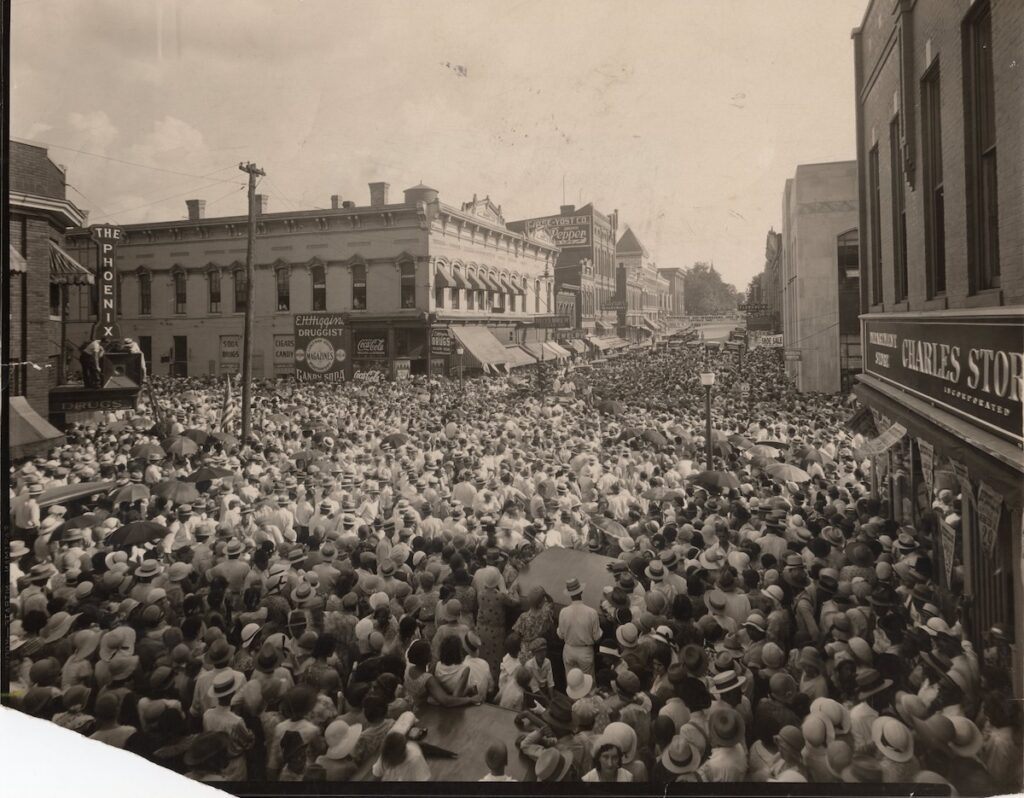
This photograph comes from the vast collection of William T. Turner and appears in his book “Gateway from the Past, Volume II.” In the book, the picture only measures about 4 inches across and is scattered among other street scenes. It took many passes through the book’s pages for it to spark my interest. And then one day, I noticed it, and I noticed that I could hardly distinguish what was in it.
The scene is recognizable. Iconic, even. The photographer is situated along the west side of Main Street looking due south across the intersection of Ninth Street.
William Turner often refers to this intersection as “the center of the universe.” For Hopkinsville and surrounding communities, that is exactly what it was on Wednesday, July 29, 1931 — 95 years ago today.
The day had been deemed “Hopkinsville Day” with the intention of bringing people into town for one big day of sales, deals, and bargains.
Mayor Lucian Cayce presented the idea to a group of local businessmen after seeing the success of similar initiatives in other cities.
The Kentucky New Era noted that Louisville businesses experienced such a boom on their promotional day that “merchandise moved as in the prosperous days which the country enjoyed previous to two years ago.”
Headed by Oscar Bass, committee chair and president of Bass & Co., Hopkinsville Day was hoped to be the most “outstanding merchandising event in Hopkinsville’s history.”
The plan was somehow both simple and elaborate. The simple part was that businesses would offer discounts and that customers would flock to town to take advantage of the deals. The elaborate part was how widespread the initiative became. The event was announced on July 15 — just 2 weeks before the event date. By July 27, more than 125 businesses and other services had signed on to participate.
Can you imagine? 125 different, competing businesses all agreeing to come together for a singular, huge blowout. It was like Hoptown’s very own Black Friday — in the heat of July!
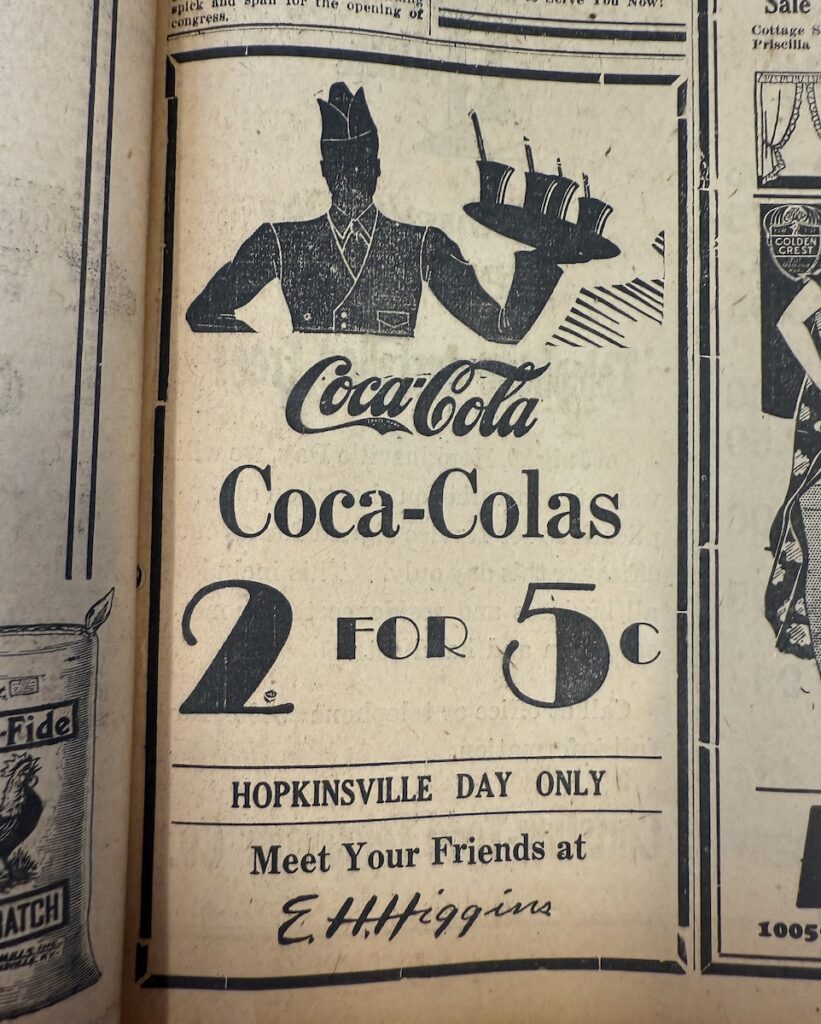
The entire newspaper was plastered from top to bottom with advertisements for the day. The bargains to be found varied widely, and some were more mainstream and expected than others. A small sampling of what was available:
- Howard D. Happy Co.: ½ off wallpaper, 20% off office supplies
- Hopkinsville Motor Co.: 13 cent gas, 10% off tires and tubes
- Ambrose Lumber Co.: 10% off building materials and paint
- 10 different druggists – including Black-owned MeHarry Pharmacy: 20% off all drugs and toilet articles
- Coggins Jewelry Co: 25% off “practically” entire stock
- Dixie Cafe: 35 cent lunch
- Hopkinsville Milling and Acme Mills: wholesale prices
- Keach Furniture Co: 20% off
- Bluebell McGowan: ½ price silk hosiery
- Roseboroughs: ½ price sailor and panama hats
- George Kolb, Optometrist, Jeweler, Gifts: “lowest prices ever offered”
- E.H. Higgins Tea Room: 2 Coca-Colas for 5 cents
The deal on Coca-Colas at E.H. Higgins Tea Room — visible in the picture in the building that now houses Southern Exposure Photography — was quite a hit. The store sold 5,000 drinks and used an entire barrel of syrup and 750 pounds of chopped ice before the day was even over.
But some of my favorites are the more creative offers. The Christian-Todd Telephone Co. waived installation fees for all business and residence telephones, extensions and hand sets. The Christian County Court Clerk offered free marriage licenses. And E.H. Armstrong gave a 10% discount on tombstones. That certainly covers the gamut!
Even with the overwhelming response of shoppers, the deals in the stores were eclipsed by the event in our picture that drew everyone to the crossroads at Ninth and Main streets. At 4 p.m., Hopkinsville Day organizers held a drawing for $400.
Anyone could get a ticket. No purchase was required. All one had to do was stop into a local business and ask for one. And that included everyone: young, old, Black, white, locals, and visitors.
People had come from all over the region to be a part of this monumental day. George Duffer, the planning committee’s transportation chair and owner of Duffer Motor Co., secured reduced bus and rail rates to make travel more accessible, and Walker Wood, Jr., advertising chair and advertising manager of the Kentucky New Era, spread marketing materials far and wide.
Estimated between 10,000 and 12,000 people, the crowd was the largest ever seen gathered in one place in Hopkinsville. By comparison, the 1930 U.S. Census tabulated Hopkinsville’s total population at 10,746. This photograph shows the equivalent of every Hopkinsvillian at the time. Out-of-towners definitely added bulk to the crowd, and the drawing results show that.
The day was miserably hot with temperatures reaching 97 degrees. The drawing took place in the dead heat of the afternoon, and luckily, only three girls fainted due to the heat.
People were packed in so tight that Kentucky New Era journalist Joe Dorris wrote, “The crowd was so dense that half the people had their hands in their neighbor’s pockets and one man who was itching kept scratching someone else all afternoon.” Now, that’s a visual.
The drawing was divided up into 31 total prizes. The grand prize winner received $100. An online historical currency converter adjusts that number to about $2,195.90 in today’s value. Thirty additional winners each received $10, or $219.59.
The magnitude — and necessity — of this cash drawing can be surmised by the sheer mass of people who participated. The year was 1931. The Great Depression had taken hold, affecting every aspect of American life.
Mayor Cayce was supposed to provide a welcome, but he had to stay home sick. Oscar Bass stepped in to run the show, and Mary Evelyn Smith was the lucky girl to draw the names.
The newspaper reported that men would be stationed strategically in the crowd to call out the winners using megaphones, but none can be spotted in this photograph. Possibly the large speaker at the Phoenix took over that job.
When the winners were announced, H.H. Mallory held the winning ticket. Mallory and his wife, Rosalie, lived on West Seventh Street. He retired as a farmer but had owned a saloon before Prohibition. He was 57 years old when he won the grand prize.
The 30 people who each won $10 represented the mass of humanity in this photograph. A search through newspapers and the 1930 U.S. Census and Hopkinsville City Directory helped to find a bit of information on most.
As some names are common and some may be children, there may be a few errors, but these are my best guesses:
- Alice Dorsey, possibly from Henderson
- Margaret Ann Adcock, no local connection found
- Minnie Carneal, operator at the Hopkinsville Clothing Manufacturing Co. who lived on Walnut Street
- John Manning, Clarksville resident and president of the Clarksville Pure Milk Co.
- J.W. Cayce, possibly John Wheeler Cayce, who was 11 years old in 1931 and lived with his mother and sister
- Robert Sholar, 41-year old Cadiz resident and father of 6 who worked as a repairman in a garage
- Mrs. Anna Howell, of Graham in Muhlenberg County, the 28-year old wife of Lee, a coal miner
- N.P. Fears, full name Newell Pinkney “Pink” Fears, a 63-year old carpenter
- Wayne Bates, Route 6
- Denver Hudson, Route 8
- J.L. Tanner, John L., farmhand who lived on West 16th Street
- Ola Foster, teacher in the public schools
- Maggie Wilson, not found, but did discover Madgie Wilson, an African American woman married to John, a classer at the American Snuff Co.
- Albert Mabry, farmer in Church Hill, about 56 years old
- Fred E. Stowe, 24, son of G. Howard Stowe, farmer on Julien Road
- Ray Brumfield, likely William Ray Brumfield, a farmer known for his large greenhouses on Canton Pike
- Lucien Anderson, 14-year old Black youth who lived with his widowed mother and six siblings and was described in 1935 as a 215-pound boxer
- Mary Sue McWhirter, 10-year old daughter of Hugh & Nena McWhirter
- Elmer P. Bell, a large landowner in the Bells Chapel area of Todd County who was 70 years old in 1931
- G.H. Anderson, a painter who lived on Jesup Avenue
- W. J. Murphy, a tobacconist who lived with his wife Hermina on Fowler Avenue
- Walter Dawson, of Herndon, 28-year old owner and operator of the store at Binns Mill
- Dorothy D. Casper, no information found
- Mary Elizabeth Finn, possibly the daughter of Guy, a cable splicer for the telephone company, and Erma, of West 16th Street
- Mrs. Mary Higgins, wife of Edward H. Higgins, the owner of E.H. Higgins drug stores and tea room — where 5,000 Coca-Colas were sold this day
- John Nelson, 41-year old resident of New Providence (although the newspaper says Clarksville) who worked at a mill
- Olney Wilson, of Howell, a laborer at a tobacco factory who was 51 at the time of the drawing.
- Mrs. Sarah Dalton Todd, the 27-year old wife of Buford Todd and heir of Dalton Brothers Brick Co.
- Mrs. Shelby Stobaugh, of Graham in Muhlenberg County
- Susie Gibson, 53-year old Dawson Springs resident
What a day! The organizers were highly pleased with the results with businesses in both downtown and the suburbs reporting an enormous increase in sales for the day. The intent was to establish Hopkinsville Day as an annual affair.
My research did find that a second Hopkinsville Day was held in 1932, but heavy rains forced the postponement of the drawing for a week. Even with the addition of a second $100 prize, the crowd was only about half of what it had been in 1931. It seems that attempts to re-create the phenomenon in this photograph were made a few more times, but nothing ever matched the enthusiasm shown by this crowd.
Certainly, the chance at a cash prize enticed many into downtown that day. But I want to believe that it was something more. I want to believe that it was the spirit of community, the spirit of everyone coming together on one day and in one place to acknowledge the hard times at hand by celebrating a short relief from them.
This picture — of what had to be a sweaty, smelly street — gives us all a glimpse into the sense of support that a strong and vibrant community provides.
I’ll say it again — what a day!

Alissa Keller is the executive director of the Museums of Historic Hopkinsville-Christian County. She’s a graduate of Centre College with degrees in history and English and of Clemson University/College of Charleston with a master’s degree in historic preservation. She serves on the Kentucky Historical Society and the Kentucky Museum and Heritage Alliance boards.