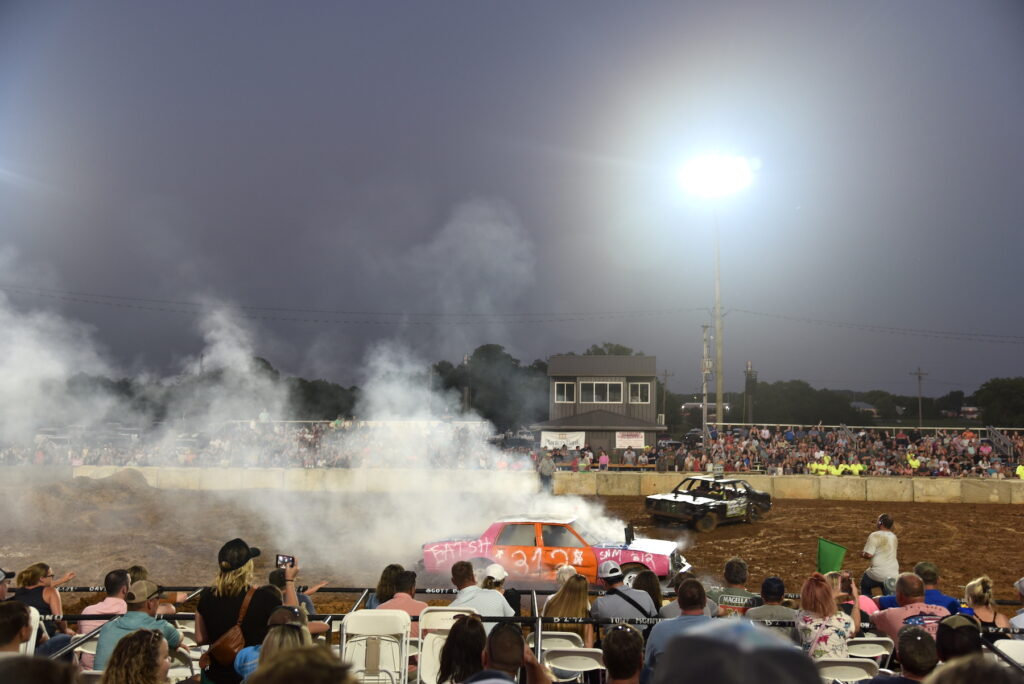
The aroma of radiator fluid wafts through thick June air, while every eardrum within a mile is assaulted by the roar of straight-piped mufflers and metal crunching impact.
No, this isn’t just another day on East Ninth Street. It is the Demolition Derby, which traditionally opens the Western Kentucky State Fair with a crash.
For me (and for many others, judging from the consistently packed stands) the Demolition Derby is a highlight of summer. The premise is appealingly simple: contestants drive cars into each other until only one is left running.
A truly American sport
It may not come as a surprise that the origins of this sport are not well-documented. Demolition derbies may have originated as early as the 1930s, using beat-up old Model Ts. Whether the demolition derby originated in California or New York is debated. Undisputed, however, are the purely American roots of this sport.
The demolition derby’s inception was likely rooted in the growing realization that spectators at motor sporting events actually enjoyed crashes more than the racing itself. One part spectacle, two parts mechanical prowess, by the 1950s, demolition derbies were becoming a fixture at county fairs across America. By the 1960s, the demolition derby was on its way around the world.
My introduction to the demolition derby was right here, at the 2012 Western Kentucky State Fair. That summer was a bumper season for firsts for me. Little did I know when I rolled into Hopkinsville for the first time that June that it would be one of the best summers of my life.
I stayed with Alissa Keller, who was a recent grad school classmate of mine. She had just been hired as director at the Pennyroyal Area Museum and hired me to start a much-needed inventory of the museum’s collection.
My free time was spent exploring and enjoying Christian County. This included driving country roads, my first of many Ferrell burgers, witnessing Harry Houdini’s grand-nephew’s bizarre escape from a strait jacket at the Kelly Little Green Men Days, and attending my first Demolition Derby. I still remember the event vividly.
You may be surprised how deep the Demolition Derby’s roots go at the Western Kentucky State Fair. It appears the inaugural derby here was in 1971. From then on, the Demolition Derby was nearly an annual event at the fair.
Of course, 2020 was an exception because of the pandemic. Taking one year off, however, seems to have bolstered audience enthusiasm for the Demolition Derby. I never remember the stands being packed out pre-Covid the way they have been since.

Rules and consequences
The Demolition Derby is not a lawless event. Written rules govern it, and contestants face censure by the officials, disqualification, and possibly other consequences if they break them. The rule sheet is intense and four pages long. About one page pertains to behavior and the rest to permissible changes made to the automobiles.
One rule is that drivers must wear helmets and eye protection. It’s also illegal to target the driver’s side door of a car you’re hitting — a safety measure. Generally accepted conduct dictates that once a driver has been eliminated, he is out of the heat for good. This year’s derby saw an infraction on this.
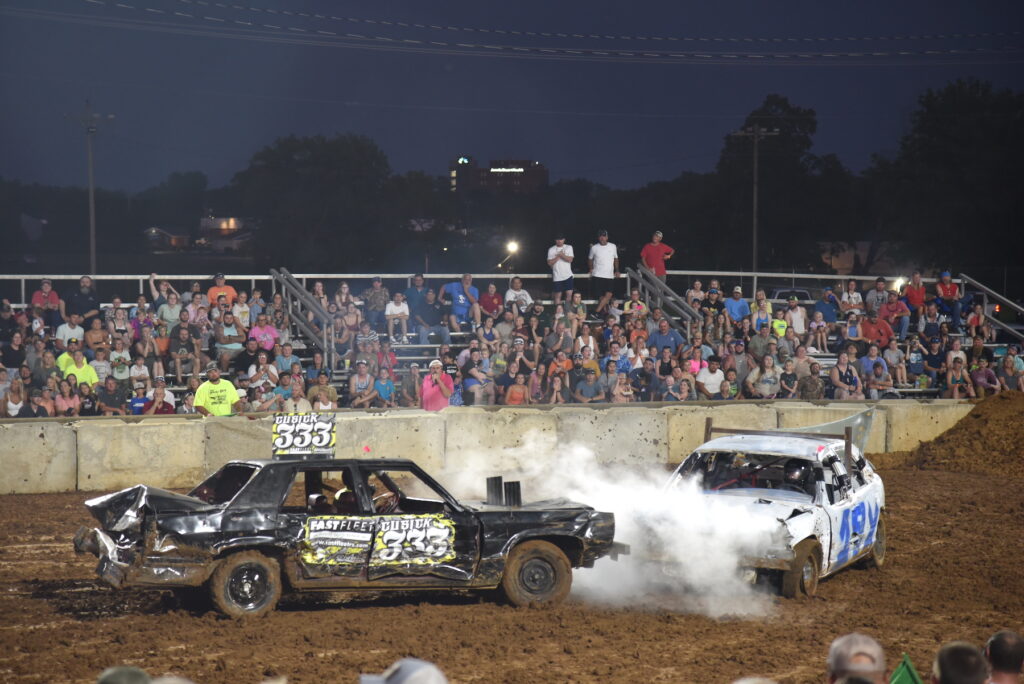
During Heat 3 (full-zized), a large pool of 12 cars had been busily bashing away for about 15 minutes until only two were left. Contestants 519 (Colin Schamp) and 829 (Allen Shepherd) careened around the pit in hot pursuit of each other, dodging the broken-down cars of other contestants that still littered the field. Car 829 had dominated the heat, but in an unexpected stroke, 519 pinned him to another car.
After several minutes of lots of noise and smoke but very little movement, it became clear they were stuck together.
On the loudspeaker, the announcer was musing about whether this was a tie when all the sudden, contestant 406 (who had been eliminated earlier in the round) zoomed back into the pit and crashed into the other two cars. This unlawful re-entry elicited a roar from the other eliminated drivers, who flooded into the pit in what resembled a bench-clearing brawl at a hockey game. Security intervened, plucking the driver of car 406 from his vehicle and escorted him out of the fairgrounds.
The crowd loved it.

Future wheels of the Demolition Derby
If that wasn’t enough excitement for one Demolition Derby, Heat 4 topped it.
This year’s Demolition Derby was divided into four classes, each based on car-type. The traditional derby car is a heavy-bodied, stick-shift sedan, typically from the 1970s or 1980s.
The 1971 entry form for the Western Kentucky State Fair’s Demolition Derby specified, “Any American made stock, hardtop automobile or station wagon is allowed.”
These are still the preferred derby cars, and they ran this year in Heat 3. As we move further into the 21st century, these cars are becoming increasingly difficult to come by.
The past five years of the Demolition Derby have seen a downtick in these traditional sedans and an uptick in other kinds of vehicles. I can tell you after watching many a demolition derby, older cars take a beating much better than newer ones!
This year, heats 1, 2, and 4 contained non-traditional derby vehicles. Heat 1 was compact cars — my favorite because they both accelerate and obliterate quickly. (I await the day a Prius debuts in this heat!)
Heat 4 was “any 1980 and newer 2-wheel drive passenger car, mini-van or mid-size SUV.” This included a Jeep, a PT Cruiser, a mini-van, what looked like a Neon, and another sedan I couldn’t identify. Most of these vehicles were new sights for me at the Demolition Derby.
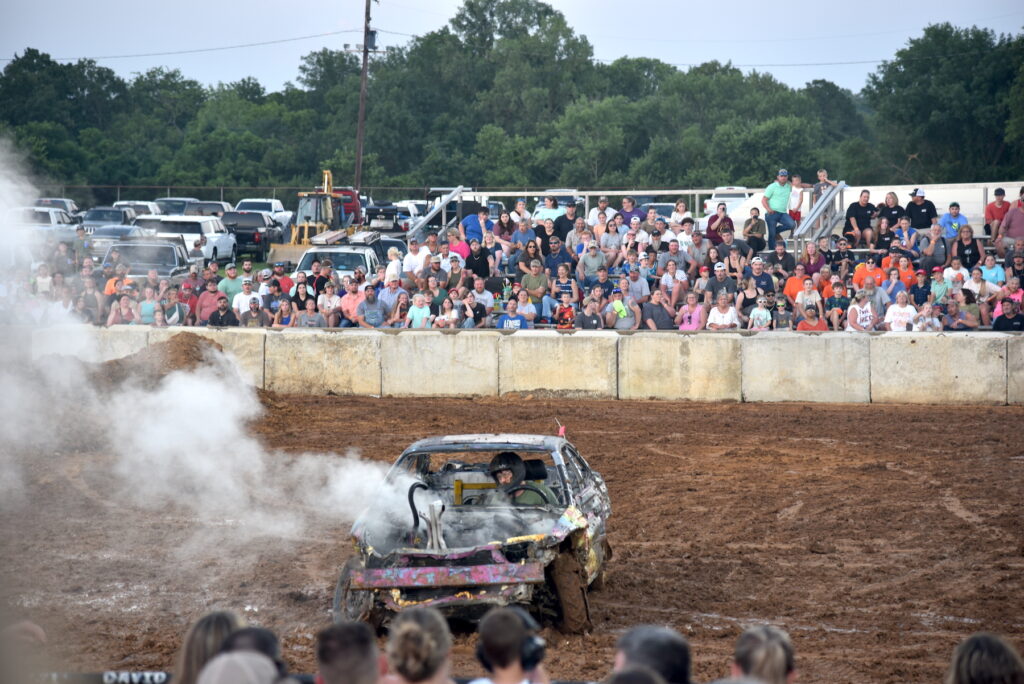
I was a little nervous about the larger vehicles in this heat for safety reasons. The van broke down on its own, right off the bat. The Jeep, however, made a couple of laps before hitting the berm that separated the pit from the grandstand. Because of the Jeep’s height, the berm didn’t stop it like it would have stopped a sedan.
The Jeep rode up the berm, into the air, rolled, and came to rest propped up on the wrong side of the berm. Without even realizing I had moved, I found myself on my feet with everyone else in the grandstand. The crowd roared when the driver wiggled out from the Jeep as quickly as he had flipped and emerged remarkably unharmed.
This mishap resolved itself in the best way possible, with a heart-stopping moment that left everyone exhilarated and healthy. Seeing that car overturn on the berm and end up so close to the grandstand full of people, though, made me pause. Larger vehicles entering the derby will doubtless lead to new regulations on pit construction and berm size.
Until 2026
When I moved from South Carolina to Nashville in 2016, I promptly instituted a tradition. Almost every year since, I have elbowed my way into the packed grandstand at the Western Kentucky State Fair to sweat with the multitudes and enjoy the American pastime of watching cars crash into each other.
See you at the Demolition Derby next year!


Grace Abernethy is a historic preservationist and artist who specializes in caring for and recreating historic architectural finishes. She earned her Master of Science in Historic Preservation from Clemson University in 2011 and has worked on historic buildings throughout the eastern United States. Abernethy was a recipient of the South Carolina Palmetto Trust for Historic Preservation Award in 2014 and won 2nd place in the Charles E. Peterson Prize for the Historic American Buildings Survey in 2011. She and her husband, Brendan, moved to Hopkinsville from Nashville in 2020. She works as an independent contractor and is a board member of the Hopkinsville History Foundation.