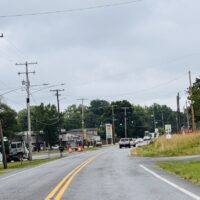
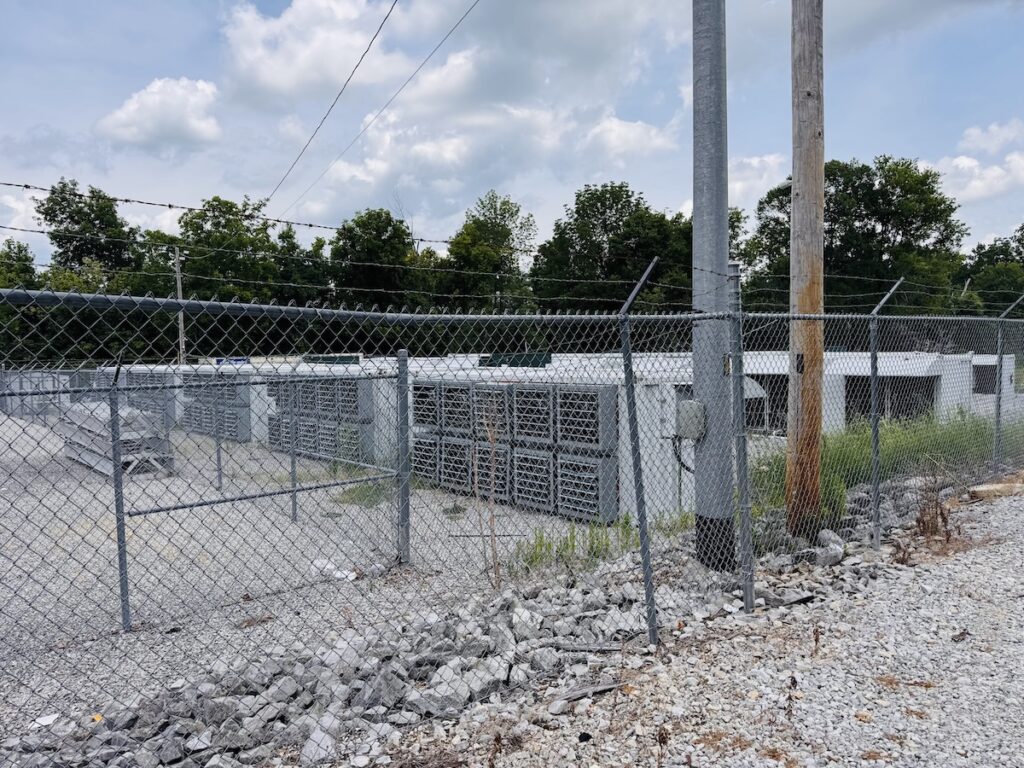
A cryptocurrency mining operation has run for three years on North Campbell Street, largely outside public view. It is located inside Hopkinsville Electric System’s Holland Substation on the north side of town.
North Campbell Land Co. owns the facility, which appears to consist of 22 modular units. Each one is about half the size of a rail car and houses specialized computers used to mine bitcoin, a digital currency.
Hopkinsville’s zoning ordinance does not currently classify data centers as a distinct land use. Under the July 17 working draft prepared by Community and Development Services, however, cryptocurrency mining would itself be considered a data-center use.
NCLC has proposed converting the existing 15-megawatt operation from bitcoin mining to other computing work. The working draft says a data center already operating when the regulations take effect would have legal nonconforming status, commonly called grandfathering.
Separately, NCLC has proposed developing a second, 50-megawatt data center at another site in Hopkinsville. Company representatives said NCLC would cover the estimated $8 million to $10 million cost of building a new 65-megawatt HES substation. The additional 15 megawatts of capacity would be available for other HES customers.
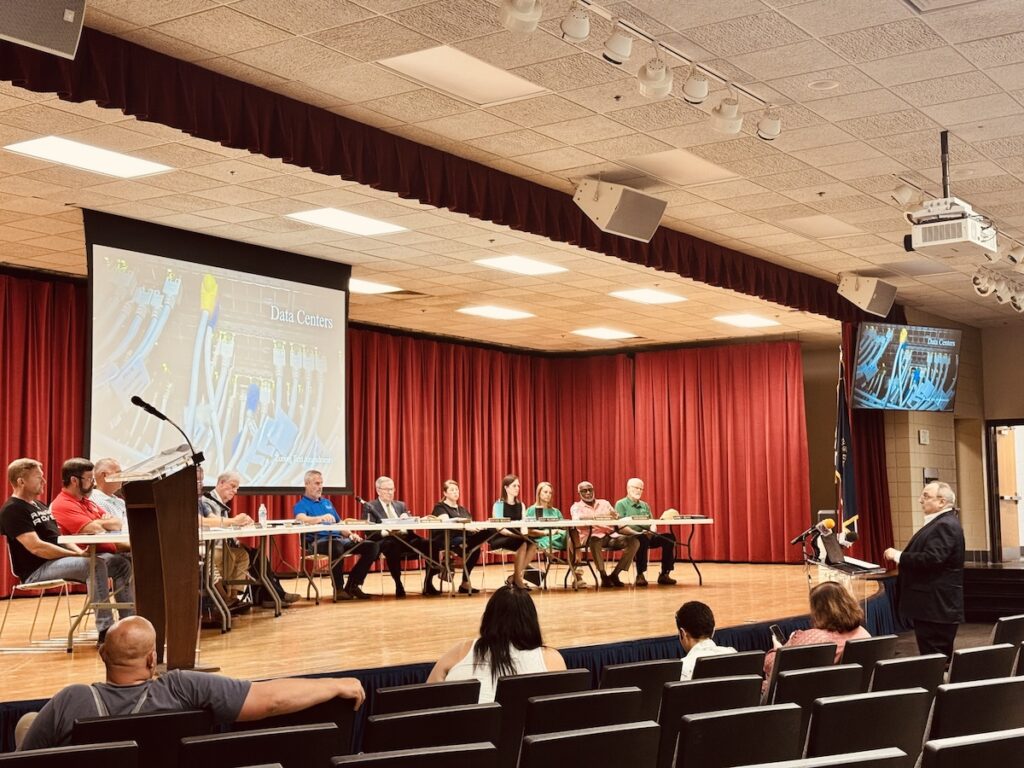
The two proposals were outlined Monday evening at Hopkinsville Community College during a public hearing on proposed zoning regulations for data centers.
Community and Development Services conducted the hearing so its board members could gauge what local residents think about data centers and how they should, or shouldn’t, be regulated. There are currently no regulations for data centers in Hopkinsville. Once CDS finishes drafting an amendment to the Hopkinsville Zoning Ordinance, it will forward the proposed regulations to Hopkinsville City Council, which has the final say on zoning rules.
NCLC representative Thomas Masiero was among 19 people who spoke at Monday’s hearing.
“To the best of my knowledge, there has not been a noise or water complaint against our facility during the three years of operation,” he said, referring to the crypto operation at the Holland Substation on North Campbell Street.
Masiero said the existing crypto mine benefits both NCLC and Hopkinsville Electric customers because it participates in a flexible-load program. The company can quickly reduce or shut down its power use if TVA, which supplies HES, faces unusually high demand because of severe weather or other reasons.
NCLC is owned by a Canada-based company, Sphere 3D, which is traded on Nasdaq under the ticker symbol ANY. (The stock closed Tuesday at $2.20, which was approximately 13% higher than its close Monday at $1.95.)
NCLC was previously part of Cathedra, a company that became a wholly owned subsidiary of Sphere 3D under a transaction approved in June.
Masiero, who resides in Tennessee, is a shareholder and trustee of Sphere 3D and serves as the head of strategy, according to a company press release. In a YouTube video, Masiero discusses the transition from bitcoin mining to artificial intelligence. Data centers store and process digital information to support AI, websites, banking transactions, social media and other uses.
New substation could bring additional capacity to HES
HES general manager Jeff Hurd said the local utility was able to provide space and power for NCLC’s crypto mining facility because of excess capacity at the Holland Substation, which he attributed to the loss of commercial business on the north side of town.
Hurd said revenue from NCLC helps HES avoid rate increases to its 13,000 customers — about 80% of which are residential customers.
“To avoid future rate increases on the backs of our customers, HES is constantly looking for additional revenue to offset these costs,” said Hurd. “So you either cut costs or you find other revenue sources. Unfortunately in our business, rate increases are the standard approach.”
Proposed zoning rules draw concerns
Jack Lackey Jr., an attorney for HES, and Robert Ison, an attorney for NCLC, said the July 17 CDS working draft was too restrictive, particularly its setback requirements — or the buffer zones between data centers and other surrounding properties.
HES also submitted an alternative ordinance that would distinguish between data centers served by the electric grid and those that generate power on site. It also says equipment replacement and the reconfiguration of existing buildings, modular units or containers would not constitute new construction, enlargement or expansion if the work remained within the existing site’s boundaries. Certain modifications increasing the original footprint by no more than 5% also would be exempt.
The CDS draft amendment would classify data centers according to both their connected electrical load and their total footprint:
- Small-scale: less than 5 megawatts and a footprint of less than 10,000 square feet.
- Medium-scale: less than 20 megawatts and a footprint of less than 20,000 square feet.
- Large-scale: less than 75 megawatts and a footprint of less than 50,000 square feet.
The draft would prohibit a hyper-scale data center, defined as a facility with an electrical load of 75 megawatts or more or a footprint of 50,000 square feet or more.
No portion of a small-scale data center’s footprint could be located closer than 300 feet from “the property line of any adjoining property containing a residential, public or quasi-public property …,” according to the CDS proposal.
The other setbacks would be 500 feet for a medium-scale data center and 1,000 feet for a large-scale facility.
Ison asked the CDS board to balance the needs of the community with the need for progress through development.
“For too long in Hopkinsville, the first response to a new idea or innovation has been to say, ‘No.’ And I say, instead, our response should be what can we do to make these types of projects work and still retain what we love about Hopkinsville,” said Ison.
“Make no mistake, if you adopt the more restrictive ordinance, you will effectively ban data centers in the city of Hopkinsville,” he said.
Communities across Kentucky and the nation are considering data center regulations amid concerns about electricity demand, water use, noise, backup-generator emissions and the amount of land and infrastructure large projects can require. The scale of those effects varies depending on a facility’s size, cooling system and source of power.
Ison said NCLC would use a closed-loop cooling system, which recirculates water instead of continually replacing it.
Residents seek environmental protections
Most residents who spoke at the hearing said they wanted protections to address possible effects on the environment and community health.
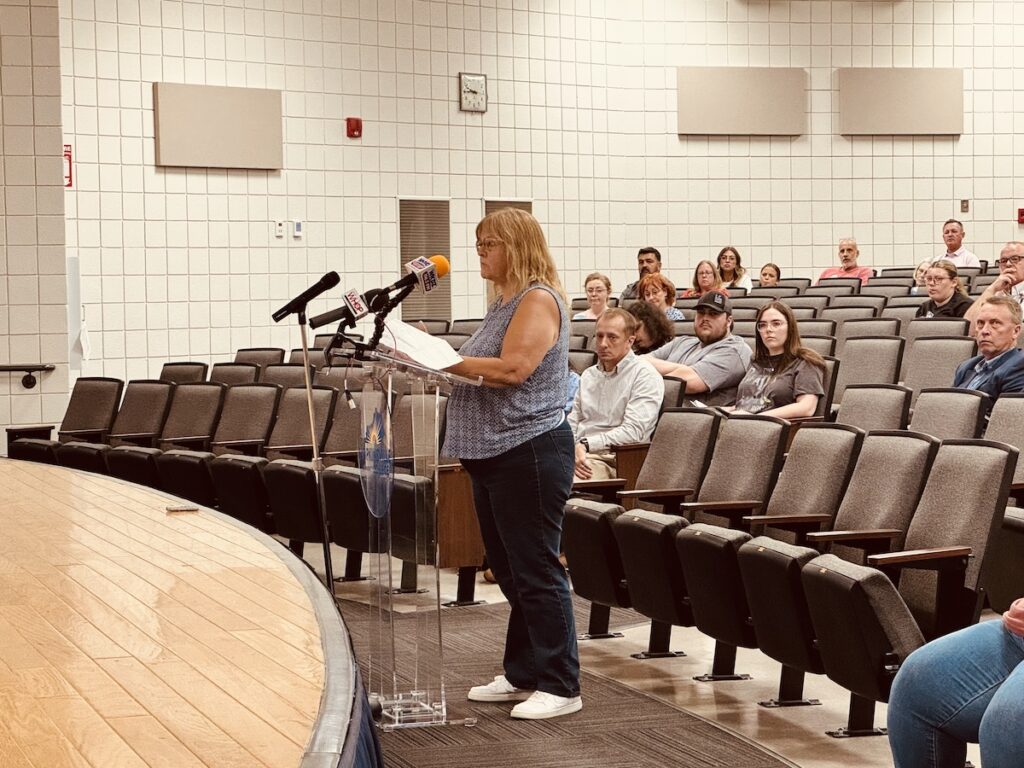
Pembroke resident Sherry Byerline said she already experiences problems from the industrial parks on the south side of Hopkinsville. She said she can hear the machinery running in factories a couple of miles from her home.
“Once they get in and get a foothold, they pretty much do what they want to do, and this creates continuous pollution,” she said.
“I want to make sure that Little River and Lake Barkley are kept safe …,” said Hopkinsville resident Becca Hostilo, adding that closed-loop water systems should be required.
“I would also like to suggest we have a cap on the number of centers that may come into this town,” she said.
Explore the proposed data center rules
Hopkinsville has not adopted data center zoning regulations. These documents show the proposals and background materials considered at the July 27 public hearing.
- Latest CDS working draft (July 17)
Proposed definitions, size categories, setbacks and operating standards. - Original CDS draft (June 22)
The first version introduced by the Planning Commission. - HES alternative proposal
Hopkinsville Electric System’s suggested changes to the CDS approach. - Kentucky Resources Council model ordinance
A detailed framework developed for Kentucky communities. - How other communities regulate data centers
A comparison of zoning approaches in Kentucky and elsewhere. - CDS memo and Planning Commission resolution
Background on the hearing and the amendment process.

Jennifer P. Brown is co-founder, publisher and editor of Hoptown Chronicle. You can reach her at editor@hoptownchronicle.org. Brown was a reporter and editor at the Kentucky New Era, where she worked for 30 years. She is a co-chair of the national advisory board to the Institute for Rural Journalism and Community Issues, governing board past president for the Kentucky Historical Society, and co-founder of the Kentucky Open Government Coalition. She serves on the Hopkinsville History Foundation's board.