Earth Day is this Wednesday, and I’ve been thinking about the natural environment very close to home that has supported three kinds of animals — one now extinct, another recently threatened with extinction and one that comes through for a couple of weeks every year in a brief but brilliant show of flight and color.
These three things that seemingly have little in common are: 1.) huge Ice Age mammals, 2.) playful river otters and 3.) long-distance migratory birds called the rose-breasted grosbeak. What they have in common is their time in Kentucky (or what we now call Kentucky).
I’ll start with the big mammals because, until this morning when I heard it on NPR driving home from church, I did not know Kentucky is regarded as the birthplace of American vertebrate paleontology, which is the study of fossilized creatures with backbones. This covers fish, amphibians, birds, mammals and reptiles.
Big Bone Lick State Park, about four hours north-northeast of Hopkinsville, owes its name to a French explorer’s discovery there in 1739 of “big bones” belonging to mammoths, mastodons and giant ground sloths in salt marshes. The fossils were preserved because the massive creatures got stuck in the boggy marshland. (Native Americans knew of the big bones much earlier.)
Benjamin Franklin was among the Americans who studied the fossils recovered from Big Bone Lick.
Describing what was later identified as a mastodon, Franklin wrote in 1767, “The tusks agree with those of the African and Asiatic elephant … but the grinders differ, being full of knobs, like the grinders of a carnivorous animal … we know of no other animal with tusks like an elephant, to whom such grinders might belong.”
Seriously, we have otters
Now the river otters are much closer to home than the big bones in Northern Kentucky, and learning about this was a huge surprise. It turns out they have been frolicking in Little River just a short walk from my house in the middle of town.
I have a neighbor to thank for this discovery. He and his wife enjoy a grand view of Little River from their back deck. He captured photos and video of three otters racing from the water to the bank and back to the water. They are amazing little athletes.
The sight of otters in Hopkinsville was so unexpected, I felt like I was watching film roll in a middle school science class.
The river otter is a “conservation success story,” writes Art Lander Jr., an outdoorsman and journalist who covers wildlife stories for Northern Kentucky Tribune.
River otters are native to Kentucky but they had disappeared from most of the state by the mid-1990s. Demand for the pelt and loss of habitat threatened their ability to survive here.
These mammals weigh around 25 pounds and can be about 40 inches long. They can run up to 15 mph on land. In the video my neighbor shot, they seem faster.
The Kentucky Department of Fish and Wildlife Resources began a three-year restoration effort in 1991, which was part of a larger program across 21 states, Lander reports. Kentucky released 355 otters that had been trapped in Louisiana.
“River otters are thriving in Kentucky’s rivers, streams and wetlands. Their return to the water landscape will enthrall generations to come,” he writes in a story published in March 2025.
Watching for Mister Red Breast
And finally, there are the grosbeaks. Readers who have followed Hoptown Chronicle for a few years might recall my affection for this grand bird. I first noticed them during the Covid lockdown in April 2020, when I spent most of my days working at the kitchen table with a wide view of my back lawn and my husband’s bird feeders.
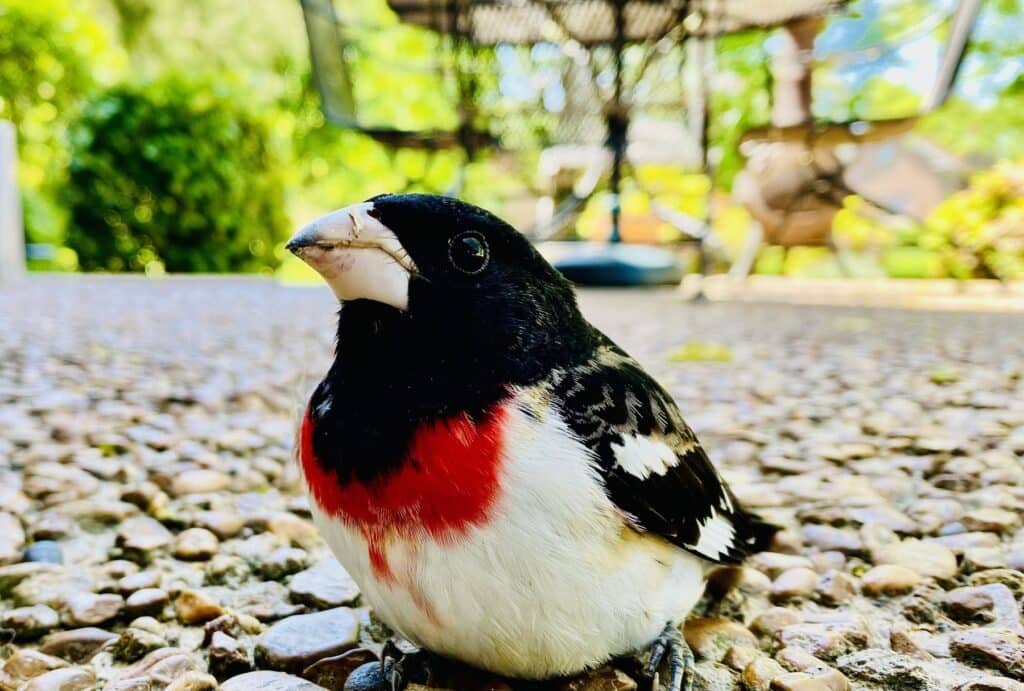
The male rose-breasted grosbeak is a plump bird with black and white feathers on his head and wings, and a little red vest on top of his white chest.
They migrate through Western Kentucky heading north in April, usually eating and resting here for a couple of weeks before moving on.
Here’s what I wrote on first discovering them during the pandemic:
For a while, I thought that the grosbeaks had never been here before. I thought I was onto something. Had nature shifted because people were mostly at home doing homebody things, like baking bread, teaching their children to read, learning to knit, making fancy cocktails, watching old sitcoms — and my personal favorite, writing real letters to family and friends near and far. (Also, I might have lost my head for a couple of weeks and made no telling how many chocolate pies and skillets of cornbread that I left for friends on porches around town. You can do that when your desk is two feet from the oven.)
In a nutshell, I wondered if less hustle and bustle, not to mention less vehicle exhaust hanging in the air, had somehow given the birds the spirit to roam more ambitiously on their migration back to the North. (As I said, I must have lost my head.)
I was dead wrong. The rose-breasted grosbeak had been there every spring. Likely in my backyard. I just wasn’t giving them any attention.
They are so dandy, like a smart dresser in a tailored suit and red necktie. I can’t believe I never noticed them.
So now I wait for the grosbeaks, both the colorful males and the brown females. Most years since 2020, I have made a note about the day they appear in our yard. It’s usually between April 20 and the end of the month.
Happy Earth Day, y’all. Let me know if you see any otters or grosbeaks.

Jennifer P. Brown is co-founder, publisher and editor of Hoptown Chronicle. You can reach her at editor@hoptownchronicle.org. Brown was a reporter and editor at the Kentucky New Era, where she worked for 30 years. She is a co-chair of the national advisory board to the Institute for Rural Journalism and Community Issues, governing board past president for the Kentucky Historical Society, and co-founder of the Kentucky Open Government Coalition. She serves on the Hopkinsville History Foundation's board.