Here’s a piece of Hopkinsville trivia appropriate for Kentucky Derby weekend: In the 1970s, when Herb Brandt’s Corner Drugs was in business at the Odd Fellows Building at Ninth and Virginia streets, you could go in there most days and buy a copy of the Daily Racing Form. As I recall, five copies arrived daily on a Greyhound Bus passing through Hopkinsville. At least one liquor store in town, The Copper Still, also sold the form.
I might have been the only high school kid in town back then who occasionally went to Corner Drugs for a Daily Racing Form, the national publication that carries a daily listing of thoroughbred races across the country. Each race in the tabloid-size publication includes the past performances of every horse entered to run. It was a good read for someone who resisted homework assignments and also loved horses. The print edition’s format has not changed much in the last 50 years.
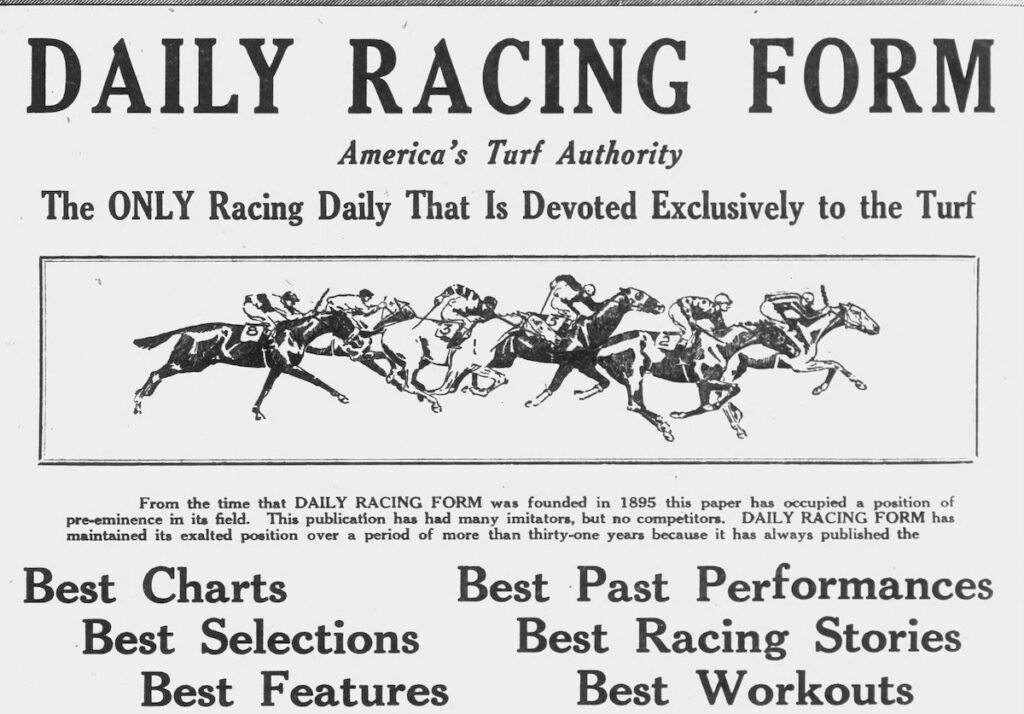
Learning to read the Daily Racing Form takes a bit of focus and time. To conserve space, the tabloid-size publication is packed with abbreviations for everything from a horse’s coat color and sex, to track conditions and special notes on how a horse performed in previous races. For example, a chestnut horse is listed as CH, and a gelding is G. If a race result indicates DNF, that means the horse did not finish the run. There are many more abbreviations like these.
It is a rite of passage for racetrack bettors and people in the horse business to master the form and what it reveals about a horse’s potential on any given day. My parents had some broodmares and horses running on Kentucky tracks, so I had the form’s meaning down by the time I could drive to the drug store. My smart daughter was reading the form by the time she was about 10 years old and spending the better part of her summer days at Ellis Park in Henderson with my mother.
If I needed to, I could probably still decipher much of the Daily Racing Form, but that part of life is well behind me. I rarely spend time analyzing races with an eye to bet.
So every year when the Kentucky Derby rolls around, I’m looking for quick, mostly unscientific reasons to pick a horse to back. It might be a name. Or a color (I love grays). It might be the way the horse behaves in the paddock, or an interesting story about a jockey, an owner or a trainer.
This year the choice was easy.
I wanted to see the first female trainer win the Kentucky Derby, so the woman to bet on Saturday was 44-year-old Cherie DeVaux. I also liked the fact that she was training a longshot, Golden Tempo.
I didn’t know anything about DeVaux until I did a quick online search as the horses were being led from their barns to the paddock Saturday evening at Churchill Downs. Originally from Saratoga Springs, New York, she was an assistant trainer for 12 years before earning her trainer’s license about eight years ago.
Golden Tempo is a Kentucky-bred colt, bay colored, and owned by Phipps Stable and St. Elias Stable. Phipps has been in business in Kentucky for a century and is currently based at Claiborne Farm, where Secretariat spent his years at stud in Lexington.
All of this was bonus stuff. I was going to bet on DeVaux regardless of her horse’s owners and their background.
Minutes before the horses were loaded in the starting gate, I placed an online bet on Golden Tempo. My bet was across the board (meaning $2 each to win, place or show).
The finish was amazing. Trailing much of the race, Golden Tempo powered down the home stretch and took the win in the last strides.
My piece of the win was relatively small, about $79 on a $6 wager. It was a sentimental pick for an anticipated achievement. All heart. The best kind.

Jennifer P. Brown is co-founder, publisher and editor of Hoptown Chronicle. You can reach her at editor@hoptownchronicle.org. Brown was a reporter and editor at the Kentucky New Era, where she worked for 30 years. She is a co-chair of the national advisory board to the Institute for Rural Journalism and Community Issues, governing board past president for the Kentucky Historical Society, and co-founder of the Kentucky Open Government Coalition. She serves on the Hopkinsville History Foundation's board.