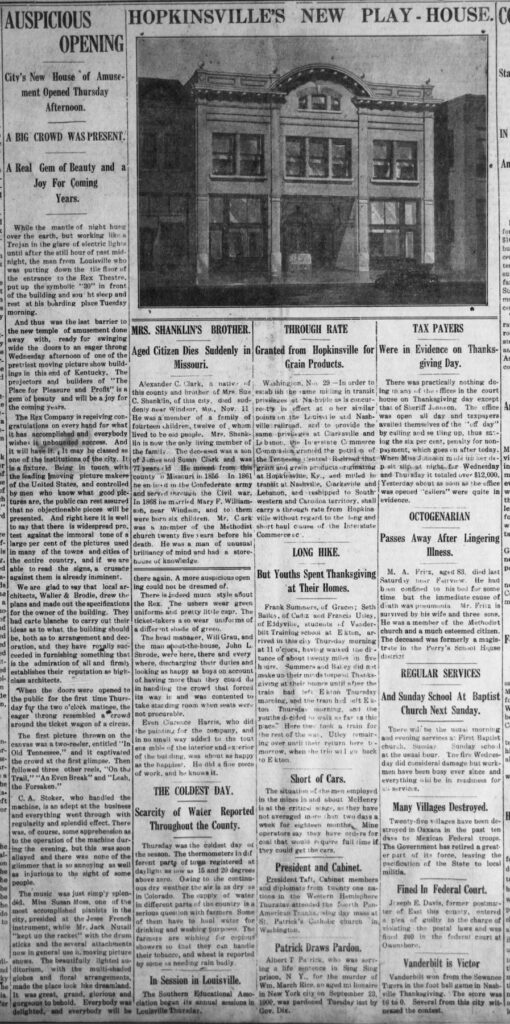
On Nov. 28, 1913, the Rex Theatre’s doors swung open for first time, inaugurating Hopkinsville movie-goers to more than four decades of cinema inside its four walls. This theater was particularly beloved by Hopkinsville’s youth, who, decades later, warmly recalled watching Westerns at the Rex.
Today the Rex Theatre is better known as Blue Streak Printers. It’s the lone building left on the north block of East Ninth Street, between Main and Virginia streets. With its future in question, this seems a pertinent time to look at its past. I’ve known for some time that the Dalton Bros. did the brickwork on the Rex, but I was curious about who else was involved and how this adds another layer to Hopkinsville’s identity.
Join me in this deep dive into the Rex Theatre’s origin story, tracing it from idea in the summer of 1913 to brick and mortar manifestation by November of that year.
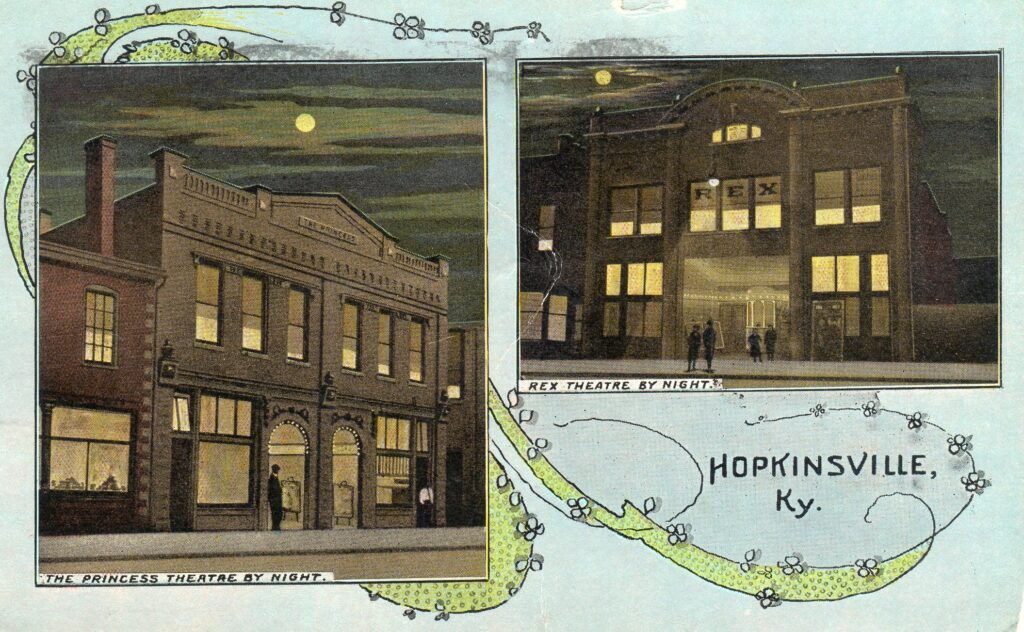
Location, Location, Location
You might find it odd that the Rex Theatre stands right across the street from another movie theater, the Princess. The original Princess Theatre dated to 1912 and predated the Rex by one year. The Princess Theatre we see today is actually the second on this spot, but that’s a story for another time.
Who decided to build the Rex in this spot, and why?
The venture was spearheaded by W.T. Cooper, who partnered with the Rex Theatre Co. Cooper paid for the construction and owned the building. He conceptualized what became the brick and mortar building we see today. When the building was complete, the Rex Theatre Co. moved in as Cooper’s tenant.
The new Rex Theatre would front “41 feet on Ninth Street” and seat 650 people. Two “rooms occupied by Stonewall Morris and the Business Men’s Association” were torn down to clear the way for the new building.
Wouldn’t this place the Rex Theatre directly in competition with the Princess? Cooper didn’t think so. The Rex featured thrillers, Westerns, and countless other silent films intended for a youthful audience. The Rex even offered monthly free movie passes as an incentive for good grades for Christian County students as early as 1914! It’s easy to see why it quickly became a hot spot for Hopkinsville’s youth in the early 20th century.
The Idea: W.T. Cooper
The Hopkinsville Kentuckian described W.T. Cooper as “the man who thus banks on the future growth and prosperity of Hopkinsville.” He was certainly involved in a number of business ventures over his lifetime. Born in 1862 in Christian County, William Cooper’s first job was as a clerk in the Phoenix Hotel during his teenage years. His father owned the Phoenix at the time and later passed it on to him.
Cooper established a booming grocery and hardware store on Main Street around 1895, which was his primary business. But he was also involved in starting Climax Mills, was on the board of directors for the Commercial and Savings Bank, which operated out of the Phoenix building, and owned a number of buildings that he rented out. And in 1913, he added the Rex Theatre to this list.
Design: Waller & Brodie
W.T. Cooper hired local architects Waller & Brodie to design the new Rex Theatre. John Trice Waller and T. Lawrence Brodie were contemporaries, both born in Christian County in the mid-1870s. Their partnership was short-lived (1911-1914) but productive. The duo designed at least three structures still standing in Hopkinsville today—the Rex, Carnegie Library, and the bandstand at Virginia Park.
Waller is the better known of the pair because he ultimately remained in Hopkinsville, while Brodie left, going to Birmingham, Alabama, in 1914. At the turn of the century, however, it seemed unlikely Waller would leave such an important mark on his hometown. Marrying in 1900, he moved to Madisonville, his wife Zena’s hometown. Several years later, the couple relocated to St. Petersburg, Florida. They hoped a warmer climate would alleviate Zena’s tuberculosis. Her consumption was advanced, though, and she died in 1905 at just 27 years old. After this, J.T. Waller returned to his hometown.
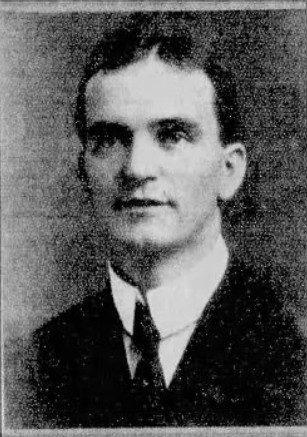
He got a job working as a building superintendent for the Forbes Manufacturing Co., where he certainly came into contact with and may have received training from the architect William A. Long. This is the first link I found between the Rex Theatre and Forbes Manufacturing.
Owned and operated by brothers James and Madison Forbes, Forbes Manufacturing did everything from providing building materials and construction, to manufacturing window sash and blinds, to selling paint, wallpaper, and jewelry. As I dug deeper, Forbes kept cropping up, again and again.
It soon became clear that Forbes Manufacturing served as a kind of incubator for people involved in construction in Hopkinsville. Personal and business relationships that began at Forbes later blossomed into contracting and sub-contracting relationships.
The year 1910 was a turning point for J.T. Waller. By this year, he had established his own architecture firm. He also remarried that year. It was almost like he began a new life, and Hopkinsville reaped the rewards of this. Over the next 20 years, John T. Waller would give Hopkinsville some of its most beloved buildings, including Attucks High School (1916), the Ninth Street Central Fire Station (1925), and the Alhambra Theater (1927). It’s hard to overstate the direct impact Waller had on Hopkinsville’s built environment. Just try to imagine Hopkinsville without any of these buildings ever having existed. I certainly can’t.
Returning to the Rex Theatre and 1913, the Hopkinsville Kentuckian reported that W.T. Cooper gave Waller & Brodie “carte blanche” in their design. The theater would be two stories tall in the Classical Revival style with interior details like marble wainscoting in the foyer, a decorative pressed tin ceiling, molded relief ornaments throughout, and a tile floor.
Also built into it were visible reminders of the inequity of the Jim Crow era. The newspaper matter-of-factly advertised the separate entrance for Black patrons, which would be from East Ninth Street. This entrance led directly to the segregated seating designated for Black people, in the balcony. These were familiar features for Hopkinsville’s Ted Poston, who frequented the Rex in childhood. Many years later, when he had made a name nationally as a journalist, he distilled these experiences in a short story set at the Rex, “Birth of a Notion.”
Construction: E.H. Hester and the Dalton Bros.
The general contractor in charge of the Rex’s construction was E.H. Hester. A native of Trigg County, he moved to Hopkinsville as a young adult and worked for Forbes Manufacturing. He and his brother later formed their own contracting firm. Although E.H. Hester took on the Rex contract, his company primarily built residences.
The Dalton Bros. did the brickwork on the Rex Theatre. It’s unsurprising that the brick selected was buff, a nod to the city’s magnificent Hotel Latham and a popular choice for many Hopkinsville buildings in this decade. This brick was not made by the Dalton Bros. at their Elm Street factory; rather, it was imported and probably came into Hopkinsville on the railroad.
The mortar the Dalton Bros. used was a mixture of lime and sand, which cured over a period of about four weeks. This involves a chemical process called carbonation, during which the calcium hydroxide in the slaked lime reacts with oxygen in the air. The mortar crystalizes and grows hard over the curing period. Any drop in the temperature below freezing interrupts the curing process, resulting in weak mortar. This governed the building season, which spanned roughly April to October. The Dalton Bros. masons probably did most of their work on the Rex during July, August, and September of 1913, since the Hopkinsville Kentuckian’s first mention of the new theater being planned appeared in July.
Inside Work
There isn’t as much information about who did the inside work on the Rex Theatre. The Hopkinsville Kentuckian tantalizingly states that the tiler came from Louisville but says nothing else of his identity. It’s likely the same person also installed the marble wainscoting that purportedly graced the foyer.
The workers who installed the decorative pressed tin ceiling likewise go unnamed. A little bit of investigation, however, reveals some interesting possibilities. Hopkinsville’s 1912 City Directory lists 15 men who worked as tinners. Three seem to have been independent contractors. Four worked for Adwell Bros. The remaining eight worked for Forbes Manufacturing. In light of the other Forbes connections among people who worked on the Rex, I think it’s likely the tinners who put up the ceiling likewise had a Forbes connection. This is something that may remain a mystery.
Setting the Stage: Clarence Harris
One of the last jobs in any construction process is painting. Even though movie-goers in 1913 spent most of their time in the dark, theater interiors were nevertheless carefully decorated with attention given to style. Theaters from this era often boasted stage curtains with beautifully painted landscape and cityscape scenes, as well as architectural finishes and hand-lettered signage.
Clarence Harris did the original painting for the Rex. Harris was a Christian County native who, like Waller and Hester, had worked at Forbes Manufacturing earlier in the 1890s. He and Hester had something else in common — both were volunteer fire fighters, though at different times.
During the 19th century, decorative painting and lettering would have been done by a house painter. House painters often did faux graining and marbelizing, as well as glazing windows. But by 1900, painters who specialize in finer work were beginning to differentiate themselves from house painters. Clarence Harris was one of these and was described in a 1903 advertisement as a “decorator,” alongside Charles Catlett and the well-known Hisgen family. All of these men also advertised their expertise in paper-hanging.
No interior photos of the Rex from this period are known to exist, so we will probably never get the chance to fully appreciate Clarence Harris’ work. The slightly later Alhambra Theater (1927), however, still has its original painted fire screen and restored finishes, which can give us an idea of the kind of painting Harris may have done inside the Rex. It’s excruciating to imagine the work of art this building’s interior probably originally was. The lone example of Harris’ work we can now access is the lettering on the ticket window in this circa 1914 photograph of the Rex.
Opening Day at the Rex Theatre
Nov. 28 dawned on the completed Rex Theatre, a venue ready to have its doors thrown open for the first time in the name of entertainment. Hopkinsvillians in 1913 cherished the building, not just because of its entertainment potential but because of its beauty. It was a testament to what a group of people in Hopkinsville could achieve when they united for a single cause.
In an oral history done late in her life, Sarah Dalton Todd reminisced fondly about the Rex. Nine year-old Sarah could very well have been at the theater’s grand opening, helping to celebrate her family’s role in creating what the Hopkinsville Kentuckianproudly called “a real gem of beauty and joy for coming years.”
—
History on Tap, at 6:30 p.m. this Thursday, Oct. 23, at the Hopkinsville Brewing Co. will pick up where this story ends, with opening day at the Rex Theatre.