DANVILLE — The Kentucky Supreme Court heard arguments Wednesday about whether discussions of government business conducted via private cell phones are subject to the state’s open records law.
A lawyer for the Kentucky Department of Fish and Wildlife Resources Commission defended its refusal to comply with an open records request in 2021 for any text and email communications by private phones in which Fish and Wildlife commissioners discussed official business.
The state Court of Appeals ruled against the department, saying that electronic communications about government business even on private phones are subject to the Open Records Act.
Excluding all text messages on personal cell phones, the appeals court said, “would surely operate to encourage the use of personal electronic devices and place vital public records beyond the reach of citizens” — a concern raised Wednesday by Justice Robert B. Conley.
Conley asked what would keep officials who want to avoid public scrutiny from “just doing public business on their phones” if such communications are, as Fish and Wildlife argues, exempt from the open records law.
Jan West, the attorney for Fish and Wildlife, said “that’s the issue” but said that is not what happened in the case before the court.
Justice Conley replied, “What’s to keep other people from down the road doing that?”

West said government agencies could advise officials and employees not to conduct government business on their private devices and provide them with government devices and accounts.
But attorney Michael Abate, representing the Kentucky Open Government Coalition, predicted “the destruction of transparency in the commonwealth” if some electronic communications about government business are no longer considered public records.
Abate likened the use of private cell phones to conduct government business to moving records from a government file cabinet to a file cabinet in a private home. They’re still public records, subject to the open records act, he said.
In their questioning, the justices explored how technological advances have changed communication and expressed concerns about the privacy of personal devices.

Justice Angela McCormick Bisig suggested that text messages have become the “modern day water cooler.”
West, the lawyer for Fish and Wildlife, raised the specter of governments being forced to comb through thousands of cell phone messages and the threat to individual privacy.
Abate disagreed with the water cooler analogy, saying that texting is “a way to communicate in writing.”
He also tried to soothe fears that private phones would be seized and searched in response to open records requests. Compliance with the open records law has always depended on individuals in government doing the right thing and responding in good faith to open records requests, Abate said. Also, the law has long shielded communications of a private or confidential nature from release under the open records law.
He stressed, however, that exempting texts from the open records act — by court ruling or legislative action — would invite officials to conduct public business outside public view.
Amicus briefs asking the court to overturn the Court of Appeals decision and rule in Fish and Wildlife’s favor were filed by the University of Kentucky and Attorney General Russell Coleman. Coleman’s brief was also on behalf of Agriculture Commissioner Jonathan Shell, Auditor Allison Ball, Secretary of State Michael Adams and Treasurer Mark Metcalf.
The attorney general’s brief argues that the General Assembly has yet to set a standard for which records on a private device must be disclosed.
Abate said the 1976 open records law is expansive and has been interpreted to include evolving technology, including faxes, email and data bases.
He said the General Assembly has considered exempting text messages from the open records act but the proposals “failed largely because of public backlash.”
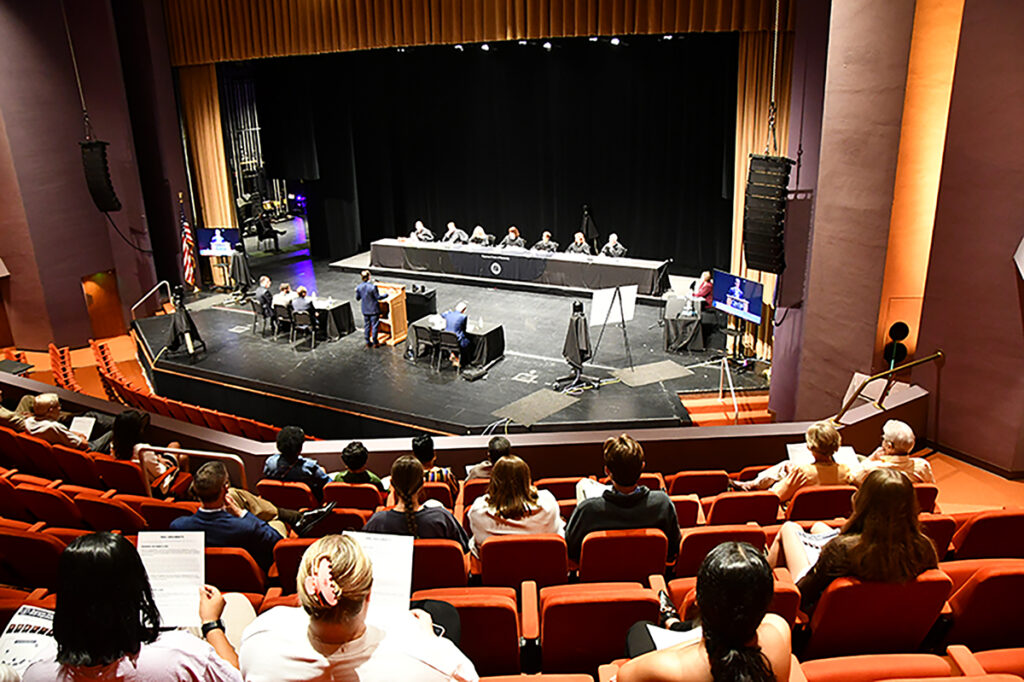
The Supreme Court is meeting Wednesday and Thursday at Centre College in Danville, where Centre students and students from nearby schools have been invited to observe.
This article is republished under a Creative Commons license from Kentucky Lantern, which is part of States Newsroom, a network of news bureaus supported by grants and a coalition of donors as a 501c(3) public charity. Kentucky Lantern maintains editorial independence. Contact Editor Jamie Lucke for questions: info@kentuckylantern.com. Follow Kentucky Lantern on Facebook and Twitter.

Jamie Lucke is editor in chief of Kentucky Lantern. She has more than 40 years of experience as a journalist. Her editorials for the Lexington Herald-Leader won Walker Stone, Sigma Delta Chi and Green Eyeshade awards. She is a graduate of the University of Kentucky.