FRANKFORT — An omnibus elections bill that among other changes would allow Republican U.S. Sen. Rand Paul to run for reelection and president at the same time cleared the House in an unusually narrow vote Thursday.
Forty lawmakers from both parties voted against House Bill 534, splitting the usually unified GOP caucus. But 53 GOP lawmakers approved the bill, which sends it to the Senate for more consideration.
Democrats futilely called on the Republican supermajority to suspend the House rules to consider their amendments which were rendered out of order when a substitute bill was approved at a morning committee meeting. Democrats also complained that the new version of the bill was not yet available for them to read before voting on it.
“I do wish that we could have done these things and waited a day on this and operated within the rules and be able to have that kind of full-fledged debate and have a roll-call vote on these amendments, which maybe people in this chamber disagree with but we can at least record that disagreement and vote and the people at home can see that in the vote database afterwards,” said Rep. Adam Moore, a Lexington Democrat who had filed four amendments to the bill.
Republicans did not air their objections to the bill during the House floor debate.

The bill allows the Kentucky State Board of Elections to enter agreements with federal agencies to identify noncitizens who have registered to vote in Kentucky. Voters in the state passed a constitutional amendment to bar noncitizens from voting in elections in Kentucky in 2024.
After drawing opposition from county clerks, the bill had been sent back to committee for revisions.
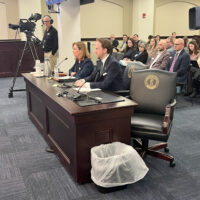
“I think it’s a good thing to do, because it’s a fairly complicated bill, and as we go forward, we hear ideas that we think are worth considering for it,” sponsor Rep. DJ Johnson, R-Owensboro, told the House Committee on Elections, Constitutional Amendments and Intergovernmental Affairs Thursday morning.
HB 534 passed out of the committee Thursday morning with 12 Republicans voting for it, and one Republican and three Democrats opposing it.
The new version removed an emergency clause that would have put the bill into effect shortly before the primary election in May, which county clerks had said would not give them enough time to prepare for the changes.
The bill would require the Administrative Office of the Courts to send the State Board of Elections a list of persons convicted of a felony, including those who are appealing their cases, who under Kentucky’s Constitution are disqualified from voting. Previously, some voting rights have been restored to people who have served sentences for non-violent offenses under the Beshear administration.
The bill also would make changes affecting candidates, including one that could make races for judges more partisan by expressly permitting judicial candidates to disclose their political party affiliation. Also, the bill would change current law to allow members of Congress to run for both their congressional seat and in another election decided by the Electoral College, which is the presidential election.

Republican Paul ran for president in 2016 and pushed Kentucky Republicans at the time to have a nonbinding caucus instead of a primary for deciding presidential nominees. Before that, the GOP-controlled Kentucky Senate passed a bill in 2014 that would allow federal candidates to have their name appear twice on a ballot, but it died in the Democratic-controlled House.
Johnson didn’t name Paul during the committee meeting, but said Kentucky has “an elected official at the federal level” who could also run for president and noted that it could apply to all of Kentucky’s federal elected officials.
“I thought … the best option was to allow them to be able to do both, and honor the desires of the voters that have already elected him, while at the same time giving him the opportunity to run for the most important office we have in our country,” Johnson said.
Paul, who would be up for reelection in the U.S. Senate in 2028, has not ruled out running for president. Earlier this year, he told reporters in Frankfort that a decision would be “a bridge we will cross after 2026.” A spokesperson for him did not immediately return a request for comment on the proposal Thursday.
Republicans voting against HB 534
Bowling, Clines, Fugate, Gooch, Grossl, Hale.
Jackson, Lawrence, D. Lewis, S. Lewis, McCool, Neighbors.
Payne, Petrie, Sharp, Thompson, Truett, Wesley.
Whitaker, White, Wilson.
Republican Rep. Jim Gooch Jr., of Providence, voted against the bill in committee because of the federal election clause.
“We have some members of our federal delegation that, to me, are becoming an embarrassment to Kentucky, and I won’t vote for this bill as long as that clause is in there,” he said. He later voted against it on the House floor.
Some still have questions
The Kentucky County Clerks Association appreciated that two of their concerns were removed from the bill — the emergency clause and a section that would have made public “cast voter records,” or the electronic record created by a voting machine that shows an individual ballot without any voter-identifying information, said the association’s lobbyist, Trey Grayson.
Grayson said the clerks still have concerns about the provision for confirming voters’ citizenship.
Another organization, the Kentucky Judicial Campaign Conduct Committee, has raised issues with the section that would allow judicial candidates to discuss their political affiliation. After the first committee hearing on the bill, the organization’s Chair Charles Boteler wrote in a letter to House members that the provision could lead to more partisan politics in the state’s judiciary.
“Voters don’t read the Constitution, the statutes, or judicial canons,” Boteler wrote. “They see and hear judicial candidates’ campaigns, and those campaigns need to be conducted outside a partisan context, so voters do not see them through a partisan lens. They need to fully understand that judicial elections are different.”
Speaking after the committee meeting, Johnson, the bill’s sponsor, told reporters the bill protects judicial candidates’ constitutional speech rights. “They should not have their First Amendment rights curtailed simply because they’ve chosen to run for an office.”
The Kentucky Code of Judicial Conduct governs political guidelines for judges and judicial candidates, including allowing them to register as a voter with a party but preventing them from endorsing candidates.
Rep. Erika Hancock, D-Frankfort, said during the committee meeting that she views the bill as “a solution looking for a problem.”
“I know that we all want our election safe, but I still think in its current form, it’s still not really doing what it’s intended to do,” she said.
This article is republished under a Creative Commons license from Kentucky Lantern, which is part of States Newsroom, a network of news bureaus supported by grants and a coalition of donors as a 501c(3) public charity. Kentucky Lantern maintains editorial independence. Contact Editor Jamie Lucke for questions: info@kentuckylantern.com. Follow Kentucky Lantern on Facebook and Twitter.

McKenna Horsley covers state politics for the Kentucky Lantern. She previously worked for newspapers in Huntington, West Virginia, and Frankfort, Kentucky. She is from northeastern Kentucky.