It measures roughly 70 by 80 inches and features a subtle scalloped edge trimmed in green. Familiar flowers in pastel colors create a distinct pattern, and their petals alternate in direction. The tiny stitches that hold this masterpiece together must number in the thousands, and its immaculate condition hints that this piece may not have been used, but rather, admired for its artistry.
Let’s take a look at one of the quilts in the museum’s collection, several of which are currently on display. She is a stunner.
Donated by Roger Futrell in 2013, this iris applique quilt was made by his mother, Bernice Banton Futrell, who was born in Allensville in nearby Todd County. She married Henry Futrell in Hopkinsville in 1932. Based on the information that her son provided, she made this quilt shortly after she married.

The early 1900s saw a virtual renaissance in the art of quiltmaking. By the 1930s, this craft-turned-art had reached a fever pitch. According to “Kentucky Quilts and Quiltmakers,” published in 2003 by the University Press of Kentucky, more than 400 city newspapers published regular quilt-related articles and close to one-third of all women in the country read popular quilt features published on Sundays.
A quick search of the Kentucky New Era in 1934 brings back more than 40 mentions of quilts. In February, the newspaper attempted to identify the quilt in the county with the most pieces. Mrs. W.E. Simpson of Crofton appears to have been the winner with a quilt made by her mother — Mrs. George Barnett — that had been created with a whopping 21,276 pieces. Wow! The newspaper described it as being made of “triangle-shaped pieces, which, when put together, form a hexagon pattern, each hexagon being about the size of a silver dollar.”
Back to our quilt. This beauty would not have made the list for most pieces — because it is not pieced. A pieced quilt is made by sewing small, separate pieces of fabric together to create a larger design that is often structured into blocks. These blocks are then sewn together to form the quilt top. Think of a bow tie, star, or nine-patch pattern.
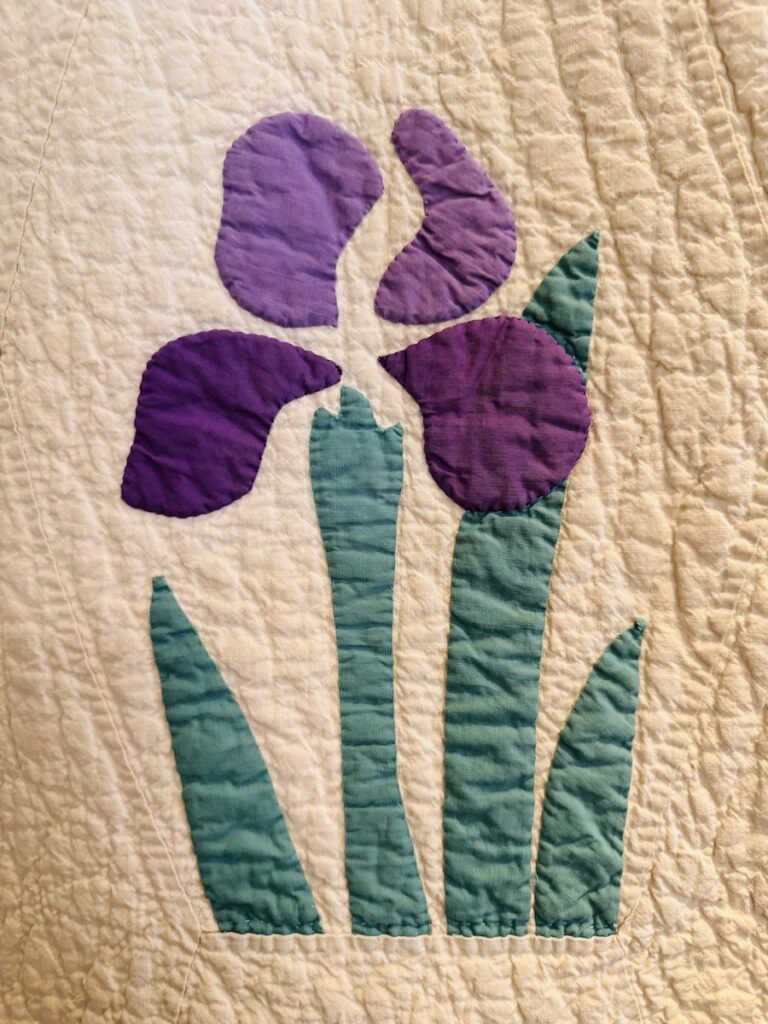
Our quilt is an applique quilt. It, too, is constructed of blocks, but these blocks are single pieces of white fabric. Pieces of colorful or patterned fabrics are cut into shapes and sewn on top of the block to create the iris pattern. The blocks for this quilt are elongated hexagons and allow for the height of the flowers and their leaves.
All quilts — be they pieced or appliqued or a combination of both — are made of three layers: a top (the pretty part), a back (often a solid sheet of fabric), and batting. Batting is the thicker layer that is sandwiched in between the fabric layers that are visible and provides the true warmth for which quilts are known. Traditionally, batting could have been cotton, wool, or leftover and worn-out textiles. Today, most batting is either cotton, polyester, or a blend of the two.
The quilting occurs when these three layers are connected together — typically with the tiniest stitches imaginable. At least, the finest of quilts are made this way. Our iris applique quilt features some of the finest of these tiny stitches. The quilting stitches themselves form their own pattern and help to accentuate the existing applique design, as well.
Based on my research, I believe that our iris applique quilt is a Mountain Mist historical quilt. Mountain Mist refers to the name of a popular batting product made by the Stearns & Foster Co. Founded in 1846, the company became the country’s first manufacturer of cotton batting.
Fast forward to 1929. The Mountain Mist arm of the company embarked on a marketing campaign. They printed quilt patterns on the paper wrappers that packaged their batting. Small images of various patterns were printed on the outside, and full instructions for one of the featured quilts was printed on the inside.
The company hired quiltmakers to make sample quilts before the pattern was brought to market. At the time, the quilts were displayed in stores across the country. Today, they live in a collection at the International Study Center & Museum at Quilt House at the University of Nebraska-Lincoln. The museum hosted a special exhibit titled “Inside the Wrapper” about these quilts in 2016.
The earliest Mountain Mist patterns were identified with letters. As more patterns were developed and shared, patterns were given numbers starting with 20.
The Iris applique — our iris quilt — is No. R in the Mountain Mist Historical Quilt pattern collection.
The iris pattern is noted as being one of the earliest ones featured by the batting company. Designed by Margaret Hays, an art teacher who adapted old and created new quilt designs, this pattern dates to 1930 and was likely adapted from an earlier iris pattern created by Marie Webster.
Webster is an icon in the quilting world. Embracing the Arts and Crafts movement of the early 20th century, she introduced new quilt designs to large audiences through her ongoing professional relationship with Edward Bok, editor of the Ladies Home Journal magazine. Webster used linen, muslin and solid color cotton fabrics in her designs, and she drew inspiration straight from the flowers in her own garden. These flower motifs were incorporated into the designs by applique, a signature of her work.
The style of her quilting stitches was also incredibly important to the design. In “A Joy Forever: Marie Webster’s Quilt Patterns,” her granddaughter explains that “texture was enhanced by quilting around the outside of each flower and leaf, to give them a three-dimensional quality.” Also, quilted “ghost flowers” were added in areas without applique. These ethereal details were created with tiny quilting stitches. Marie Webster would go on to publish America’s first quilt book, “Quilts: Their Story and How to Make Them”in 1915, and she turned her quilting talent into a full-out pattern business.

Which brings us back to our quilt — once more.
The pattern directly reflects the Mountain Mist iris pattern — with a few alterations. The sample quilt in the International Quilt Museum’s collection features green sashing between the hexagonal blocks; whereas, our example eliminates these sashes to leave a solid white background. Also, the irises in the sample quilt are all purple, while our quilt has purple, pink, yellow, and blue flowers. Ours also has a charming scalloped border, as opposed to the squared-off edging of the sample quilt.
Those differences point back to quilting pioneer Marie Webster. The colors in the museum’s iris quilt more closely reflect the colors of irises in nature. (Fun fact: irises got their name from the Greek goddess Iris, the Goddess of the Rainbow, because their blooms come in so many colors.) Our quilt utilizes Webster’s quilting technique to make the appliqued flowers pop, and it also has subtle, detailed ghost flowers quilted into the smaller blocks along its border. And like our quilt, Marie Webster favored a flowing, undulating border on many of her designs.
I would love to know where and how Bernice Futrell discovered the pattern to make this quilt, and more than anything, I would love for her to know how her work connects to a larger, national history of quiltmaking. It truly is a treasure.
The museum will also host a show-and-tell event for anyone who wants to bring in their own quilt to share. It will be from 11 a.m. to 2 p.m. on Saturday, May 16, at the Pennyroyal Area Museum, 217 E. Ninth St. Then when the quilt show closes, community members will get a chance to learn about the museum’s packing and storage techniques. This will occur from 2 to 4 p.m. on Tuesday, June 2.

Alissa Keller is the executive director of the Museums of Historic Hopkinsville-Christian County. She’s a graduate of Centre College with degrees in history and English and of Clemson University/College of Charleston with a master’s degree in historic preservation. She serves on the Kentucky Historical Society and the Kentucky Museum and Heritage Alliance boards.