(Editor’s note: This column first ran in The Sunday Brew newsletter. If you are interested in articles like this, see them first by signing up for the newsletter.)
It’s an odd feeling to long for something you could never see and touch in your lifetime. I believe many people who call Hopkinsville their hometown today can relate to this feeling when they see old postcard images and paintings of the grand Hotel Latham, a beautiful four-story landmark of cream-colored brick and a red tile roof.
Most of the Hotel Latham stories that I’ve heard for more than 50 years seem to focus on its tragic end on Aug. 4, 1940, when a fire destroyed the building.
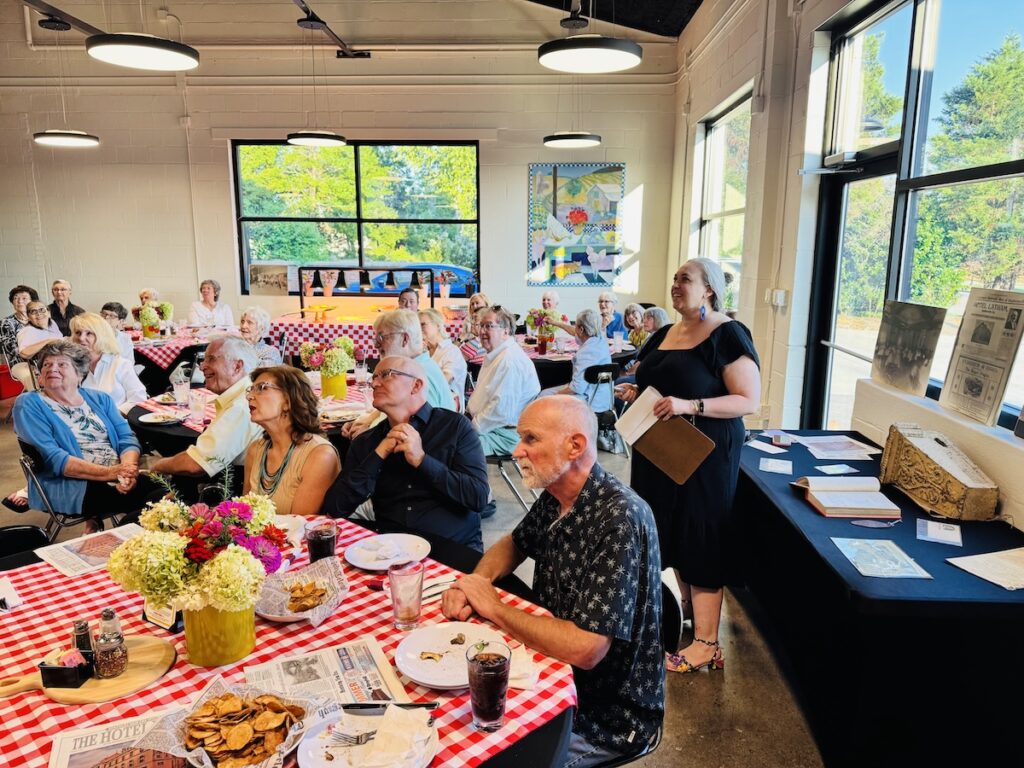
But during a program Tuesday evening at The Crusty Pig restaurant, which stands today where Hotel Latham did a century ago, Alissa Keller filled in many details about the life of Hotel Latham.
Keller, who is the executive director of the Museums of Historic Hopkinsville-Christian County, spoke to roughly 40 guests while we enjoyed a pizza buffet. Many of the details she shared came from newspaper articles that ran in the Kentucky New Era and the Hopkinsville Kentuckian.
Built in 1894 and named for its main investor, Hopkinsville philanthropist John C. Latham, the hotel opened Jan. 4, 1895.
Here are some highlights from Keller’s talk that helped me better understand what Hopkinsville residents in that time experienced if they were fortunate enough to be at Hotel Latham.
The Hotel Latham architect was Edward S. Child, of New York. His Italian Renaissance design featured cream-colored bricks from Columbus, Ohio, and terra cotta trimmings from New Jersey. Out-of-town contractors handled most of the construction.
The hotel lot stretched from South Virginia Street to Liberty Street and from Sixth Street to Seventh Street.
Several shops were included in the first-floor layout. Some included a drug store, a tailor’s shop, a barber shop and a telegraph office.
The hotel had steam heat, and gas and electric fixtures.
John C. Latham Jr. held 51% of the stock in the hotel company. The formerly enslaved businessman Peter Postell, who owned a grocery on the opposite corner of Sixth and Virginia streets, was one of the hotel’s major stockholders despite the fact that Black residents could not stay in the hotel.

The dining room, on the second floor at the Seventh Street end of the building, held seating for roughly 150 guests.
The grand opening, with a banquet on Jan. 4, 1895, and a ball the next night, attracted celebrants from Memphis, Louisville, Owensboro, Clarksville, Bowling Green and Paducah. The local newspapers carried descriptions of the dresses women wore to the opening.
John C. Latham couldn’t get away from business in New York, but his wife, Mary Lewis Allen Latham, originally of Memphis, did attend the opening and wore a French designer’s gown. The opening night party started at 8 p.m. and guests began leaving around 2 a.m. The ball the following night began around 9 p.m. and some guests were still present at dawn, according to the newspaper accounts.
A wedding at Hotel Latham a week after the opening had 200 guests. They were served an eight-course meal that included raw oysters, broiled salmon, turkey with oyster dressing, stuffed mallard duck, shrimp salad and ice cream. The meal lasted more than two hours.
“Over and over and over again this hotel is described as being like a hotel that should be in a big metropolis,” Keller said. “It’s just almost unbelievable that it ends up in Hopkinsville right where we are sitting tonight.”
I’m glad my longing for Hotel Latham now has proper bookends — the beginning and the end.

Jennifer P. Brown is co-founder, publisher and editor of Hoptown Chronicle. You can reach her at editor@hoptownchronicle.org. Brown was a reporter and editor at the Kentucky New Era, where she worked for 30 years. She is a co-chair of the national advisory board to the Institute for Rural Journalism and Community Issues, governing board past president for the Kentucky Historical Society, and co-founder of the Kentucky Open Government Coalition. She serves on the Hopkinsville History Foundation's board.