FRANKFORT — Leaves crunch under Kasia Bradley’s boots as she walks through the woods on Kentucky State University’s campus, listening for another sound — the knocking of a woodpecker against a tree.
“You hear it?” Bradley said, noting the volume of the knocking. “It’s probably red-bellied.”
She thought she had heard the call of a red-bellied woodpecker earlier that December afternoon, and she’s seen the bird on both sides of campus. “That’s just an ear over time that I’m like, ‘Oh, can I distinguish what bird that is?’ Bradley said.
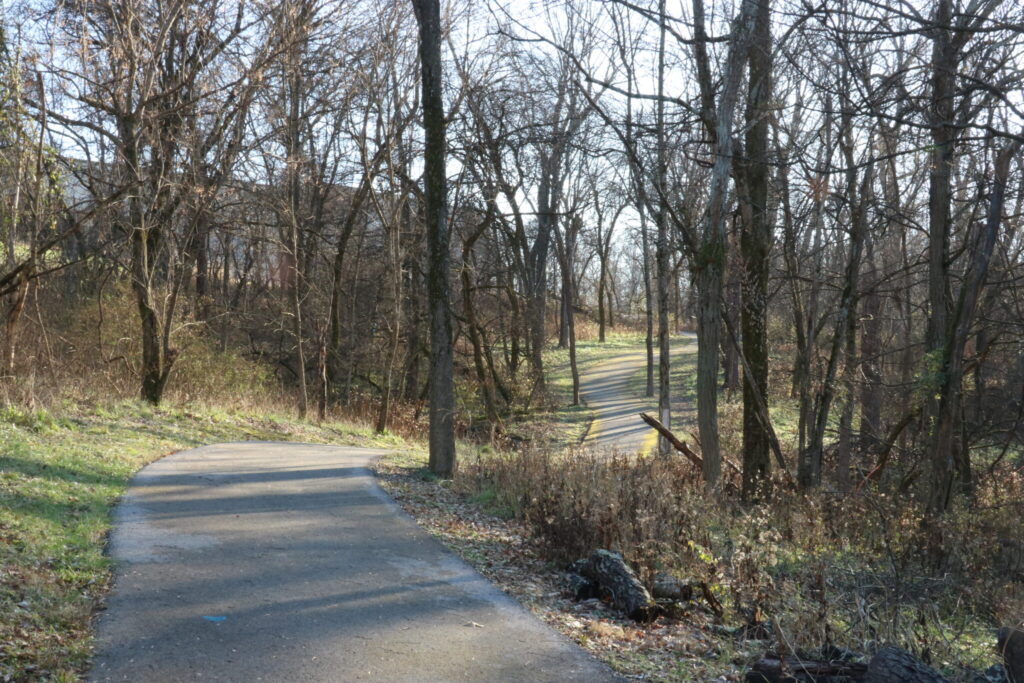
Bradley, an extension associate for forestry and natural resources at the university, has been spending a lot of time in these woods this year because of the woodpeckers, or what she calls “ecosystem engineers.” The holes woodpeckers create to build nests are sometimes reused by songbirds like chickadees or bluebirds, creating habitat for other species.

Supported by a grant from the National Wildlife Federation that promotes conservation of vulnerable species on university campuses, Bradley and her extension colleagues alongside community volunteers have been working to slowly reshape the woods along the Thorobred Trail into a place that better supports native birds.
That especially includes the red-headed woodpecker — a different species within the same genus as the red-bellied. Both of them are part of the seven woodpeckers that call Kentucky home.
While the red-bellied woodpecker has orange-red feathers on top of its head, the red-headed woodpecker’s head is entirely crimson — a “striking redhead,” Bradley said. The red-headed woodpecker is also called a “flying checkerboard” due to its vivid red, white and black coloring.
“This bird’s a beautiful bird. It’s probably one of the most favorite woodpeckers in my opinion,” she said of the red-headed woodpecker. An example of a red-headed woodpecker seen in Illinois.

It’s also a bird that has steadily and steeply declined in population, losing approximately 54% of its population from 1966 to 2019, according to data from the North American Breeding Bird Survey. While not listed as threatened or endangered by wildlife authorities, in part because of its large range across North America, that steep population decline has made it a species of concern in some U.S. states like Wisconsin.
Habitat loss is one of the reasons cited for the red-head’s decline, a significant factor in why bird populations across North America in general have declined by the billions since the 1970s.
“Especially red-headed woodpeckers, they like open woodlands, savannahs,” Bradley said. “That’s something that we’ve lost a lot of in our state.”
“If we can focus on a bird that needs a little bit of help, that’s a striking bird that is in everyone’s backyard … that really kind of brings the community in,” she said.
Finding the ‘snags’ among the forest
Walking through the brush, Bradley and her colleague Anna Claire Rogers come across a wooden bird box attached further up a tree. The box, blending in with the woods, is one of the ways they’ve been trying to bring the community together around these birds.
Woodpeckers usually prefer their homes to be “snags,” or dying and dead trees among the forest that woodpeckers can drill into to make cavities for nests or to store their food. But if a woodpecker can’t find a suitable snag, then a bird box can serve as an alternative home.
“Forests don’t have to be pristine, or what we think of as pristine. They’re living in these dying trees, ” said Claire Rogers, also an extension associate at the university. “Everything is used.”
Extension associates at the university have held workshops this year to bring the community in with their grant-funded work; one of the workshops focused on identifying trees, while another focused on building the bird boxes themselves. They’ve placed three boxes so far over the approximately 10 acres of woods they’re focusing on along the campus trail.
Bradley and Claire Rogers credit the funding from the National Wildlife Federation for giving them the resources to go about their work transforming the woods. They’ve been able to buy chainsaws, loppers and handsaws along with herbicide and chemical sprayers to combat invasive plant species.

Clearing out the sheer prevalence of invasive species in the woods is something that Claire Rogers specializes in. She easily points out where a mess of thorny, red-hued wineberry branches reach out of the ground, or where green Japanese honeysuckle leaves continue to grow in the middle of winter.
These invasive species can crowd out native plants on the forest floor. Japanese honeysuckle and winter creeper vines can grow aggressively fast, even climbing trees, Claire Rogers said, harming a tree’s health with thickets of vines. Native birds such as the Kentucky warbler or prairie warbler need a diversity of plants and growth as habitat for nesting and food.
A “monoculture” of invasive plants essentially deprives native birds of that flora diversity.
“That results in a lot of different things, but mostly the suppression of our forest floors or our grassland corridors, suppression of those native species that our wildlife depends on,” Claire Rogers said.

Building campus connections
Bradley and Claire Rogers have had plenty of support in their conservation efforts from the local bird watching community.
Gary Spandel, a retired employee with the Kentucky Department of Fish and Wildlife Resources and the secretary of the Frankfort Audubon Society, has been visiting campus at least once a month to take a survey of the birds around the woods.
He helped with intensive surveying of campus in 2023 that found 92 species of birds, ranging from hawks to turkey vultures to the red-bellied woodpecker.
“I walk that Thorobred Trail pretty regularly,” Spandel said. “KSU is very lucky. It is kind of a forested campus.”

Another benefit Spandel sees with the grant-funded conservation effort: getting Kentucky State University students more involved with the nature next door to them.
“The advantage of even a handful of acres next to campus is, you know, hopefully that will influence the students there,” Spandel said. “Those are our future.”
Bradley and Claire Rogers see the campus forest as a “classroom” of sorts, too. Bradley said students don’t always want to drive out to the university’s educational farm, and having the natural environment close by to engage students is a plus.
For now, they plan to wait until the spring to potentially add more bird boxes when woodpeckers are seeking new cavities to use and new homes to find.
“There’s so much opportunity out here for it to just be better, and that’s what we’re working on,” Bradley said.

This article is republished under a Creative Commons license from Kentucky Lantern, which is part of States Newsroom, a network of news bureaus supported by grants and a coalition of donors as a 501c(3) public charity. Kentucky Lantern maintains editorial independence. Contact Editor Jamie Lucke for questions: info@kentuckylantern.com. Follow Kentucky Lantern on Facebook and Twitter.

Liam Niemeyer covers government and policy in Kentucky and its impacts throughout the Commonwealth for the Kentucky Lantern. He most recently spent four years reporting award-winning stories for WKMS Public Radio in Murray.