In 1928, Hopkinsville First Methodist Church welcomed a new minister and an old friend, Paul Shell Powell. Methodist ministers were kept on the move by the bishops in charge of regional conferences.
Each year, a pastor could be assigned to a new congregation — two to five years in one community was typical. Some conferences even imposed a four-year limit on pastors staying in one location. Paul Shell Powell and his family were at Hopkinsville First Methodist from 1928 until 1932.
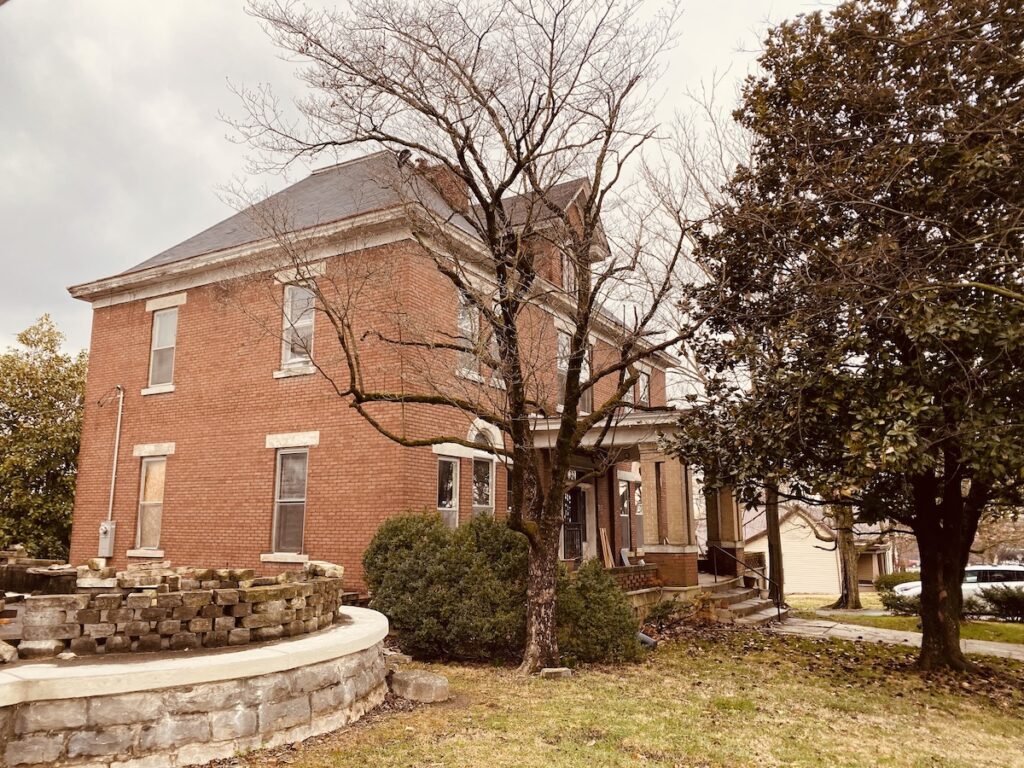
By the time the Powell family climbed the front steps of their Hopkinsville residence at 713 E. Seventh St., the various parsonages they had called home must have started running together —this was their fifth in 10 years! But as the son of a Methodist minister, this was the life Paul Shell Powell had always known.
At the heart of Powell’s life story was the Methodist church. But his story began with his father, Lewis, whose winding path eventually led both him and his son to Hopkinsville.
So let’s start with Lewis Powell.
Small beginnings
In the early 20th century, Lewis Powell was a power player in the Methodist Church. But his road hadn’t been an obvious one. Raised an Episcopalian, Lewis found his way to a Methodist revival when he was 17 years old. This experience lit a fire in him to become a Methodist minister. He turned out to be a gifted orator, a competent superintendent of church construction and an energetic leader.
Born in 1854, Lewis Powell grew up the oldest son in a farming family in southwestern Arkansas. His help on the farm was likely critical to its operations. With his mother’s death in 1869, young Lewis would have taken on more responsibility in the household as well.
Lewis’s life took a sharp turn with his father’s death in 1876, which left five mostly grown children. The Powell family had begun breaking up two years earlier, with Lewis’ sister Anna’s marriage. Their father’s death sped the fracture.
Nashville
At this point, Lewis Powell made a life-altering decision. He left rural Arkansas for divinity school at Vanderbilt University in Nashville, Tennessee. By 1880, he had graduated and secured the charge of the Greenland Methodist Church in East Nashville. This is the heart of suburban Inglewood today, but it was farmland in 1880.
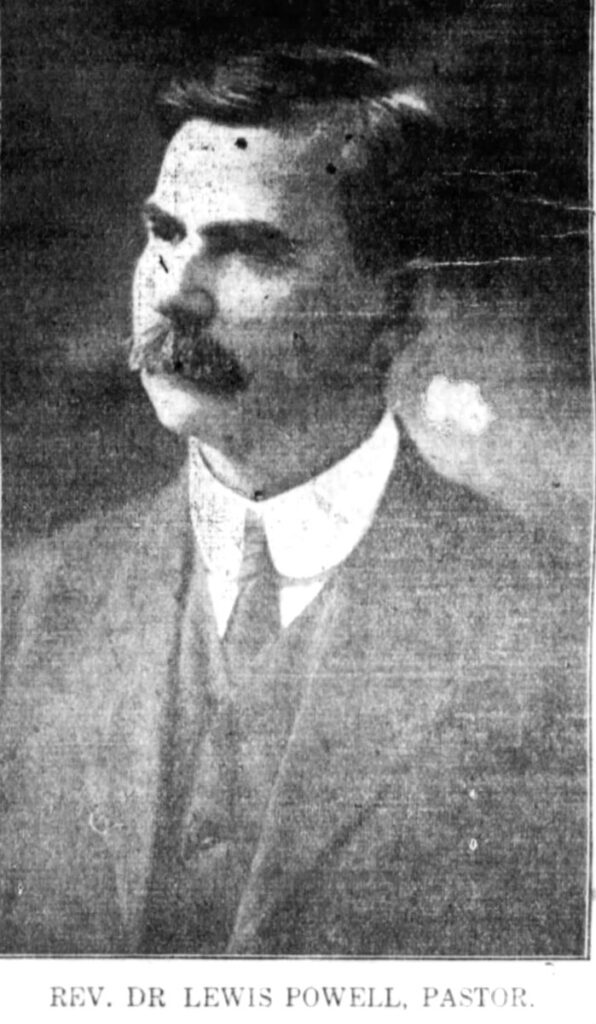
Lewis boarded with William Robertson, a farmer, and his family. With him was his youngest sister, Mary. Just 13 when her father died, she was now 17 and a student. Lewis’s pursuit of a big dream had made a better life possible for his sister, too.
Women’s education
In 1879, Dr. George Washington Fergus Price moved to Nashville from Alabama at the request of the Methodist Church to open a Methodist female academy. The city already boasted 28 schools, at least five of which were exclusively for women.
Education in the South for white youth was segregated by sex and race (Black schools and universities were structured differently and are their own subject entirely), and formal education for Southern women was still in its early stages.
Considered edgy and controversial at the start of the century, women’s education in 1880 was generally accepted as a good mode of molding a girl into a future mate, mother, and housewife. But this was still, and would continue for many years, to be a finishing school education.
Twelve years Lewis Powell’s junior, Anna Shell graduated from Dr. Price’s school, Nashville College for Young Ladies, in 1884. She bopped back and forth between Mississippi and Nashville for the next four years, and the Tennessean newspaper reported in 1888 that her numerous Tennessee beaux would miss her when she returned to Mississippi! She and Lewis Powell married later that year.
Homebuilding
Lewis and Anna Powell set to work putting down roots in the 1890s. They purchased a house on Meridian Street and started a family. Anna would give birth to four children over the next 10 years, and two would die young.
Toward the end of the decade, Lewis started traveling outside Nashville to preach at revivals. In April 1898 alone, he travelled both to Spring Hill, Tennessee, and Guthrie, Kentucky, leaving his own church’s pulpit for two weeks in a row. Additionally, he was chaplain to the inmates at Central Insane Asylum.
At the end of February 1899, Anna Powell gave birth to her last child, Lewis James. He died 10 days later.
Itinerant minister
After nearly 25 years in and around Nashville, Lewis ‘s career was about to enter a new phase far more typical for a Methodist minister of that time: itinerancy.
In 1902, he was transferred out of the Nashville Methodist Conference to the Central Methodist Church in Hot Springs, Arkansas. In many ways, his experiences here would serve as practice for his later role at Hopkinsville First Methodist.
On Feb. 25, 1905, a fire ravaged downtown Hot Springs. One of the buildings destroyed was Central Methodist Church. For the next year and a half, the congregation met at City Hall. Lewis threw himself into the work of building a new church. This so engrossed him that the congregation hired an associate pastor to take over his ministerial duties for six months.
In June 1906, construction started. By that fall, the basement had been built and much of the chapel was complete. But Lewis didn’t get to stay to see the work finished. In 1907, he was transferred to Memphis First Methodist Church.
Paul’s education
What was Paul Shell Powell doing during this time? Now 16 years old, he was enrolled at Henderson College, a Methodist school in Arkadelphia, Arkansas. One day he would be considered a gifted orator like his father. His classmates at Henderson, however, considered teenage Paul a constant babbler!
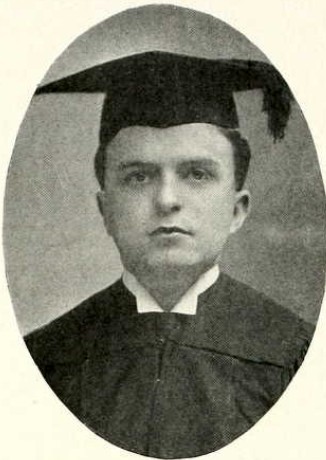
Upon graduating from Henderson, Paul followed in his father’s footsteps. He enrolled in Vanderbilt University’s divinity school. He spent summers with his father, mother, and younger sister Annie Louise.
On to Kentucky
From Memphis, Lewis Powell was sent to Owensboro. His new congregation was overjoyed to have him. Before his arrival, details had circulated from his time in Memphis about how he had paid off an old debt of several thousand dollars held by the church, added more than 1,200 new members to the congregation over four years, made dmore than 10,000 pastoral visits and married over 360 couples!
In 1914, he arrived at Hopkinsville First Methodist Church. The congregation was based in an 1849 building on the corner of East Ninth and Clay streets but wanted to build a new church in a new location. Powell’s reputation as a church builder preceded him. (Ironically, the church where he had overseen construction in Hot Springs had burned to the ground the year before.)
Within a year, Lewis began the process of planning for the construction of a new church on Main Street — and also added 200 new members to the congregation. On May 29, 1915, the Hopkinsville Kentuckian newspaper predicted the architect for the new church would be chosen within the week.
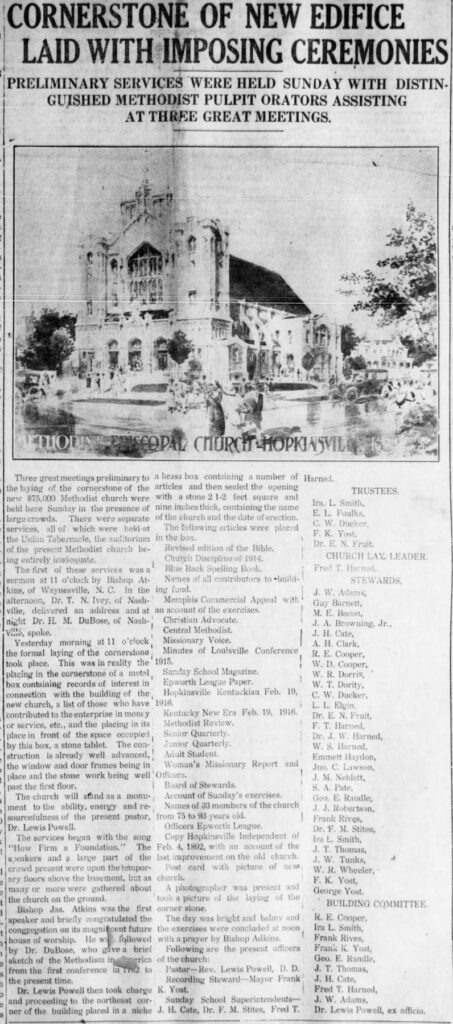
The new church cost $75,000 to build — over $2.4 million in today’s money. The cornerstone was laid on Feb. 20, 1916, to the strains of “How Firm A Foundation.” The first service in the new church followed just a little over a year later, on March 4, 1917. Lewis Powell took the pulpit. He must have savored this sweet moment, the culmination of a lifetime of dedication and hard work for Methodism.
He had no way of knowing how soon he would pass on that mantle.

Grace Abernethy is a historic preservationist and artist who specializes in caring for and recreating historic architectural finishes. She earned her Master of Science in Historic Preservation from Clemson University in 2011 and has worked on historic buildings throughout the eastern United States. Abernethy was a recipient of the South Carolina Palmetto Trust for Historic Preservation Award in 2014 and won 2nd place in the Charles E. Peterson Prize for the Historic American Buildings Survey in 2011. She and her husband, Brendan, moved to Hopkinsville from Nashville in 2020. She works as an independent contractor and is a board member of the Hopkinsville History Foundation.