While the first battles of the American Revolution were fought at Lexington and Concord in the colony of Massachusetts more than 251 years ago on April 19, 1775, the United States of America was born officially on July 4, 1776, with the signing of the Declaration of Independence.
“We hold these truths to be self-evident, that all men are created equal, that they are endowed by their Creator with certain unalienable Rights, that among these are Life, Liberty and the pursuit of Happiness.”
By signing these venerated words, the Founding Fathers of the fledgling republic set her upon a course of conflict lasting just over seven years and resulting in a new, independent nation. The Americans lost approximately 25,000 men in the conflict (far more due to sickness and privation than to battle wounds).
After the war ended with the signing of the Treaty of Paris on Sept 3, 1783, in which Great Britain gave formal recognition of the independence of the American colonies, land-hungry former colonists began moving westward into the frontiers of Kentucky and Tennessee, Ohio and Indiana and Illinois.
Congress had passed a federal act in 1776, which promised free land to soldiers serving for the duration of the war, and in 1788 it began issuing land warrants to Revolutionary veterans who met eligibility requirements.
The western migration began as a trickle, then quickened until it was a veritable flood by the 1830s. Christian County’s population grew from 2,318 in the year 1800 to more than 11,000 in 1810 and nearly 20,000 by 1850.
Many of the earliest white settlers (and doubtless numerous African-American residents, though most were enslaved and records to prove service are rare) were Revolutionary patriots. Their stories, not unlike our own in the 21st century, are rich and varied.
With the 250th birthday of these United States on July 4, we thought it would be a worthwhile endeavor to delve into the records for any available information regarding Christian County’s patriots —any soldier for whom evidence could be found supporting both Revolutionary service and residence within what comprised this county at the time.
Christian County is formed and settlement expands
Christian County was formed in 1797 from Logan County, and at that time was composed of just west of the modern Logan-Todd County line, westward to the Tennessee River (now Lake Barkley), and northward to the Ohio River, and containing all or parts of the current counties of Todd, Christian, Trigg, Muhlenberg, Hopkins, Caldwell, Lyon, Livingston, Crittenden, Union, Henderson, Webster, and McLean, and including lands in the disputed area between the originally mis-surveyed Walker’s Line, now the Kentucky-Tennessee state line, and the 36’30” parallel, where the state line was supposed to be (including the site of Clarksville, Tennessee).
Some new states, rich in lands and poor in funds, also issued land warrants, generally in their western territories. Virginia issued land in what became Kentucky to pay her veterans, as did North Carolina in what became the state of Tennessee in 1796. While many veterans sold their land warrants and stayed in the Eastern Seaboard states, many did choose to make the perilous journey westward to claim their land and settle the the untamed frontier that was Western Kentucky and Tennessee.
While this westernmost region of what would become the state of Kentucky in 1792 was only sporadically settled prior to 1800, there were some former Revolutionary soldiers, as well as long hunters, who made their way into the area by the 1790s. The two earliest known white inhabitants in Christian County were James Davis and John Montgomery.
Settlement in the region around what is now Nashville and to its east, as well as in the area around present-day Clarksville and northward to the state line, began earlier and was consequently more fraught with conflicts with the indigenous people already inhabiting the area.
Patriot veterans settle Christian County
Records are patchy regarding Revolutionary veterans, but rich in context and description. Early pension application records do not give as much information as the often detail-rich applications of the 1830s. For those veterans who survived until that point and filed paperwork to claim land, depositions taken in the process are often replete with dates and places of birth, details of wartime service, and migration after the war. Early census enumerations (pre-1850) only give the name for the head of each household, with the other people in the house designated by “tick” marks categorized by gender and a range of years of age.
The 1840 U.S. census form, however, had a specific category for the name and age of any Revolutionary soldiers still living at the time of the enumeration — a valuable resource, as by that point most of the former Revolutionaries were either deceased or quite elderly. The 1840 enumeration counted 1,061 former Patriots living in Kentucky at the time, seven of whom were noted in Christian County. They were John Cain, who was listed as 77 years old; Jonathan Clark, 81; William Gray, 81; Isaac Palmer, 93; James Sullenger, 77; Charles Thomas, 76; and Thomas Woosley, 79. William Dupuy, 77, did appear in that census record but was not noted as a revolutionary veteran. Only Clark and Woosley were living by the 1850 enumeration, and they died in 1851 and 1856, respectively.
The process of gleaning information about former soldiers from records scattered over the country’s repositories is ongoing and unfinished, and as of this writing, the total discovered for Christian County currently stands at almost 200. Details from the personal life of each soldier are uncovered through often-tedious research, and the stories that have emerged are sharpening the focus of the lens into the earliest decades of our county.
Some of these men were large-scale landholders and often slaveholders as well, while others maintained smaller farms and did not participate in human enslavement. A few were land speculators, who bought and sold land on a large scale and often over a number of regional counties.
Several patriots have been chosen for details which demonstrate various aspects of the soldier’s life during the war, the journey westward into Kentucky, or his life here in Christian County.
Among the Minute Men: Col. Jonathan Clark
Col. Jonathan Clark was born May 20, 1759, in Bedford County, Virginia, and moved with his father in 1773 to Surry County, North Carolina, where he joined a company of volunteer Minute Men in the spring of 1776. He served as a lieutenant under Col. Martin Armstrong, and it is unclear when he was promoted to colonel or perhaps lieutenant colonel, by both of which he was referred by various veterans in their pension depositions.
Clark moved to South Carolina in 1784, and on to Christian County, Kentucky, in 1803, where by 1808, he was noted in the tax rolls as having 960 acres of land in the vicinity of Pond River. He gave depositions and/or was mentioned in the pension applications of a number of other Christian County veterans, several of whom stated they served under his leadership. This suggests that those men maintained their connections after the war’s end, or that they perhaps continued to follow their former leader, all the way to Western Kentucky.
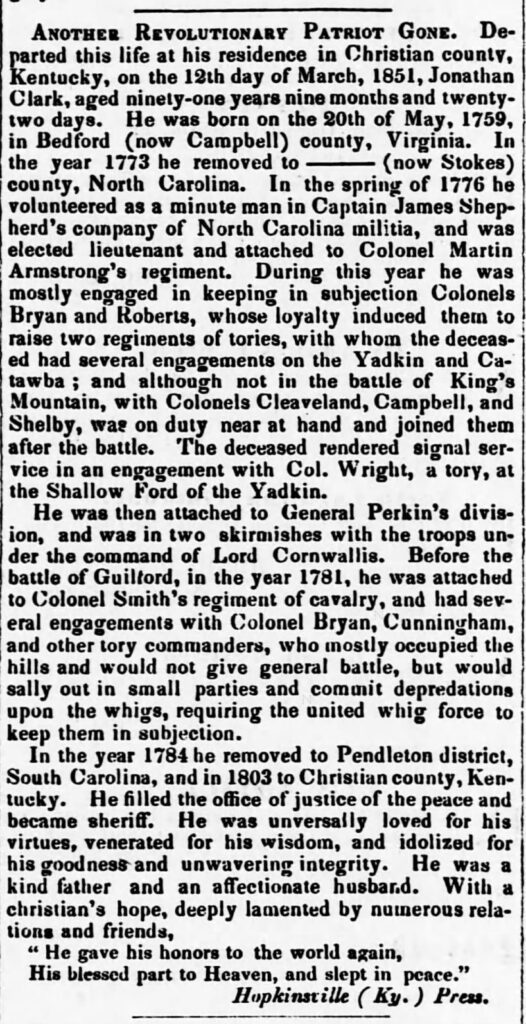
He served as justice of the peace and as sheriff. He last appeared in the 1850 census enumeration in the home of his son, William, as a 91-year-old blind Virginia-born man. He died a year later on March 12, 1851, and was laid to rest in the Clark Cemetery near the intersection of Crofton-Fruit Hill Road and Crofton Fire Tower Road.
Endured tragedy migrating to Kentucky: George Barnes
George Barnes was born in County Armagh, Ireland, about 1756, and was a private in the Virginia Continental line. He enlisted in April 1780 and was present at the Battle of Guilford Court House on March 15, 1781, near Greensboro, North Carolina, followed later that year by several battles in the South Carolina backcountry. (The “backcountry” consists of everything north of roughly where Interstate 95 transects the state today).
Some of the bloodiest and most brutal battles and guerilla warfare of the war were fought in this region, and some of the battles here were pivotal in turning the tide of the war. Barnes’ records state that he served as a wagon master.
He stated that as his family was making the journey into Kentucky after the war, their party was attacked by Native Americans who carried away two of his sons, and he never saw them again.
By July 1805, Barnes appeared in the Christian County court records, when he was being appointed surveyor of the road “leading from Christian Court House to Muhlenberg Court House,” or modern-day Greenville Road. He was noted in the 1808 tax roll as having 200 acres in the Pond River area. Barnes died Nov. 13, 1838, and was buried in the Campbell Cemetery off the Campbell Cemetery Road northwest of Crofton.
The youngest patriot: Nathan Futrell
Nathan Futrell was the youngest of Christian County’s patriots. He was born, along with his twin brother, William, on Sept. 10, 1773, in Northampton County, North Carolina. Futrell served as a drummer in the North Carolina militia at just 7 years of age — and according to the Kentucky Historical Society, is believed to be the youngest serving drummer boy and thus the youngest person to serve in any official capacity in the American Revolution.
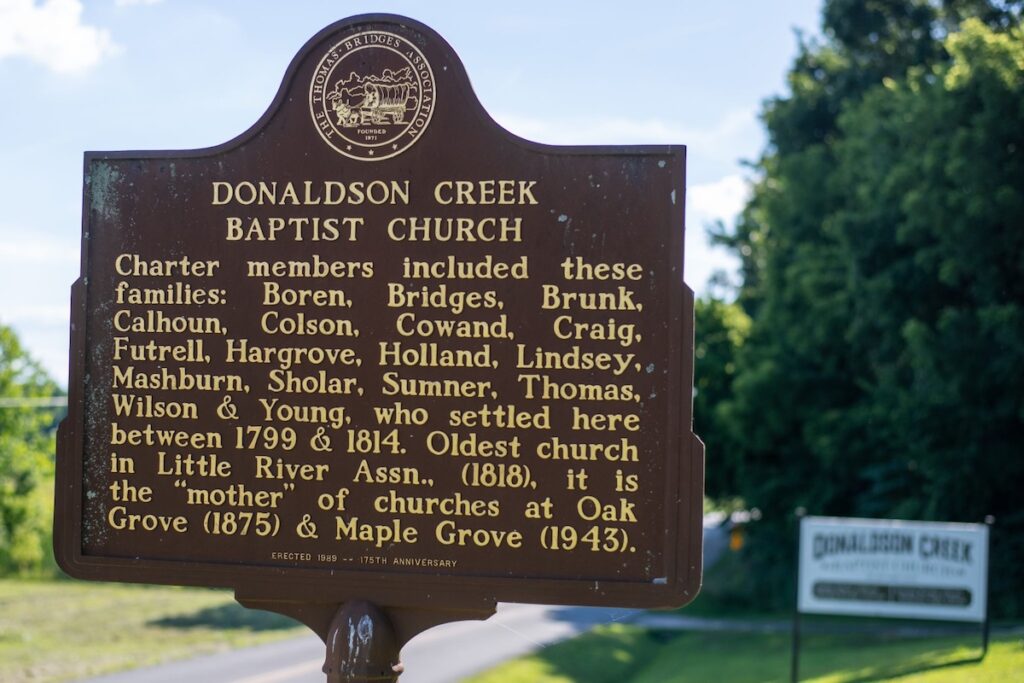
He settled with his parents in the Donaldson Creek area of what is today southwestern Trigg County, appearing initially in the 1804 Christian County tax rolls. His land would be in Trigg County after it was formed from Christian in 1820.
Futrell was a charter member of Donaldson Creek Baptist Church, organized in 1814, and served as one of its first two deacons. About 1820, he acquired land in what is now Land Between the Lakes, near the present-day Golden Pond and Wrangler’s Campground and built his home and farm there. He built one of Trigg County’s first grist mills about 1824 on Ford’s Creek.
The governor appointed Futrell as a justice of the peace for Trigg County in 1824. He appears in Trigg County records as having solemnized the marriages of a number of couples.
His land, along with more than 800 other families who lived Between the Rivers — as it was called before TVA dammed the Cumberland and Tennessee Rivers to form Barkley and Kentucky lakes — were bought out by the government in the 1960s to form a national preserve.
Nathan Futrell died Aug. 31, 1829, and was buried in the Futrell Cemetery in Land Between the Lakes.
The oldest patriot: Henry Clark
Henry Clark was the oldest known Christian County patriot, though there were some for whom no birthdate or estimated birth year could be determined. Clark was born in 1732, probably in New Jersey.
In a then-common migration pattern of moving into new areas as land opened up for white settlement, the Clark family moved into Virginia, followed by North Carolina, then Lancaster County, South Carolina by 1758 and were living in Washington County, North Carolina, (now Sullivan County, Tennessee) by 1777, when Clark was named justice of the peace there. He represented that county in the North Carolina House of Commons in 1779 and 1780.
During the Revolutionary period, Clark served as captain of the Washington County (North Carolina, though it would later be in Tennessee) Militia under Col. John Sevier, later Tennessee’s first governor, and Col. Evan Shelby, father of Isaac Shelby, who became Kentucky’s first governor. Clark’s son Benjamin Clark was lieutenant in the unit.
This militia group was part of the so-called Overmountain Men, frontier militia from the Carolina backcountry and mountain region, widely credited with the success of patriots at the the Battle of Kings Mountain in 1780.That battle turned the tide of the Revolutionary War and eventually led to American freedom. While it is not clear that Henry Clark participated in that battle — though he may have — his son Benjamin is known to have been there.
Henry Clark was involved in the 1776 Battle of Island Flats against the Cherokee, led by Dragging Canoe, a Cherokee war chief opposed to the land-sale his father, Chief Attakullakulla, had made with white settlers. During the Revolution, the Cherokee sided with and were armed by the British, creating another battle front on the frontier. Lt. Benjamin Clark and Henry Clark’s eventual son-in-law John Wheeler — both later Christian County settlers —were also present at that conflict. In 1799, Capt. Henry Clark was commissioned lieutenant colonel by North Carolina Gov. Richard Caswell.
Clark first appeared in Christian County records in 1797, the year the county was born, when he paid tax on 200 acres of land on the West Fork of the Red River. His son John C. Clark was appointed Christian County’s first court clerk that same year.
Court notes in 1812 and 1813 reveal that “Col. Henry Clark” was one of several southeast Christian County men ordered to survey roads from Hopkinsville to the Tennessee state line. He served as a justice of the peace for his newest and final home by 1817. Clark died in Christian County in March or April of 1823, and presumably was buried on his property in southeastern Christian County.
Redcoat turned his coat: Joseph Caskey
Sgt. Joseph Caskey was born in County Derry, Ireland, in 1747. He came to America as a soldier in the British forces, serving under Gen. Sir William Howe. Depending on when he actually arrived, he may have participated in the Battle of Bunker Hill and likely in the New York campaign.
He deserted the British forces in New Jersey in October 1776 and joined the Continental Army “under Colonel or General Mercer’s regiment …”
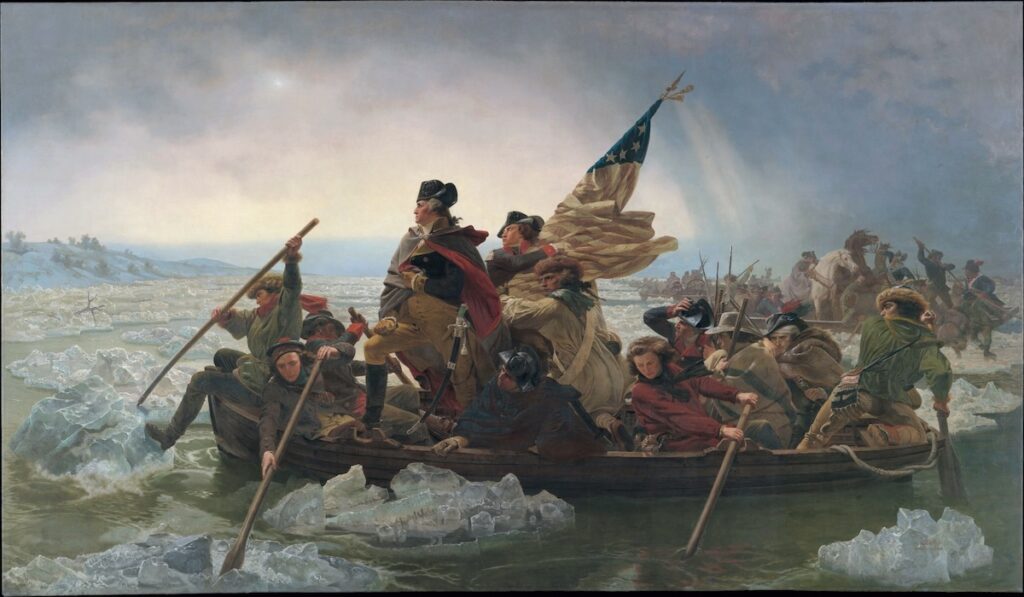
This was almost certainly Brig. Gen. Hugh Mercer, a close personal associate of Gen. George Washington. Caskey described having crossed the Delaware and participating in the Battle of Trenton, which occurred Dec. 25-26, 1776, and was immortalized in Emanuel Leutze’s 1851 painting, “Washington Crossing the Delaware.”
Caskey was also engaged in the battles of Princeton, Monmouth and Brandywine, where he was wounded. He participated in several other conflicts and was wounded a second time.
William Perrins’ 1884 “County of Christian, Kentucky: Historical and Biographical” notes that after the Revolutionary War, Caskey lived with Henry Clay for a time.
Caskey first appeared in Christian County tax rolls in 1809, with no noted land holdings. By a year later in 1810, he had acquired 186 acres on the “Montgomery Fork,” a tributary of the Red River which crosses the Christian-Todd County line southeast of Pembroke.
Caskey appears in court records several times over the years, being sued and suing others, mostly over land disputes and breach of contract. He was charged with swearing in 1811, a common charge in early court records. Caskey and his wife, Lucy, reared a family of at least seven children. Caskey died Feb. 16, 1847, and was buried in the Casky Cemetery near his home on Pembroke Road.
A tragic end: Joseph Cavender
Sgt. Joseph Cavender was born about 1759 in Amelia County, Virginia. He stated in his 1818 pension application that he enlisted in the 15th Virginia Regiment in 1777.
A register of soldiers taken at Chesterfield Courthouse in 1781 offers a physical description of then 19-year-old Cavender. A farmer, he was 5-foot-7 and had dark hair, gray eyes and a fair complexion.
He participated in the battles of Brandywine (Pennsylvania) and Monmouth (New Jersey), the longest and second-longest single-day battles of the war. He specified action in 11 other battles during his term of service as well, and served as an orderly sergeant.
Cavender first appeared in Christian County tax records in 1820, with no land holdings noted in any of his tax-list entries. In his pension deposition, he stated he had very little income and no property of value, listing his entire personal property as: “an small earthen dish, an half dozen Teacups & Saucers, one half dozen teaspoons, One pot & one Kettle, one farming ax, one Coffee Pot, [and] one half dozen plates …,” giving the combined total value as $9.75.
He attested that he was a farmer, but due to “disease infirmity and accidents to the injury of his limbs & person” he was scarcely able to work and had a wife who depended on him for support. His son Thomas had died by October 1823, when Cavender legally gave up all rights as heir-at-law of all of Thomas’ real estate and personal property to Thomas’ widow.
An article in the Aug. 21, 1826, edition of the Lexington [Kentucky] Weekly Press, detailing the “Jubilee of American Independence” that year on July 4 at Hopkinsville, noted that Joseph “Cavander” was one of the commanders of artillery for the festive 50th anniversary celebration.
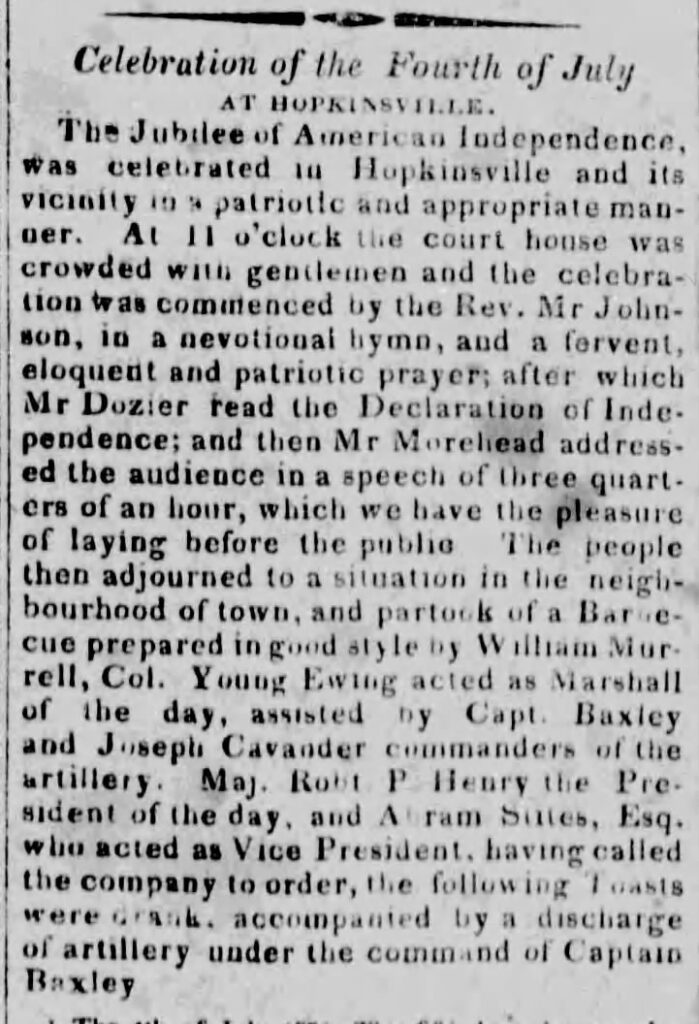
His estate was entered into probate in Christian County Court on Sept. 4, 1826, suggesting that he likely died in August. His widow was named as Susan Cavender.
A notation on page 2 of the Sept. 11, 1826, Washington, D.C., National Daily Journal reveals the rest of the heartbreaking story:
“Kentucky — Joseph Cavender, an old revolutionary soldier committed suicide last month, near Hopkinsville, by drinking laudanum. On the previous day, he showed to several persons two phials full, which he said he had procured for that purpose. He was an honest innocent old man, and there is a general regret in his neighborhood that he should have committed such an act.”
Versions of this article appeared in newspapers in Ohio, Delaware, and North Carolina as well.
The last located chapter of the story was found in a Christian County court order in November 1826: Susan Cavender was being “certified to the commissioners for the poor,” indicating that she had no means of supporting and caring for herself, and was likely being consigned to the county poor farm. No further record for either of them have been found thus far, and their places of burial remain unknown.
Virginia Militia man: Thomas Cocke
Thomas Cocke was born Oct. 26, 1752, in Surry County, Virginia. He was a captain of Greensville County, Virginia, militia by 1782, and was promoted to major by 1795. He was likely the Thomas Cocke noted in the December 1797 Virginia Statutes as having been named among the trustees of a new town called Belfield in Greensville County.
Cocke’s son, John W. Cocke, migrated to Christian County about 1811, and about 1820 built Cocke’s Mill on Little River in South Christian, lending his name to both the mill and the road leading to it. The name of the road later mutated to the well-known Cox Mill Road.
Thomas Cocke followed his son to Christian County about 1817, and John built a two-story log cabin for his father. John died in September 1822, leaving a will in which he stated he was “laboring under a violent illness.”
Thomas Cocke followed his son to the grave a year and a half later on April 9, 1824. In his will, he manumitted (granted freedom) four of his enslaved workers: Michael, Ephraim, Ephraim’s wife Betty, and their son Ephraim. Their manumission was the first item of instruction noted in the will, just after the statement of his name and soundness of mind, suggesting it was a matter of great importance to him. He did not, however, manumit at least 25 other enslaved individuals who were named in his will.
Cocke was buried in the Cocke Cemetery, near Mason Mill Road in South Christian.
Once enslaved, free man of color: Ephraim Cocke
Ephraim Cocke was born about 1753, likely in Virginia. He first appears in any thus-located record on Jan. 22, 1824, in Christian County, when he was being legally manumitted along with his wife, Betty, and their son, Ephraim.
A detailed physical description of each appears in the court record: “Ephraim a negro man emancipated by Thos. Cocke aged about 40 years [suggesting a birth year of around 1780, but age descriptors for Black people in the antebellum era are notoriously inconsistent] light complected, bald, 5 feet 3 inches high, a scar on the inside of his little finger on the left hand.” Young Ephraim was described as “4 years old in Dec. next …,” indicating a birth date of December 1820. The will also specifies that another son of Ephraim and Betty’s, William, was to be deeded to Ephraim in exchange for some notes of debt which Ephraim held on Thomas’ deceased son John W. Cocke. Court notes show that Ephraim manumitted William the same day, and state that William was about 10 years of age.
Three years later, on March 17, 1827, a deed was registered in Christian County court wherein Ephraim Cocke, “… a coloured man …” purchased a lot of land from Magness T. Carnahan for 25 dollars. There are no noted street names or other indications of location, but it does specify that Carnahan had acquired the land from B.T. Wood — Bartholomew T. Wood, Hopkinsville’s founder — suggesting it was likely in or near the current downtown area.
Cocke appeared next in the 1830 Christian County tax list, when “Ephraim Cock a man of colour” paid tax on a one-half acre lot adjoining the town of Hopkinsville. He also appeared in the 1830 Christian County census, one of 49 free people of color enumerated in the county that year. Cocke’s household was one of free people of color, and consisted of himself, a female and two young boys whose age ranges fit Betty, William, and young Ephraim.
By 1840, Cocke disappeared from records, and “Betty Cox,” a free woman of color, was enumerated with a young man. Ephraim Cocke was buried in the city cemetery — now Pioneer Cemetery — with a monument. It denoted his birth in 1753, and his death in 1838. There are undoubtedly a number of enslaved people and free people of color interred there, but few if any others were marked with a monument.
No records detail his Revolutionary service, but turn-of-the-20th-century newspapers indicate that he served. The lack of records is unsurprising, given his status at the time. Records for enslaved individuals in Virginia for Revolutionary War service are exceedingly rare. His service would have been likely alongside his enslaver, Thomas Cocke, or as a substitute for a member of the Cocke family.
In 1850, 67-year-old Virginia-born “Elizabeth Coke” was living in a household with 25-year-old Ephraim “Coke,” noted as being blind, in Hopkinsville. Betty died about 1867 and in her will, left her house and half acre town lot to her son, Ephraim.
An early white settler: James Davis
James Davis was born in April 1755 in Augusta County, Virginia. The database of the Daughters of the American Revolution denotes that Davis was a private in the Virginia Continental line. Family stories passed down report that Davis settled in what would become Christian County about 1782, having traveled down the Ohio River and up the Cumberland via boat with his family — a common way to migrate into frontier Kentucky and Tennessee.
Davis and Col. John Montgomery built a blockhouse — necessary for protection and defense in this frontier region when they arrived — on the West Fork of the Red River, southeast of the present site of Pembroke.
An original document regarding a land transaction, the image of which was shared on Ancestry.com, notes that it was signed “at Davis’s Station this 25th day of July One Thousand Seven hundred & eighty nine,” suggesting that the station or blockhouse may have been a common safe meeting place for 18th century frontier settlers in the area.
Davis’ land holdings are difficult to follow, as there was another James Davis, contemporary of this Davis and also connected with Col. Montgomery, in the same area.
Word-of-mouth stories passed down through descendants and descendants of neighbors and later preserved in print tell that Davis was a deer and bear hunter, and lost a son in a skirmish with a group of Native American scouts in “Croghan’s Grove,” in today’s Todd County. Several of the anecdotes regarding Davis appear to have been passed down from the telling of Dr. John Bell (1796-1878), an early Pembroke-area physician who purchased former Davis property in the early 1800s.
Davis died March 29, 1797. According to family tradition, Davis was riding horseback when Native Americans began to pursue him. A low-hanging grapevine caught him as he fled, pulling him from his horse, and he was caught and killed.
The veracity of this is unclear. Davis’ will, which he signed in February that year, stipulated that his wife was to execute a deed of land sale to Brewer Reeves, which he had not yet legalized and wished to be sure it was done. The timing of the will could suggest Davis had reason to believe that death was likely imminent.
Davis’ will was the first to be probated in the county. It was filed July 17, 1797, only about six weeks after Christian County was created on June 1.
Neighbors Brewer Reeves and Moses Shelby were among those appointed to appraise the estate. The 1797 Christian County tax list notes Davis’ widow, Deborah Davis, paying taxes on 495 acres of land on the West Fork of the Red River. She remarried in 1798 and in 1806 she and her second husband, Peter Ferguson, sold some of the land to Azariah Davis, another Revolutionary veteran from Augusta County, Virginia, who settled near West Fork.
Davis’ likely gravesite is marked by a monument in southeastern Christian County.
Frontier fighter and explorer: John Montgomery
John Montgomery was born in 1748 in Botetourt County, Virginia, and is considered one of Christian County’s first white settlers, along with James Davis.
Montgomery County, Tennessee, was named for him, and he was one of Clarksville’s founders. Montgomery’s brother-in-law and one of the earliest settlers of Montgomery County, Hugh Bell, described him: “John Montgomery was six feet, near two inches high and 200 pounds — of commanding frame; as straight as an Indian, handsome features, ruddy, fair skin, full auburn hair, of great strength and activity, and full of animation. He was capable of great endurance and hardship; of great perseverance and firmness.” Another contemporary referred to him as “a man who has the intrepidity necessary for desperate enterprises.”
By 1771, Montgomery was in Kentucky, then part of Virginia, as an explorer and Long Hunter — so called because of their often months-long sojourns into the Kentucky wilderness on hunting expeditions. He served as a captain under Col. William Christian — for whom Christian County is named — in Lord Dunmore’s War, a six-month conflict between Virginia militia and Shawnee and Mingo warriors.
In 1775, Montgomery, along with Col. Christian and Col. Evan Shelby, was a signer of the Fincastle Resolutions, a document written in Fincastle County, Virginia, similar to statements issued from other counties in a political movement that eventually became the American Revolution. In it, they began by stating their love for their English sovereign, but expressed their unwillingness to accept the so-called Intolerable Acts restricting their rights: “we are deliberately and resolutely determined never to surrender them to any power upon earth, but at the expense of our lives …”
Montgomery was commissioned a lieutenant colonel in 1778 after serving under Gen. George Rogers Clark in Illinois to capture French colonial settlements there, as part of the Revolutionary War on the frontier. He was also one of the signers of the Cumberland Compact, a document which in 1780 established an early form of government for settlers in the Tennessee frontier territory.
After the Revolution, Montgomery settled in Kentucky. A 1930 Filson Club Quarterly article specifies that Montgomery had settled in [what would become] Christian County in 1785. Hugh Bell wrote more specifically: “Colonel John Montgomery left Virginia late in 1784, settled in Kentucky on the Red River, but fearing the lonely, exposed situation, he moved in the spring of 1786 to the very mouth of the Red River, where he owned land.” Montgomery and Davis built a blockhouse on the West Fork of the Red River, in southeastern Christian County near the Tennessee state line.
Montgomery continually explored the region and by about the same time, 1785, Montgomery and Col. Martin Armstrong had surveyed and founded the town of Clarksville, Tennessee, named for Montgomery’s former colonel. Montgomery was named justice of the peace in then Tennessee County, North Carolina in about 1788.
He continued surveying, exploring, hunting and periodically leading militia troops into conflict. In November 1794, on a long bear and deer hunt into Western Kentucky, the hunting party was attacked by Native Americans near the confluence of the Cumberland and Ohio rivers in present-day Livingston County, and Montgomery was killed.
Bell was in the group and gave a first-hand account of his death, stating that they had been fired upon and another man had been injured and called to Col. Montgomery for help. Montgomery climbed a tree and returned fire before being shot, then stabbed to death and scalped. Bell and others escaped, but returned the next day to bury Montgomery’s body.
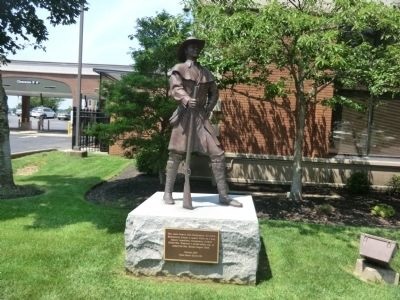
A monument stands in Livingston County near Smithland to his memory, and a statue of him stands in Clarksville at 120 N. First St.
Boy militia spy: William Dupuy
William Dupuy was born Oct. 17, 1766, in South Carolina, and moved with his parents at age 13 to Wilkes County, Georgia. There about a year later at the young age of 14, he joined a company of Georgia militia as an Indian spy. His rank was private.
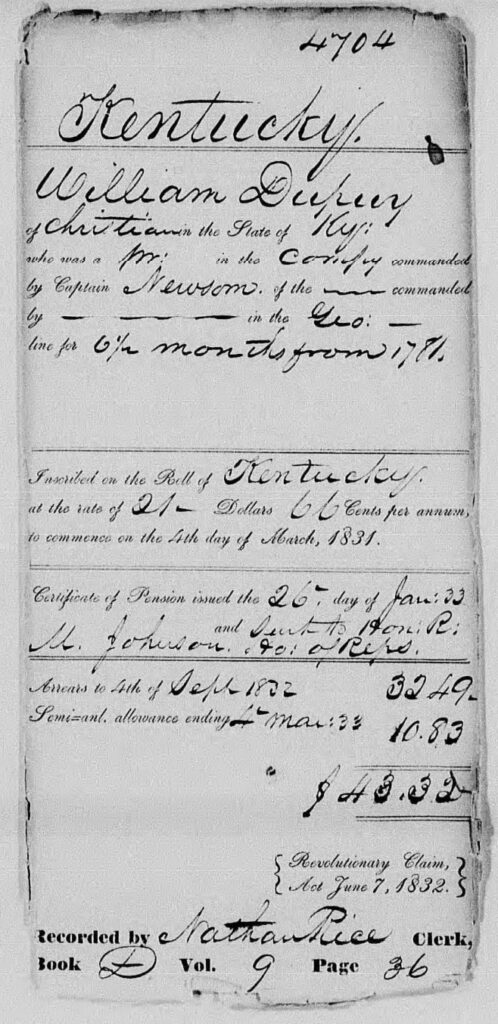
Dupuy stated in a 1832 deposition that he had lived in Christian County for 29 years, suggesting an arrival year of about 1803. He first appeared in Christian County records in 1805, when he paid tax on 100 acres of land in the Little River watershed. His 1851 will specified that his home was along the Town Fork of Little River.
He served on a jury in July 1814, and was named as a guardian for several children over the years. A guardian at that time did not refer to the physical caretaking of children; rather it referred to overseeing an inheritance due to a minor child, usually from a deceased parent’s or grandparent’s estate.
Dupuy died Sept. 11, 1851, and was buried in his family cemetery at his home on Greenville Road near Concord Lane. A stone bridge still known today as Dupuy’s Bridge straddles a branch of Little River on Greenville Road northeast of Hopkinsville.
Regimental surgeon: Dr. Samuel Gay
Dr. Samuel Gay was born about 1740, possibly in England, and reportedly studied medicine at the University of Edinburgh. It is unclear when he emigrated to the American colonies, but he likely enlisted from Augusta County, Virginia.
During the Revolutionary War he served with both the 8th and 12th Virginia Regiments of the Virginia Continental Line. Extant pay cards from 1777 give his rank as “Surgeon’s Mate,” considered similar to a warrant officer, and in medicine similar to a physician intern. From 1778-81, he was a surgeon with the Virginia Continentals.
While it is unclear that Gay was present, these units were involved in the intensive battles at Brandywine and Germantown, with heavy casualties, and spent the winter of 1777-78 at Valley Forge under Gen. George Washington.
After the war’s end, Gay settled in Rockingham County, Virginia. It is unknown exactly when he migrated to Christian County, but statements quoted of him in his son’s deposition to claim his father’s entitled land, stated the elder Gay had wanted to claim his land “in the west.”
Gay died in Christian County sometime in 1811, and his three children inherited the 4,500 acres of warranted land for his Revolutionary service. He may have been buried in Pioneer Cemetery.
Perished with cholera: Charles Kenady
Pvt. Charles Kenady was born Dec. 12, 1763, in New Jersey. He stated in his pension deposition that he moved as a youth in 1779 to Kentucky, which was then still a county of Virginia. In 1780 he volunteered in the militia and fought against “Indians & British emissaries” in the Ohio territory.
He described a three-hour “hard fought” battle where Joseph Grundy, brother of Felix Grundy (later a U.S. attorney general and Tennessee senator, “fell by his side.” Records show that Joseph Grundy perished in that battle on Aug. 8, 1780. Kennedy later also served in a spy company during the war.
Kenady first appeared in Christian County records in the 1809 tax list, when he was recorded as having paid taxes on 400 acres of land on Muddy Fork. In 1818, Kennedy was a jury member in a burglary trial against “Kent and Patrick, male slaves, the property of Joshua Cates …” Joshua Cates was another Christian County Revolutionary patriot. The men were found guilty and remanded to jail.
Kenady’s land was noted to have been in the Wallonia area on Kennedy Creek, in the part of Christian County that in 1820 became the new county of Trigg. In 1828 he was appointed to survey part of the road “leading from Snelling’s Ferry to Hopkinsville,” likely modern-day Kentucky 276, Blackhawk Road.
Kenady died July 23, 1834, in Trigg County in the cholera pandemic that swept through Western Kentucky. Roughly one quarter of the population of Russellville, Kentucky, died that summer. During the previous summer, 1833, Lexington, Kentucky, lost 500 of its 7,000 residents in just three months.
This epidemic was part of a wider Asiatic cholera pandemic that raged the globe from 1826 to 1837. Cholera is today known to be caused by the bacterium Vibrio cholerae, typically spread via contaminated water sources and causing abrupt onset of massive watery diarrhea and leading to rapid dehydration and death without treatment. The phrase “fine at breakfast, dead by dinner” was used to describe its aggressive course.
Kenady was laid to rest alongside his wife, Jane, who died two days after him, in the Kenady Cemetery near the conjunction of Blackhawk and Hopson Store roads in Trigg County.
Revolutionary trumpeter: Conrad Lear
Pvt. Conrad Lear was born in 1738 in Lancaster County, Pennsylvania, and enlisted there in January 1775. He was a trumpeter and was a member of the “life guard” for Col. William Washington (a distant cousin of Gen. George Washington) in the Virginia Continental Line.
Lear stated in his pension deposition that he had participated in the battles of Boston, New York, Princeton, and Brandywine, and was twice wounded. He described that after the war’s end, he resided in North Carolina before moving to Christian County, Kentucky, after which he moved to Logan and then Muhlenberg Counties before finally staying in Todd County.
Christian County tax records denote his residence beginning in 1811, when he lived on 50 acres in the vicinity of Pond River. He is found in several deeds and court records in Christian County, being charged and acquitted of assault in 1813.
By the time of the 1820 census enumeration, he was residing in Todd County, where he remained until his death, most likely sometime in the year 1838, as his pension payments ended after the March installment that year. His burial location is unknown but is possibly somewhere in the Pond River area.
Serving in Christian County’s first court: Brewer Reeves
Brewer Reeves was born Sept. 14, 1745, in Virginia. Early to die in the history of Christian County, records of his war service are nearly nonexistent, but he was located on the roll of Capt. Robert Harrison’s militia company of Rockingham County, Virginia. Additionally, claims for Revolutionary service were allowed to him and others in Rockingham County court on June 7, 1782.
Reeves was apparently a mason by trade. Several court records in Rockingham County reference him being paid for varying amounts of mason work. He was Presbyterian in faith, and there are notes in Rockingham County Court in June 1789 wherein he and Reuben Reeves, who later appears in early Christian County records as well, were being given permission to “build a house for public worship on the public lott …” They were trustees for the Presbyterian Church at Harrisonburg.
Reeves first appeared in Christian County records in the 1797 court order book entry, the very first for the new county. The opening line of the first court note in the county reads as follows:
“Agreeable to an Act of Assembly Passed at the Session 1796 for the Erection of a new County from the county of Logan called and known by the name of Christian. And Agreeable to a Commission from his Excellency the Governor appointing Jacob Barnett, Moses Shelby, Jonathan Logan, Brewer Reeves, & Henry Knox, Esqr., Justices of the Peace for the County …”
The first meeting of Christian County court was held March 21, 1797, in the home of Brewer Reeves in southeastern Christian County. In that meeting, John Clark, son of Col. Henry Clark, was elected court clerk, and Charles Logan presented his governor’s commission as sheriff, and took his oath of office.
Probate for Reeves’ estate was opened in Christian County court in November 1799, suggesting his death in the autumn of that year. His burial location is unknown, but could be in the same area as James Davis’ and perhaps in the same cemetery, as Reeves purchased some of his land from Davis.
Brother of a governor: Moses Shelby
Capt. Moses Shelby was born Oct. 31, 1760, in Maryland, son of lEvan Shelby, who later became a general, and his wife Leticia. The family moved near what is now Bristol, Tennessee, in 1771 and Gen. Evan Shelby built a fort, known as Shelby’s Station, which offered shelter to many early settlers during times of escalated danger.
Gen. Shelby was a also signer of the Fincastle Resolutions, along with Col. John Montgomery, and was a friend and associate of Gen. George Washington.
Several of Gen. Shelby’s sons, including Moses, Evan, and Isaac (later Kentucky’s first governor), were also military leaders not only in the Revolutionary War, but in the many conflicts between Native Americans and white settlers on the frontier.
A great number of these conflicts occurred in eastern and middle Tennessee in the mid-18th century in the years leading up to the Revolution. Gen. Shelby and his sons, along with members of the Sevier and Robertson families which would help found the state of Tennessee, were deeply and frequently involved in the colonial military leadership.
Capt. Moses Shelby is known to have fought in several battles, leading a company of western North Carolina militia. He and his brother, Col. Isaac Shelby, were instrumental in bringing about the rout of the British at Kings Mountain in 1780, turning the tide of the war and leading to Colonial independence.
Capt. Shelby was badly wounded in the leg in that battle and reportedly had life-long limitations from it. He also received saber injuries during the Battle of Cowpens in 1781. His brother Maj. Evan Shelby is believed to have accepted the flag and sword of surrender from the British commander after the Battle of Kings Mountain.
After the war’s end, Shelby and his brother Maj. Evan Shelby were involved with early exploration, long hunting, and sometime fighting with Native Americans in Middle Tennessee and Western Kentucky.
In January 1793, a group including both Moses and Evan Shelby, along with Hugh Bell (James Davis’ brother-in-law), another white man, and two enslaved people, were on a hunt and had camped at the mouth of Casey’s Creek — now in southeastern Trigg County, west of Pee Dee. Bell later recorded the details of the occasion, stating that on the morning of Jan. 18 “A party of about 30 Creek Indians, with the customary yells, fired upon the camp. Shelby, Harris, and one of the negroes were killed. The other negro, uninjured, ran 100 yards down the river, the Indians in close pursuit, and finally escaped. Moses Shelby, hearing the guns, also escaped.” The dead were hastily buried there.
Capt. Moses Shelby received several land grants that totaled 600 acres in Christian County along Montgomery Creek, which crosses the Christian-Todd County line and places his land holdings near that of pioneer James Davis’ property.
Along with Brewer Reeves, Shelby was one of the first five justices of the peace for Christian County and was named in the first meeting of Christian County court in March 1797. He was appointed to inventory the estate of the deceased James Davis that summer. He also apparently did some surveying. An 1835 court case references him having been hired to survey a 1,000-acre land grant in 1814.
Shelby and his wife sold some of their land in 1798. By 1804, Shelby began receiving land grants in Livingston County, Kentucky, but shows up in court records there beginning in August 1799, just a few months after the county was carved from Christian. By November 1822, when he gave a deposition regarding the Battle of Kings Mountain, Shelby and his family were living in New Madrid County, Missouri. He died there Sept. 17, 1828, and was laid to rest in the Mills Cemetery near Salem, Kentucky, in Livingston County.
Beverly Stubblefield
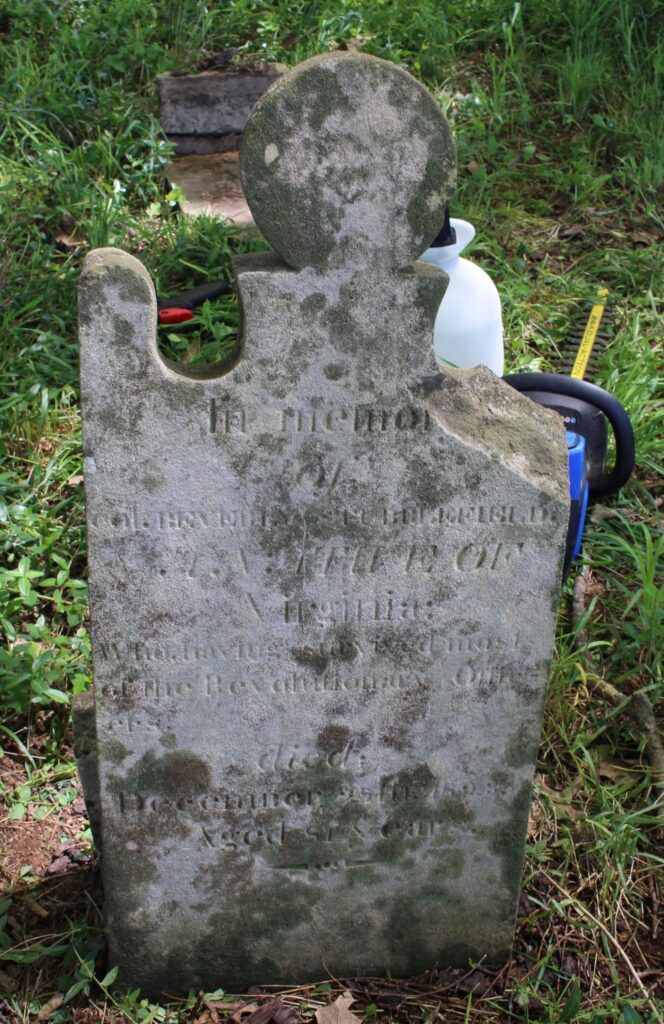
Capt. Beverly Stubblefield was born Nov. 8, 1742, in Virginia. He enlisted in the Virginia Continental Line in 1776, serving in the 6th and 2nd Regiments. The 6th saw action at the battles of Trenton, Brandywine, and others, before merging into the 2nd and fighting in several battles in the Carolina backcountry.
Stubblefield first emerged in Christian County records in the 1813 tax list, when he paid tax on 800 acres of land on the Elk Fork. In 1827 he applied to the court for a license to keep a tavern at his place of residence in Hopkinsville, suggesting he may have had a home at his farm, now in southern Todd County, and one in the city.
Stubblefield died Dec. 25, 1823, likely at his home near Trenton, Kentucky, and was buried there in the Stubblefield Cemetery. A 1952 issue of the Clarksville Leaf-Chronicle adds another chapter to his story. In 1824, the Revolutionary War hero and much-loved French general, the Marquis de LaFayette, returned to the United States at the invitation of Congress and President James Monroe, in conjunction with the 50th anniversary of American Independence. He spent about a year touring the young country and was given numerous celebrations and receptions.
The 1952 article relates that while en route to visit Gen. Andrew Jackson at his home near Nashville, LaFayette stopped in Clarksville and also traveled into southern Todd County to visit Stubblefield’s grave, as they were close friends and war comrades.
A Christian County sheriff: Samuel Younglove
Sgt. Samuel Younglove was born April 15, 1763, in New Jersey. He stated in his pension deposition that he was the youngest of his six brothers, “all of whom were prisoners at times or wounded or both.”
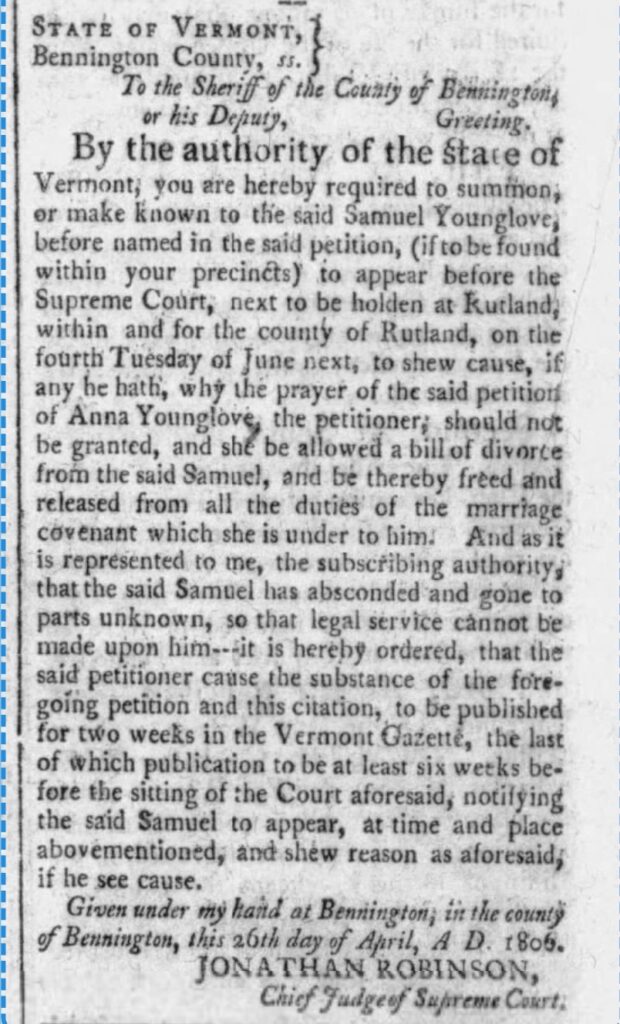
Younglove served in the Albany County, New York, militia, as well as the well-known Green Mountain Boys, a militia unit in New York and Vermont led by Ethan Allen and Gen. Benedict Arnold. Younglove stated he was in the Battle of Bennington as a volunteer at age 15, and that he served at Fort Ticonderoga.
He related that he moved from New York to Christian County, Kentucky, in about 1802, though he was first found in the 1809 tax list, paying tax on 766 acres of land. His land grants in the county totaled more than 1,200 acres.
An ad in an 1806 Vermont Gazette demonstrates that there was more to Younglove’s story than merely moving across the country. His wife, Anna Younglove, sought divorce for Samuel having abandoned her and “absconded and gone to parts unknown.” The 1790 census entry for Younglove’s Bennington, Vermont, household suggests that Samuel and Anna had three young sons. He married for a second time in 1804 in Christian County and had several more children.
Younglove served as sheriff of Christian County in 1832 and 1833, and served as a land processioner, meaning he was responsible for walking and marking the legal boundaries of a tract of land. Interestingly, given his past, he also served as surety for a number of marriage bonds, pledging to pay a fine if a legal impediment emerged to a planned marriage (for example, the couple being closely related, underage, or already married to someone else).
A family story relates that during the 1840 presidential campaign of William Henry Harrison, 77-year-old Younglove rode horseback in a parade. That election year was the first time presidential candidates actively campaigned for office, and torchlight parades were held in many communities.
Supporters of Harrison carried miniature log cabins and shouted the campaign slogan “Tippecanoe and Tyler, too,” referencing Harrison’s leadership in an 1811 battle against the Shawnee in Indiana territory, and Harrison’s running mate, John Tyler. Harrison was portrayed as a “man of the people,” a campaign strategy first used by Andrew Jackson and which has echoed through campaign cycles to the present day.
Younglove died Aug. 30, 1846, and was laid to rest in the Keeling Farm Cemetery on Butler Road near Gospel Peace Road in Christian County.
The brothers French: Simon French
Pvt. Simon French was born about 1765, likely in South Carolina. French served alongside several of his brothers in Col. Benjamin Roebuck’s regiment of South Carolina militia, beginning in about 1780. This regiment fought in the Carolina backcountry and was present at the Battle of King’s Mountain and numerous other engagements.
French’s brothers Joseph and William were noted in court and regimental records as having also been in Roebuck’s regiment, and a deposition in the pension record of another brother stated that William, Joseph, and Simon had all moved to the state of Kentucky. William and Joseph were both noted in early Christian County tax records, but apparently either moved on or died early.
Simon French sold his land in Pendleton County, South Carolina, in 1795 and appeared in the Christian County tax list of 1797, making him one of the county’s earliest settlers.
In 1824 he was appointed among several local men directed to view and mark a road from Allensworth’s mill in southeastern Christian County to the state line. He was also noted several times in court records as being chosen to participate in inventories, part of the probate process, of the estates of deceased neighbors. He built a brick home near Barker’s Mill in the southeastern part of the county which still stands today.
French is believed to have died Feb. 26, 1831. His will was probated in July 1831, and he was buried near his home.
Revolutionary physician: Dr. Walter Bennett
Walter Bennett was born May 22, 1745, in County Leitrim, Ireland, and emigrated to the American colonies in 1766, traveling as a ship’s physician aboard a vessel bound initially to Jamaica before the American mainland. He moved to Caroline County, Virginia, about 1768 and there trained as a country physician.
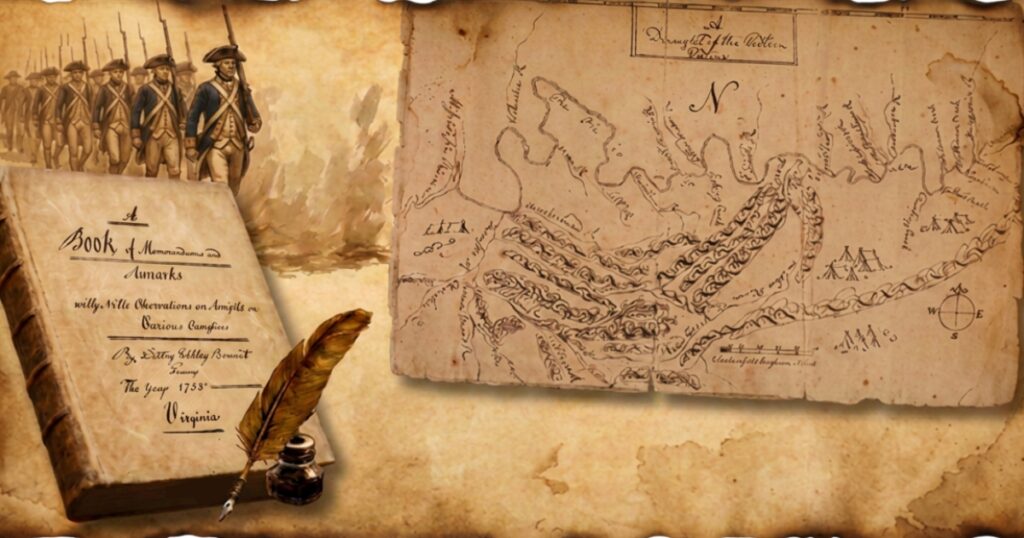
Many details of Bennett’s sojourns are preserved in his hand in his journal, now preserved in the Osher Map Library on the Portland campus of the University of Southern Maine.
Likely due to his early death, few records were found regarding his wartime activities. He is known to have served with the 2nd Virginia Brigade during the war as a physician-surgeon and was present at the Battle of Guilford Court House in 1781.
He detailed some of the units involved in this conflict in his journal, as well as details and a hand-drawn map of the Battle of Fort Washington, which occurred in 1776 on Manhattan Island, New York. Virginia soldiers were involved, so it may be presumed that he was there as well.

After the war, Bennett and his family moved to Halifax County, Virginia, about 1780 and had a home called Prospect Hill. In 1801, he was appointed sheriff of Halifax County.
Bennett received two land grants in Christian County totaling 500 acres on Little River in 1799 and 1804. He likely made the trek west about 1808, as he first appeared in tax records in 1809. His property was near current-day LaFayette Road and Lovers Lane. Bennett’s wife, Jane, was a charter member of the New Providence Baptist Church of Christ, now First Baptist Church.
Bennett’s journal also details the lives of his family, the people he enslaved, his horses, as well as weather phenomena, medical cases with which he was involved, political officeholders of his day, and philosophical musings, prayers, and sage advice to his children.
He include two entries from his time in Christian County. In 1811, just a year before his death, he noted an extreme drought, and also described in detail his observations of a comet which was visible for several weeks in the autumn that year. “… the first time I saw it was on the 8th of September after sun set … it was very brilient and continued this in our vew Till a few days before Xmass.”
Of the drought, he wrote “The drouth which in Kentucky in the year 1811 commenced directly after June and lasted until the last of November with a few lite showers … the springs almost in the county of Christian were dried up except a very few larger ones…”
Dr. Bennett died in Christian County on Dec. 21, 1812, and was buried in an unmarked grave in the Bennett Cemetery near Lover’s Lane and Little River.

Yvette Smithson Holmes, a native of southern Christian County, is an avid researcher of local history and genealogy. A graduate of Western Kentucky University, she previously worked in nursing. She is married to Bradley Holmes. They have five adult children and a granddaughter.