Last year’s movies were full of unlikely protagonists. Timothée Chalamet’s ping-pong playing hustler (Marty Supreme, 2025) and Leonardo DiCaprio’s fumbling ex-radical stoner dad (One Battle After Another, 2025) both stole their respective shows and earned well-deserved Oscar nominations.
But Norwegian filmmaker Mona Fastvold (“The Brutalist,” “The World to Come”) takes this eccentricity to another level in “The Testament of Ann Lee” (2025), a musical depiction of the life of the prophet who founded the Shaker Church in the United States in the 1770s.
At their height in the 1840s, there were over 6,000 Shakers spread across 19 communities.
[Two former Shaker communities are preserved historical sites in Kentucky — Shaker Village of Pleasant Hill near Lexington and South Union Shaker Village near Auburn.]
Today, just one community of three Shakers remains in New Gloucester, Maine. The movement was known for their craftsmanship, pacifism, and their orderly communal societies. But as “The Testament of Ann Lee” reminds us, behind their modest dress and simple way of life, the Shakers represented a radical religious and social experiment that embraced racial and gender equality long before the rest of the country caught up.
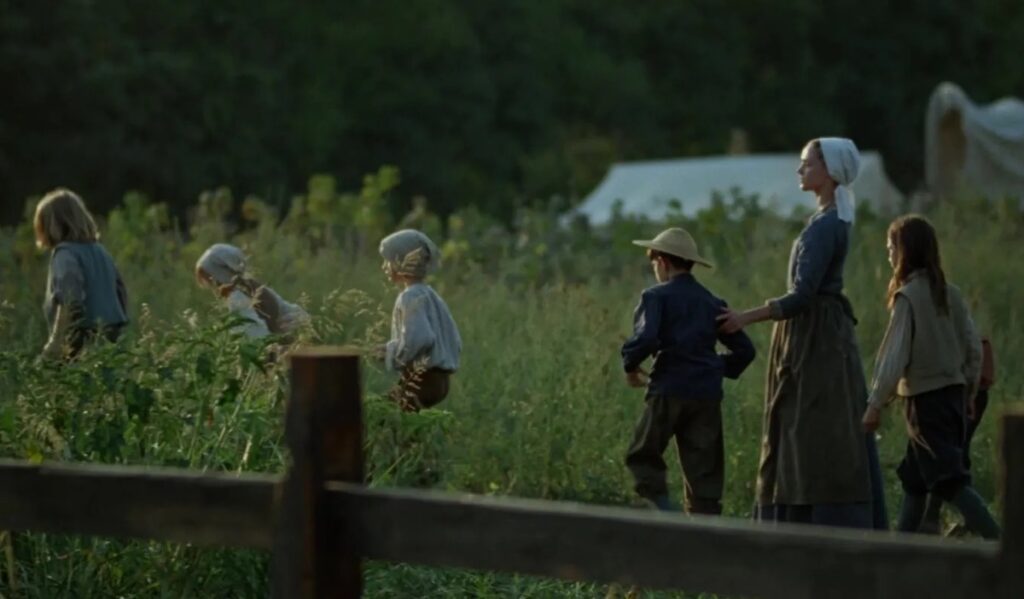
Fastvold’s film stars Amanda Seyfried as Ann Lee, Shakerism’s most important figure. The movie begins with Lee’s childhood in Manchester, England, where she worked in factories and lived in a crowded apartment with her large family.
We follow Lee as she becomes a member, and then leader, of the Shaking Quakers, an offshoot of the Society of Friends who preached radical equality and the sanctity of an individual connection with God, as opposed to the dominant churches of the day which relied on priests as spiritual intermediaries. Facing persecution in Manchester, Lee brings a small group of followers (played by Lewis Pullman, Thomasin McKenzie, and Christopher Abbot) to the New World, where they create the first Shaker community at Niskayuna, 165 miles upriver from New York City.
This transition from industrial Manchester to remote upstate New York makes it possible for Lee and her followers to realize their vision for a communal, egalitarian, and utopian society.
The Shakers were part of a long line of American rural utopian experiments, from the Pilgrims to the lesbian separatist movement of the 1970s. Like any of these communities, the Shakers were an object of curiosity to their neighbors. Their commitment to pacifism and equality helped the movement gain followers across New England. But as the film shows, their unique way of life — including an insistence on celibacy and dedication to a female leader — attracted enemies who accused Lee of witchcraft and treason when the community refused to participate in the Revolutionary War.
In some ways, the movie serves as a history lesson, educating audiences about the life of a fascinating but little remembered historical figure. The screenplay is based in part on the writings of Lee’s followers in the decades following her death, as Lee, who was illiterate, left no first-hand accounts. But while the broad strokes of the story are essentially accurate, fully accepting the film’s version of Shaker history would be akin to treating “Jesus Christ Superstar” as a primary source. After all, it’s still a movie musical at its core.
Despite the Shakers’ penchant for simplicity (the hymn “Simple Gifts” is one of their best-known cultural contributions), “The Testament of Ann Lee” has a baroque sensibility. The film is a riot of movement and color, and emphasizes the practice of ecstatic dance during worship that gave the Shakers their name. Freely roving cameras, expressive choreography, and a layered original score based on traditional Shaker hymns capture the vibrancy of the movement. The many dance numbers see-saw between dizzying Baz Luhrmann-esque revels and staid processions that wouldn’t feel out of place in Ari Aster’s “Midsommar” (2019) — but maybe that’s just all the tantric wailing.
This sense of spirited energy is one of the movie’s most important accomplishments. As denizens of the 21st century, we often have a difficult time imagining the past as vital or dynamic. Shakers, especially, with their bonnets and minimalistic agrarian societies, strike us as “quaint” in the purest sense of the word. Fastvold makes sure her audience doesn’t fall into this trap. The film’s costuming, language, and set design ground the story firmly in its distinctive historical moment. But these features enhance, rather than detract from, the audience’s connection with the vibrant human complexity of the founding Shakers.
It’s an unusual movie, to be sure, but one I thoroughly enjoyed. And while I never quite connected with the more esoteric and spiritual experiences of the characters, I left the theater with a new fascination for and appreciation of one of America’s greatest religious experiments: a community of innovators who used everything at their disposal, from new technologies to radical egalitarian practices, to try to bring about Heaven on Earth.
“The Testament of Ann Lee” is now streaming on Hulu.
(This article first ran on The Daily Yonder.)