Tuesday afternoon in the middle of a lengthy call to AT&T — attempting to fix a billing snafu that required the help of a living, breathing customer service representative, which is a person previously known as an operator — I drifted into another great communication tool of our times.
“I miss Ma Bell in the analog world,” I wrote on my Facebook page.
My friend George quickly responded, “You could dial up an operator and they could fix any problem …”
Another friend, who once worked for BellSouth, also commiserated. He remembered running wire for party lines that had eight houses on one phone line.
I had time to dilly dally on Facebook because this call to AT&T was running very long.
Hours long.
On the other end of the line, a representative who introduced herself as “Venus” was attempting to merge two telephone numbers into one account for me. I thought this had been accomplished a month earlier in another very long call but later learned my original account was canceled and now I was getting two bills for a pair of brand new accounts.
I’d like to believe that Venus was the telephone rep’s real name but if it wasn’t, I respect that she invented a pseudonym that gave her goddess status.
It turned out my billing issue was so complicated that Venus had to call on bigger gods and goddesses to fix things for me.
While she sent questions to others higher up the tech chain, I waited. I thought I could hear her typing. Occasionally, she reassured me that she was still there working on my problem. Then, a good two hours into our call, the connection went dead. Venus vanished.
I was shocked when she called back a few minutes later.
“Oh, thank goodness I got you back,” she said.
Venus was invested. She sounded determined to finish this task and get me on my way. She even began to chit chat, asking about my family while she waited on someone else on her end to produce some results. It was the last thing I had expected when I got all nostalgic for Ma Bell.
Eventually Venus wrestled down my two accounts and merged them into one.
The same day I encountered Venus, I happened to learn about a social experiment using two old pay phones to randomly connect two very different groups of people living 3,000 miles apart.
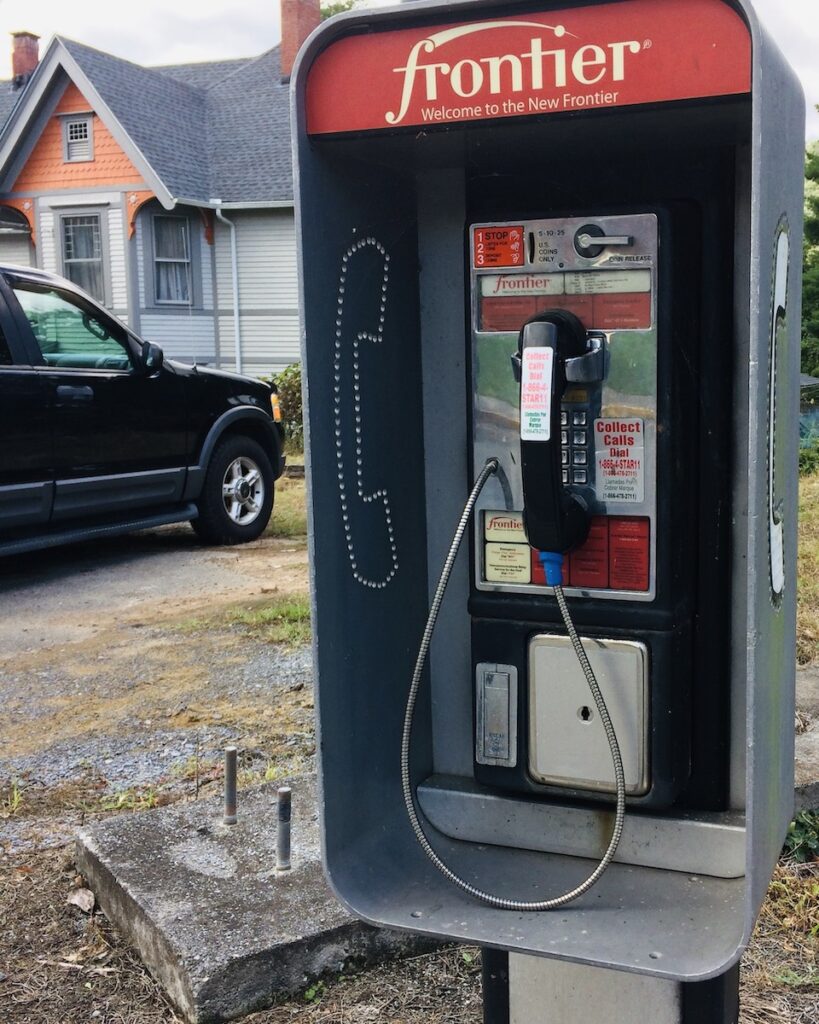
I read about this project on The Rural Blog because I read all stories that mention pay phones. I cannot pass them up.
The story explained that one of the old pay phones went into a nursing home in Nevada and the other went outside a coffeehouse near Boston University. Any time a person on one end picked up the receiver, it automatically rang at the other end across the country.
According to a story on CNN, the idea is to help people feel less lonely. On one end you have boomers in a nursing home — presumably the people most likely to be lonely. And on the other end you have zoomers, members of Generation Z born in the late 1990s and early 21st century who are highly tech savvy but also might be lonely because of too much exposure to the digital world.
I love this idea of connecting strangers and seeing how it might affect them. The fact that pay phones are involved is a bonus. The calls are free. No digging around for dimes and quarters. I started imagining a pay phone installed in downtown Hopkinsville that would connect to another pay phone in a remote Alaskan village (think “Northern Exposure” eccentrics) or a coffeehouse in the Scottish Highlands (think beautiful accents).
I miss pay phones, which are vanishing quickly. Really, though, I miss all phones from the analog age. These were the house phones resting on bedside tables and mounted to kitchen walls, and the pay phones inside dingy streetside booths or anchored to brick walls outside grocery stores.
The thing that separates these old phones from the cellphones/personal computers we now carry in our pockets is our response to the call.
We answered house phones and pay phones because those calls could be about something important. Or interesting. Or worthwhile. And since we couldn’t know until we picked up — well, we picked up.
We don’t answer cellphones very often because there are other ways to reach us, including texting and social media, and because we can easily screen out those we don’t want to answer. Even if we recognize the number and know it’s a good friend, a child or a spouse calling, we might wonder why they didn’t text first.
Text: “Can you take a call?”
Text back: “What’s it about?”
Sigh.
Another phone experiment that intrigues me involves a kind of magical thinking.
An old rotary dial phone is mounted to a tree deep in a forest. It is not connected to any other phones through a land line or wifi. But people are attracted to this remote phone as a way to “call” a deceased loved one.
I know it sounds a little too magical. That was my reaction the first time I heard about these “wind phones” as therapeutic devices. But it took me only a few moments to imagine calling my mother. I’d pick up the receiver and start telling her about her great-grandchildren.
Seems like a wind phone would be hard to beat.

Jennifer P. Brown is co-founder, publisher and editor of Hoptown Chronicle. You can reach her at editor@hoptownchronicle.org. Brown was a reporter and editor at the Kentucky New Era, where she worked for 30 years. She is a co-chair of the national advisory board to the Institute for Rural Journalism and Community Issues, governing board past president for the Kentucky Historical Society, and co-founder of the Kentucky Open Government Coalition. She serves on the Hopkinsville History Foundation's board.