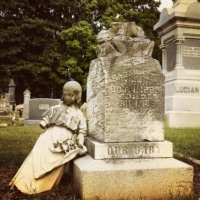
In her memoir detailing growing up on East Seventh Street during the early 1900s, Sarah Dalton Todd emphatically stated that it was the New Year, not Christmas, that was the main event. Nevertheless, Christmas is the holiday that gets far more coverage in her work.
Sarah’s statement regarding Christmas’s sub-status to the New Year is teeming with historical and cultural insight. It certainly was true in the 1800s. But was it still the case in the 1910s?
Born in 1903, Sarah may have believed it to be true during her early years simply because it was the status quo for adults around her. But the pace of change ramped up when America hit 1900. These changes encompassed technology, culture, relationships and even the smallest details of daily life, including how people celebrated holidays.

During the early decades of the 20th century, we see a definite shift in focus away from the New Year and toward Christmas as the primary winter holiday — as well as changes in how Americans celebrated both. With hindsight, we see this far more clearly than Sarah could. And even though I’m sure she staunchly believed what she said, I think she intuitively picked up on the transition that was happening. That comes through in her writing.
Would you have recognized Christmas if you stepped into a Hopkinsville house in 1910? We’ll take a look at Sarah’s description of her childhood Christmases on East Seventh Street as well as visit a couple of other locations in Hopkinsville where Christmas celebrations happened in that era.
From gift-giving, to parties and decorations, to jolly ol‘ Saint Nick, let’s delve into a world so different and yet similar to ours that it sometimes feels eerily like an alternate universe.
Gifts
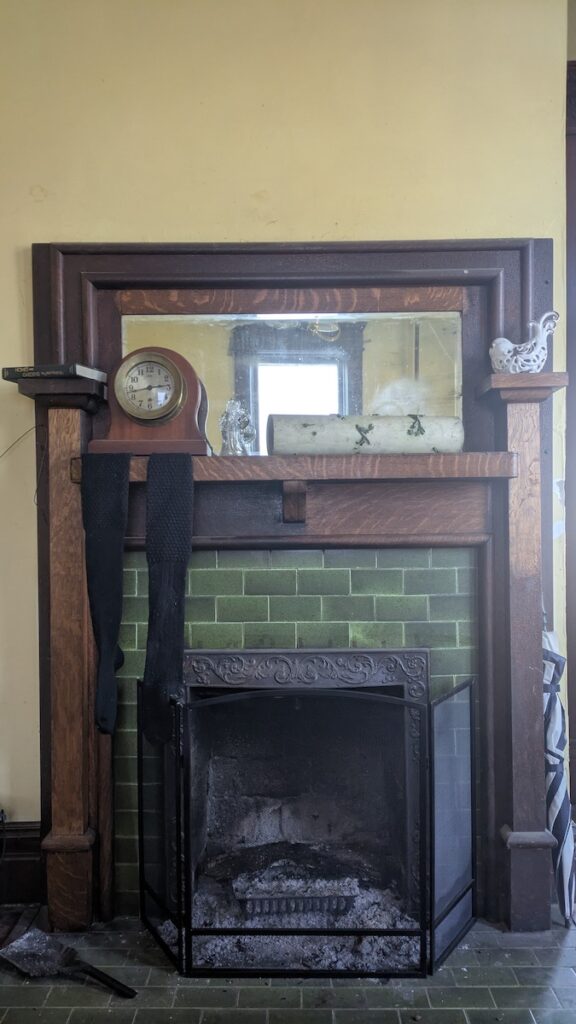
In her memoir, “Quality Hill,”Sarah wrote that she and her sister, Margaret, dreamed “… of Santa coming down our chimneys and filling our long black stockings that we had hung by the fireplace.”
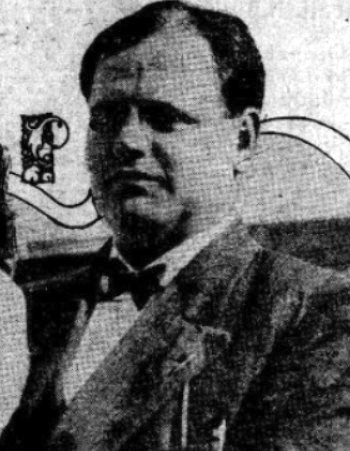
Gift-giving was already an important feature of Christmas at the turn of the century but on a smaller scale than today. Margaret and Sarah bought their parents small gifts in town. These probably came from stores like Anderson’s or Frankel’s Busy Store.
Most of the Christmas gifts Sarah remembered receiving were made by family members. These presents usually revolved around outfitting Sarah’s dolls and are a fantastic display of old-time crafts. Her grandmother, Dovie Wiley, sometimes embroidered a doll bonnet or pieced together a little quilt. Sarah’s Aunt Minnie crocheted a doll cap or little sweater. And her Uncle Will Long, Aunt Minnie’s husband, made beautiful doll furniture.
One especially exciting gift Sarah recounted came from their minister, Milton Clemens, who boarded with the Daltons before he married in 1910. It doesn’t have anything to do with Christmas, but Milton Clemens’ story is too good not to recount.
Hailing from Missouri, Clemens was the pastor at the Cumberland Presbyterian Church in Hopkinsville. He was a young man, in his mid-20s, and was engaged to be married to a Margaret Moore. The hitch in the plan? Margaret was in Japan.
Milton and Margaret had met and become engaged in seminary. Both were the children of ministers. The engagement proved a lengthy one, however, as Margaret was determined to fill a four-year stint as a missionary. The two finally married in May 1910 at Margaret’s parents’ house in Bowman, North Dakota. After their marriage, the couple returned to Hopkinsville, where Milton continued to serve as the Cumberland Presbyterian minister.
Milton Clemens gave Sarah Dalton a beautiful doll. But rather than wrapping it and placing it under a Christmas tree, like we would do today, he put it in a dresser and simply directed Sarah which drawer to open.
O, Christmas tree!
This story struck me as strange until I realized that something important was missing. I don’t think the Daltons had a Christmas tree. In fact, many homes in Hopkinsville in 1910 were probably devoid of this object that we associate the most with Christmas.
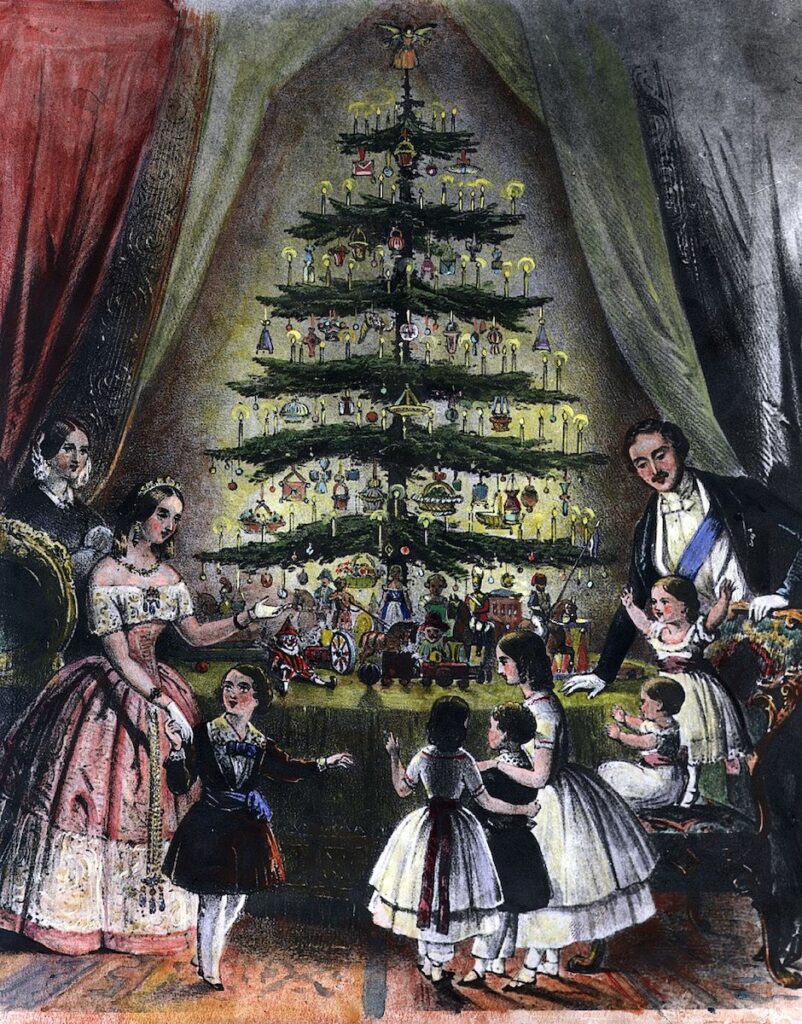
Christmas trees were first popularized in English-speaking countries by Queen Victoria, who ruled Britain from 1837 to 1901. With strong German roots as well as an authentic German husband, Victoria adopted the German custom of decorating a Christmas tree in Windsor Castle. An 1848 engraving showing the royal family around their Christmas tree circulated widely and launched a new tradition in Britain and America.
In Hopkinsville, however, Christmas trees were still novel enough in the 1880s that the newspaper reported on who had one. In 1888, the Semi-Weekly South Kentuckian noted the Misses Edmundson gave a “Christmas tree party” at T.M. Edmundson’s house, the Episcopal Church distributed presents from under their Christmas tree to Sunday school students, and Dr. Rodman had Mrs. Southerland’s Sunday school class to another Christmas tree party at his home.
Newspaper articles from the 1910s don’t read too differently. Churches and schools set up Christmas trees, but one still gets the feeling they weren’t found in every home.
One location in Hopkinsville in the 1910s where someone could definitely gaze on a Christmas tree was the Hotel Latham.
In the 1910s, the staff at the Hotel Latham set up an enormous Christmas tree and handed out gifts to children. In 1913, they distributed nuts, candy, fruit, and 135 dolls to 220 children around the Christmas tree.
The next year, hotel clerk Ira “Red” Parish dressed up as Santa. Parish’s World War I draft papers describe him as “tall” and “stout,” placing him in the class of Santa Claus we would probably recognize today!
Gatherings
In a time when holiday parties now start anytime after Thanksgiving, I find it refreshing that Christmas gatherings in 1910 usually began on Christmas Eve. That night, most people in Hopkinsville convened at their church of choice for a Christmas service. After this inaugural event, it seems like parties and drop-ins continued with frequency through New Year’s Eve, where friends and neighbors would gather for games, hot chocolate and sandwiches.
But back to church. The Monroe Dalton family attended Cumberland Presbyterian Church, which was located on East Seventh Street between South Virginia and Liberty Streets, where the city of Hopkinsville’s municipal parking lot is today.
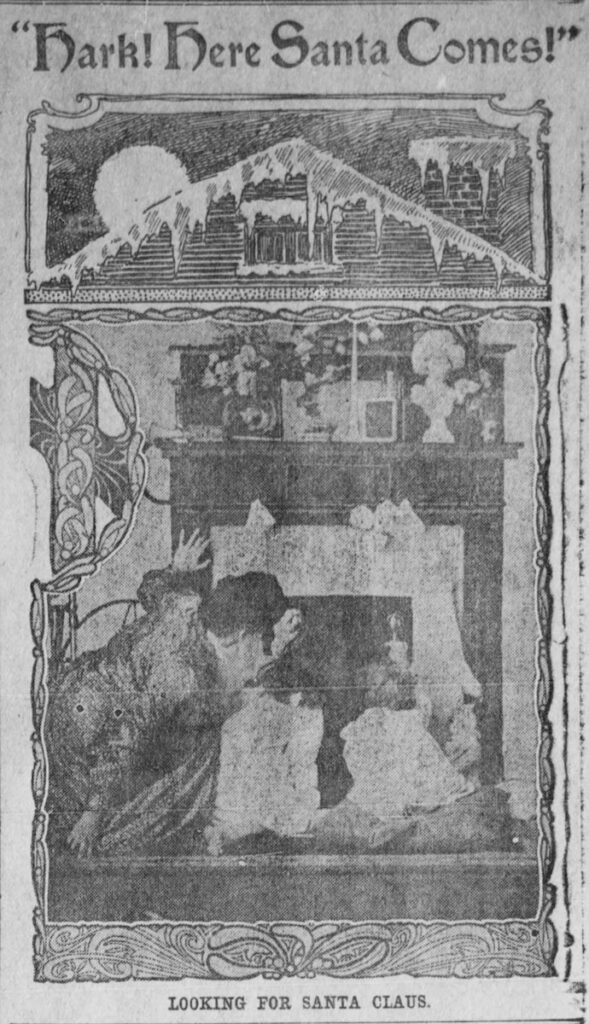
The Christmas Eve service at the Cumberland Presbyterian Church was lessons and carols. Before you start to feel too at home with the seeming continuity here, let me add the service ended with a recitation of “The Night Before Christmas” and an appearance by Santa Claus himself, two things that feel like a hearty dose of secular Christmas culture.
Santa Claus
Saint Claus, or Saint Nick, really did embark on his career as a saint in the Catholic Church. Numerous articles that ran in Hopkinsville newspapers in the late 1800s and early 1900s reminded people of this and continually linked him to Jesus.
In fact, 12 year-old Mary Louise Rascoe of Julien won second place in a writing contest in the Louisville Courier-Journalin 1902 for her Christmas story. Coming in around just 300 words, the story recounts a burned-out Santa Claus taking a trip to Fairyland, where the sprites reminded him that Christmas was about Jesus.
It was as if they already saw the Christmas culture war that could ensue if Santa Claus was seen as a rival to Jesus.
You might be surprised to learn it was common for men, women, boys and girls all to play Santa in the early 1900s. While the fur-trimmed red garb had already become Santa Claus’ attire, the man himself was still more an archetype than an individual.
In 1906, the Endeavor society from Hopkinsville, a social group for Methodist young people, sent men and women up to the prison at Eddyville to play Santa for inmates. In a tragic turn of events, 14 year-old New Yorker Carrie Hanley sustained major burns while playing Santa Claus in 1900. (Burn injuries while playing Santa Claus frequently appear in newspapers from this period, on account of the bulky, flammable costume and lit candles that often decorated Christmas trees.)
Uncle Will
The Santa who appeared at Cumberland Presbyterian Church on the Christmas Eves of Sarah’s childhood must have been a fairly realistic impersonator. He certainly fooled her for many years. And this was a feat, as he turned out to be none other than her Uncle Will!
William Allen Long, the gifted maker of Sarah’s doll furniture, was also one of Hopkinsville’s earliest architects. Born in Hopkinsville in 1857, Long grew up on Bridge Street, the old name for the part of East Seventh Street by the Little River. His father was George Long, a carpenter. Young William’s construction education almost certainly began at home, with his father, and the 1880 census already lists 22 year-old William as a carpenter.
In 1887, William Long married Margaret “Maggie” Wiley, who lived nearby on Bridge Street. Maggie was the daughter of Gustavus Wiley, a grocer. Her younger sister was Carrie, who went on to marry Monroe Dalton.
William Long worked most of his career as a construction manager for Forbes Brothers Manufacturing. He was responsible for overseeing the daily construction of many of the Hopkinsville buildings we now love. Later in life, he started his own company, which did commercial and residential construction.
By the early 1900s, William and Maggie Long had moved further up East Seventh Street. They lived in a one-story frame house on the north side of East Seventh, just above Mechanic Street, and a short walk from the Monroe Dalton house. I suspect a young Sarah Dalton made this walk quite frequently. Uncle Will and Aunt Maggie, as well as Sarah’s Wiley grandparents, show up far more frequently in her reminiscences than the numerous Dalton relatives.
Wrapping it up
In fact, after they had opened their stockings, Sarah and Margaret Dalton made their way over to Uncle Will and Aunt Maggie’s house and their Wiley grandparents’ house, also on East Seventh Street, for more presents and visiting.
Christmas Day ended with something I feel is the strongest strain of continuity between Christmases past and present — a meal. After a day of running all over East Seventh Street, the Monroe Dalton family came back together around the dining room table for Christmas dinner.

Grace Abernethy is a historic preservationist and artist who specializes in caring for and recreating historic architectural finishes. She earned her Master of Science in Historic Preservation from Clemson University in 2011 and has worked on historic buildings throughout the eastern United States. Abernethy was a recipient of the South Carolina Palmetto Trust for Historic Preservation Award in 2014 and won 2nd place in the Charles E. Peterson Prize for the Historic American Buildings Survey in 2011. She and her husband, Brendan, moved to Hopkinsville from Nashville in 2020. She works as an independent contractor and is a board member of the Hopkinsville History Foundation.