There is something poetically beautiful about being from a place. You know where you belong, and that place knows you, too. Every step you take is on ground trod by your ancestors. You are named, identified, valued just for being, individually, you.
This describes the archetypal Southern family in American culture. An ancestor trekked to a place, thought it looked good enough, and made a homeplace. And just like that, generation after generation has passed in that same place. It’s, unsurprisingly, a recurring theme in literature. Writers like Wendell Berry, William Faulkner, and Hopkinsville’s own bell hooks all explore the idea of belonging as interwoven with place in in their fiction and non-fictional works. bell hooks opens her book Belonging: A Culture of Place with this statement:
“Talking about place, where we belong, is a constant subject for many of us.”
I’ve mulled over this idea of belonging quite a bit. I wish I could identify with William Faulkner, who was trailed wherever he went by the idea his hometown of Oxford, Mississippi. However far he ran from it, he always found it hot on his heels. And he always returned.
But this is not my story.

New York to South Carolina
My childhood was cast in a different mold, split between New York and South Carolina, where my family moved when I was eight. In small-town South Carolina, people constantly remarked, “You’re not from here, are you?” And every time I returned to New York, I was told I had a Southern accent. (I don’t.) I was never really from anywhere.
My grandparents were. And so were my parents. My dad’s family has deep, deep roots in Mecklenburg County, North Carolina. If I’m in the area, all I have say is that my grandfather was Joe Washam, and everyone knows what umbrella to place me under. As for my mother, her family has been in the same New York county since the 1650s.
But I’m not from either of these places, and I’m not really from South Carolina either. This kind of displacement has become increasingly normal over the past three or four decades. Families have spread out and moved around, spending a few years in one place and then moving on to another. This can be hard on the psyche.
Population Movement
It can also be hard on places that “had” people and now find themselves depleted.
People have always moved around. I’ve spent most of my life in small cities and towns, where the constant fear is that all the young people will grow up and move to the Big City. And this is exactly what I did. If this happens, small cities and towns could dry up and die.
In upstate South Carolina, where I spent the largest chunk of my life, this often was true. The area invested heavily in the textile industry. As these companies shut down their South Carolina plants, one by one, and moved them to cheaper countries, job opportunities in South Carolina small towns disappeared. Young people had little hope of reliable income in these places, and so they moved away, usually to the closest urban area.
But the current of life is cyclical. The most recent big migration this country has seen was during the COVID-19 pandemic. The University of New Hampshire published a fascinating map with six color designations for population loss and growth. It tracked changes between 2020 and 2022, using U.S. Census data. What it showed was massive population movement out of the Northeast, coastal California, and the Rocky Mountain region and into parts of the Southeast, Florida, much of the Southwest, and the Upper South. A lot of the areas that grew were towns and small cities.
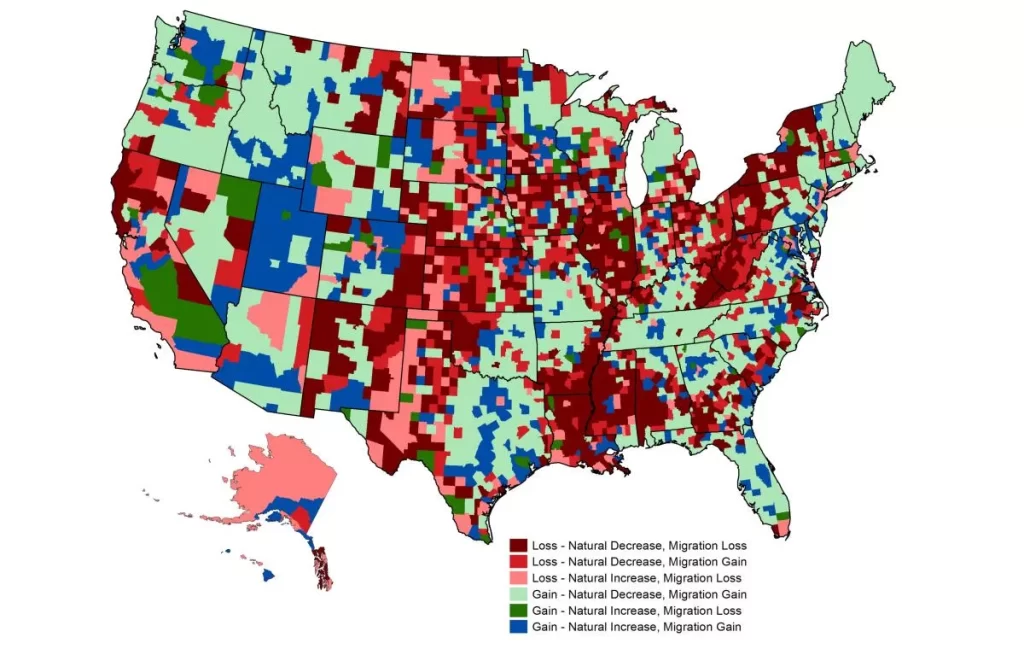
In fact, Christian County’s population grew in this two-year period. That’s when my husband and I moved here, and it looks like we weren’t the only ones.
A Balance
Life anywhere has always been a balance between people who are from a place and people who move to a place. And this is a very good thing. Because a healthy place needs both kinds of people.
What do people from a place offer? Stability, hospitality. They are the ones who have largely been responsible for making a place what it is. In historic preservation, we call this a sense of place. In other words, they create identity.
But let me put a good word in for the outsider. I’ll give you an example of a family of outsiders who moved to Hopkinsville and offered so much. If you are a regular Hoptown Chronicle reader, you already know them quite well.
Meet the Daltons.
The Daltons Come To Hoptown
Samuel, the Dalton family patriarch, was born in 1822 somewhere between Logan County, Kentucky, and Springfield, Tennessee. He eventually made his way to Barren Plains in Robertson County, Tennessee, where he worked as a brick mason and farmer. He married Sarah Jane Mason, and they raised six children. Eventually, five of the six children moved to Hopkinsville, as well as Samuel and Sarah Jane.
The first Dalton to come to Hopkinsville was George, the oldest son. Already a brick mason, he moved here in 1881, at just 21 years old, and established a brickyard. His timing was impeccable. The following year, a fire devastated downtown. When the rubble had cooled, the city decided it would be wise to build back using brick, a more fireproof material than the wood that had made the old buildings.
Samuel Dalton moved the rest of his family up to Hopkinsville shortly after. He joined George at the company that would eventually be known as the Dalton Bros. Brick Company and would last for the next century, constructing numerous buildings that still stand on Hopkinsville’s historic landscape and employing hundreds of men over the years.
The Daltons did so much for Hopkinsville that we, today, remember them as being from here. If you want to nit-pick, they weren’t. But I bet if you had asked them where they were from, they would have said Hopkinsville.
Of all the qualities exhibited by the Daltons, the one I find the most compelling is that they chose to be here. Out of all places they could have moved, they chose Hopkinsville to be their home. The whole family came. They started businesses, they ran for public office, they served on the boards of schools and civic groups. They built beautiful and durable buildings and dreamed of providing reliable transportation and cheap electricity to the people here.
They made Hopkinsville their home, and they made it better by doing so.
The View from the Outside
What have I learned from the Daltons? So many things. At the foremost, they have shown me the gifts outsiders can bring to a place. Places that are settled need a little agitation now and then to keep things from growing stagnant. Outsiders can bring new ideas and energy.
They can give a fresh perspective. They can cast a light on all the everyday good things about a place that make it special but are so easy to forget. And sometimes, I think they fight with a fierceness that seems foreign to a place. Because they have searched and found something. And when you choose to be somewhere, you have a different kind of stake in it.
There’s something beautiful about being from a place. But I have discovered there’s something equally beautiful in finding a place.

Grace Abernethy is a historic preservationist and artist who specializes in caring for and recreating historic architectural finishes. She earned her Master of Science in Historic Preservation from Clemson University in 2011 and has worked on historic buildings throughout the eastern United States. Abernethy was a recipient of the South Carolina Palmetto Trust for Historic Preservation Award in 2014 and won 2nd place in the Charles E. Peterson Prize for the Historic American Buildings Survey in 2011. She and her husband, Brendan, moved to Hopkinsville from Nashville in 2020. She works as an independent contractor and is a board member of the Hopkinsville History Foundation.