L.A. and Gertrude Tapp knew their son was serving aboard the USS Arizona when they heard the big battleship had sunk in the surprise Japanese air attack that plunged the United States into World War II.
But for two agonizing weeks, the owners of Shakertown Fruit Farm in Mercer County didn’t know if 23-year-old Gunner’s Mate Third Class Lambert Ray Tapp was dead or alive.
The age of cell phones and instant communication was decades away on Dec. 7, 1941, the date President Franklin D. Roosevelt predicted “will live in infamy.” Thus, the Tapps — and other stateside families with loved ones in uniform in Hawaii — suffered agonizing uncertainty for days.
For the Tapps, the terrible wait turned into weeks.
All of the families hoped or prayed for the best, while fearing the worst. Some tried to convince themselves that “no news is good news.”
Relatives, especially mothers, fathers and spouses, dreaded the knock at the door that would announce the arrival of a Western Union messenger bringing the worst possible news.
“With limits on how many words a telegram could accommodate, the military adopted distinct standardized phrasing to convey the news; hence, the common chilling phrase ‘I regret to inform you …,’” wrote Megan Harris in a Library of Congress blog.
Between Dec. 21, 1941, and Jan. 9, 1942, a Western Union courier called at L.A. and Gertrude Tapp’s home three times.
The first Navy wire said Lambert Ray was reported missing. Some families took “missing” to mean “dead.” Others believed, or wanted to believe, that “missing” meant their relative might somehow be alive.
The second cable instantly turned the Tapps’ anxiety into joyous relief. He was alive. But their jubilation was short lived; the third telegram again said he was missing.
Stories in the Harrodsburg Herald and Lexington Herald-Leader are silent about the emotional roller coaster the Tapps must have endured. In the chaos and confusion following the Pearl Harbor attack, military authorities went with the best information they had. As a result, some telegrams erroneously listed servicemembers as missing or killed in action, necessitating another cable saying the first one was a mistake.
But the triple telegrams sent to the Tapps seem rare, if not unique.
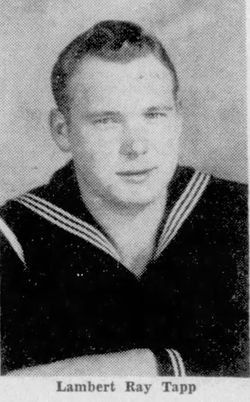
Lambert Ray Tapp was born in Webster County on Oct. 25, 1918, the same day his mother, Helen Callis Tapp, 19, died, evidently in childbirth. L.A. married Gertrude Dossett Tapp in 1919. They reared Lambert Ray and two children of their own.
Lambert Ray joined the Navy in Louisville on March 6, 1940, and ended up on the battleship Arizona, one of the largest and most powerful warships afloat.
When the air raid began, the Arizona was part of “Battleship Row,” a procession of seven capital ships moored alongside Ford Island in the middle of Pearl Harbor.
The attack sprang from a half-dozen aircraft carriers and included 350 fighters, torpedo-bombers, dive-bombers and horizontal bombers. While some Japanese planes also struck Army Air Force and Marine air bases on Oahu, the Pacific Fleet at Pearl Harbor was the main target.
The enemy appeared over Pearl Harbor at 7:55 a.m. Dec. 7 was a Sunday, and most of the sailors had the day off, “liberty” in Navy lingo.
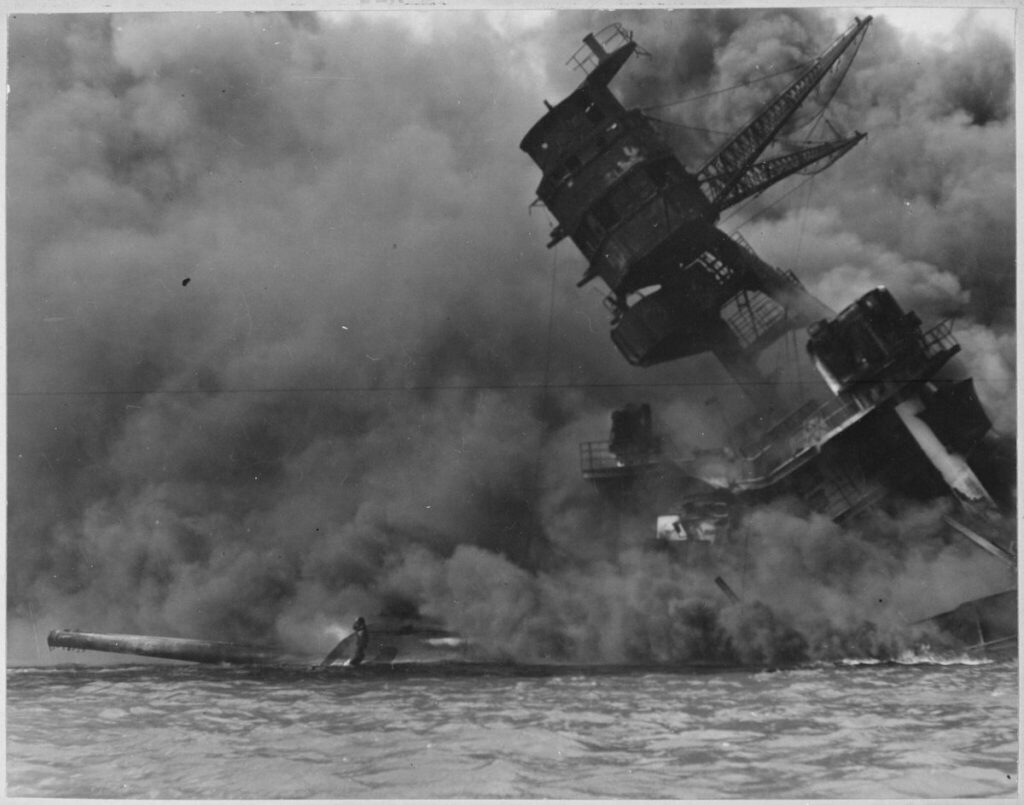
About 8:10 a.m., a 1,763-pound naval shell converted into a bomb crashed through the Arizona’s forward deck, penetrated deep into the ship and ignited powder magazines and gasoline used to fuel the battleship’s scout planes.
The blast produced a huge fireball, heaved the 32,600-ton battlewagon’s bow nearly 50 feet into the air and broke the ship virtually in half, according to Craig Nelson’s book “Pearl Harbor: From Infamy to Greatness.” The bomb killed 1,177 sailors and marines. All told, the attack claimed the lives of 2,340 sailors, marines, soldiers and airmen and 49 civilians. The enemy sank seven ships and left several more damaged.
The initial telegram said Lambert Ray was “missing following action in the performance of his duty and in the service of his country.” A Jan. 6 wire provided the Tapps “a very happy new year,” according to the Harrodsburg Herald. Lambert Ray, the Navy assured his parents, was “now reported to be a survivor” and “will doubtless communicate with you at an early date informing you of his welfare and whereabouts.”
The Navy “deeply regretted ” any “anxiety caused by the previous message.”
Three more days passed with no word from their son. On Jan. 9, the third telegram destroyed L.A. and Gertrude Tapp’s dreams of a happy reunion with Lambert Ray.
The cable said Murray Leland Tapp, also a sailor on the Arizona but evidently not related to Lambert Ray, had survived, but L.A. and Gertrude’s son was “now reported missing upon the latest casualty lists.” The Navy “fully appreciated” the family’s “great anxiety” and promised: “Any report as to the fate of your son will be communicated to you promptly when received.”
Lambert Ray Tapp’s remains were never found. But his name is enshrined in stone in the Courts of the Missing, also known as the Gardens of the Missing, which are part of The National Memorial Cemetery of the Pacific in Honolulu.
L.A. and Gertrude Tapp had grieved over the loss of a child 10 years before Lambert Ray’s life ended at Pearl Harbor. Their daughter, Ann Marie, died as a toddler in 1931.
Their son, John Bethel Tapp, grew up to follow his half-brother into the Navy where he earned the gold wings of a naval aviator and rose to the rank of lieutenant commander. His name is also carved in stone in the Honolulu cemetery.
On March 23, 1966, during the Vietnam War, the 32-year-old carrier-based pilot’s attack jet crashed in the South China sea. Like Lambert Ray’s, his body was not recovered.
A simple stone slab memorializes the siblings on the family plot at Shady Grove Cemetery in the Poole community in Webster County. “LOST AT SEA” is their common epitaph.
While L.A. died five years before Commander Tapp lost his life, Gertrude, who outlived a second husband, survived to age 93 in 1998. She and Ann Marie also are buried on the family plot in Shady Grove.
This article is republished under a Creative Commons license from Kentucky Lantern, which is part of States Newsroom, a network of news bureaus supported by grants and a coalition of donors as a 501c(3) public charity. Kentucky Lantern maintains editorial independence. Contact Editor Jamie Lucke for questions: info@kentuckylantern.com. Follow Kentucky Lantern on Facebook and Twitter.

Berry Craig, a Carlisle countian, is a professor emeritus of history at West Kentucky Community and Technical College in Paducah and the author of seven books, all on Kentucky history. His latest is "Kentuckians and Pearl Harbor: Stories from the Day of Infamy" which the University Press of Kentucky published.