On a routine day in Western Kentucky, only a few random visitors and occasional school groups drop in to Murray State University’s Wrather Museum. However, when a traveling exhibition from the Smithsonian Institution comes to town, attendance steps up because rural communities value having local access to cultural experiences usually reserved for big city museums.
In 2012, the Smithsonian’s Journey Stories exhibition came tothe Wrather Museum. About 4,000 people viewed images and information that explored the ways travel and migration have impacted individuals and communities, past and present. Inspired by the exhibit, scores of school kids wrote and recorded journey poems that were broadcast on WKMS-FM, the NPR affiliate at Murray State.
One image in Journey Stories, an engraving of a line-up of male slaves being transported on foot, sparked comment from a middle-schooler. The artwork, a primary document from the antebellum era, showed barely clothed African men yoked together with leg irons and neck braces.
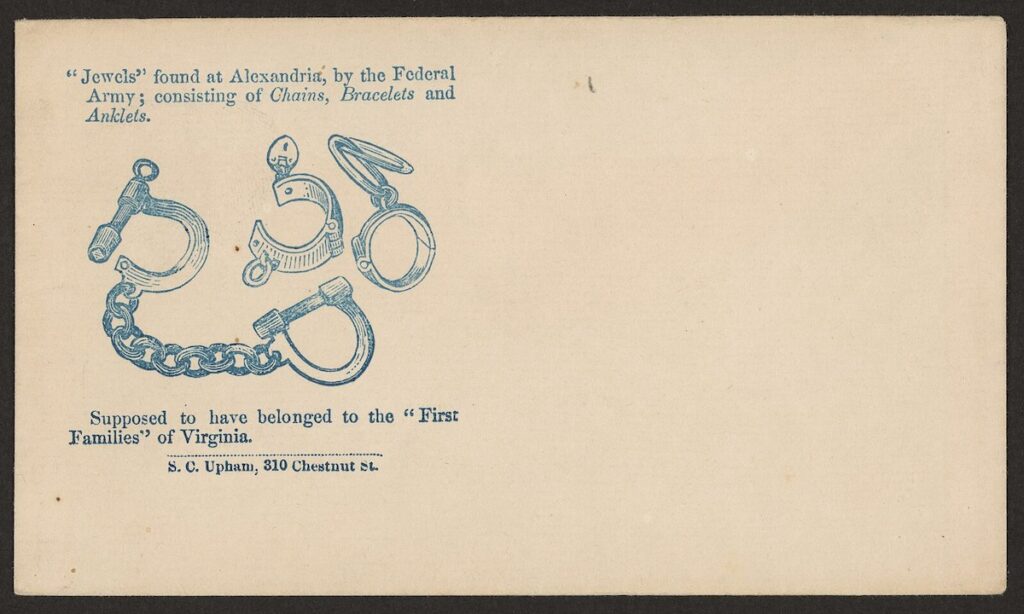
Pointing to the picture, the student declared, “They didn’t wear those things around their necks, they just wore ones on their ankles,” as if leg irons were good, but neck irons not so much.
The boy’s observation sparked my memory of the word “coffle.” I would have taken the opportunity to introduce a new word into the kids’ vocabularies, but the school buses were waiting outside: No time for the teachable moment.
Coffle, according to “The American Slave Coast” by Ned Sublette and Constance Sublette, means, “the common way slaves were transported from slave breeding states on the Atlantic coast to the slave markets and plantations of the deeper South. Southern children grew up seeing coffles approach in a cloud of dust.”
Enslaved people in America were marched in coffles at a pace of 20 or 25 miles a day, sometimes for weeks and in all weather, to a point of sale. The origin of coffle leads to an Arabic word meaning caravan, harkening back to overland slave trade that trekked across the desert from sub-Saharan Africa to the Middle East.
“About a quarter of those trafficked southward were children between 8 and 15, purchased away from their families,” describes “The American Slave Coast.”
Charles Ball, who was forcibly taken from Maryland to South Carolina in 1805, said, “The women were tied together with a rope … which was tied like a halter round the neck of each.” Men were collared in chains and “fitted by means of a padlock round each of our necks.
“Women with babies in hand were in a particularly cruel situation. Babies weren’t worth much money and they slowed down the coffles,” Ball said. “William Wells Brown hired out a slave trader named Walker, who recalled seeing a baby given away on the road.”
In 1841, when Abraham Lincoln witnessed a coffle of slaves in chains, he said, “The sight was a continued torment to me and I see something like it every time I touch the Ohio or any other slave border.”
Although coffle has faded from usage, the word retains precise historic accuracy and relevance. For example, the deportees who were dispatched to a notorious Salvadoran prison without due process were tethered in a coffle, even forced to bend from the waist as they shuffled to an uncertain fate.
Nevertheless, just the other day, the president chastised the Smithsonian Institution for focusing too much on “how bad slavery was” and not enough on the “brightness” of America.
In a social media tirade, Mr. Trump wrote, “The Smithsonian is OUT OF CONTROL, where everything discussed is how horrible our Country is, how bad Slavery was, and how unaccomplished the downtrodden have been — Nothing about Success, nothing about Brightness, nothing about the Future.”
“This Country cannot be WOKE,” he wrote, “because WOKE IS BROKE. We have the ‘HOTTEST’ Country in the World, and we want people to talk about it, including in our Museums.”
When the president wants people to talk about America, however, he specifies the words that can (or cannot) be used. For instance, take the now-verboten term, DEI. Through a recent series of executive orders, Donald Trump flushed the words diversity, equity, and inclusion — and the acronym DEI — into the golden toilet of obscurity by threatening financial ruin, public humiliation and physical harm to those who implement the words and the concepts they represent.
So today’s lesson is that the nation’s vocabulary can be censored in less than a hundred days. Nevertheless, such tactics cannot change history. And that’s a fact, not fake news.
You have my word.

Between 1989 and 2023, Constance Alexander’s newspaper column Main Street was recognized for excellence five times by the Kentucky Press Association. She is an award-winning columnist, poet and playwright, and she received the Governor’s Award in the Arts for Media in 2014. A Murray resident, she now writes Left on Main, an occasional column. She is a Hoptown Chronicle board member.