While some Kentucky Democrats are pulling for Andy Beshear to run for the Senate next year, others want him to toss his hat in the ring for their party’s 2028 presidential nomination.
Evidence suggests that our two-term governor is more inclined toward the latter option. And he’s attracting national attention. NPR’s Steve Inskeep interviewed Beshear on “Morning Edition” last week. Washington Monthly just published an article headlined “Why Andy Beshear Is a First-Tier Presidential Contender.”
If he were to win the Democratic nod, Beshear would be the first lifelong Kentuckian to top a major party’s ticket in 168 years.
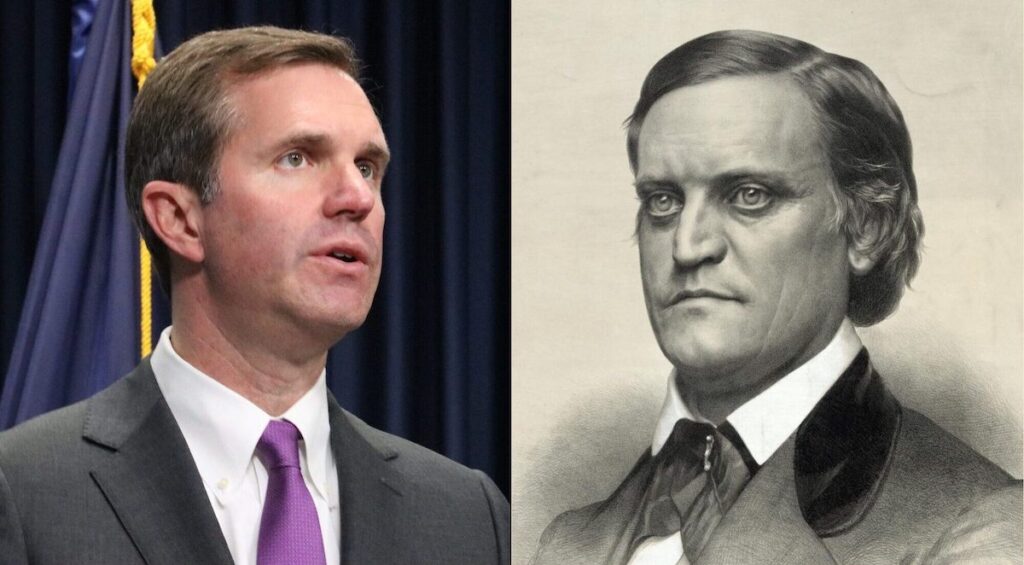
That gap underscores Kentucky’s declining prominence in national affairs since the Civil War. “Between 1824 and 1860, there were 10 presidential elections,” explained James Klotter, Kentucky’s official state historian, in an email. “A measure of Kentucky’s importance in the nation is that the state had a candidate running for president or vice president in eight of the 10 races.”
When our nation was young, not many states had a greater impact on national politics, the economy and society than Kentucky.
“Kentucky was the breadbasket for the nation as late as 1840, when it ranked first or second in the production of corn, wheat, hemp, tobacco and bourbon, and fourth in rye, and was a leader in the horse and mule industries,” Klotter said. “Louisville was the third largest city in the South, after New Orleans, and Baltimore, and Lexington’s cultural strengths earned it the title of ‘the Athens of the West.’”
In addition, Kentucky, the first state admitted to the Union west of the Appalachian Mountains, was the gateway to our first West — the vast territory from the Appalachians to the Mississippi River. After the Revolutionary War, thousands of westward-bound migrants trekked through the Cumberland Gap or floated down the Ohio in flatboats and other vessels.
Many who stopped in Kentucky later moved on to other states. Volume I of Lewis and Richard Collins’ 1874 “History of Kentucky” lists more than three dozen Kentuckians who became governors, acting governors, lieutenant governors or secretaries of state elsewhere. Another 28 became diplomats.
Kentucky emigres sometimes transplanted Kentucky place names to other states. Elizabethtown is the seat of Hardin County in southern Illinois, which also includes the towns of West Frankfort and Eddyville.
Anyway, the last major party presidential nominee from Kentucky was Democrat John C. Breckinridge in 1860. Elected vice president in 1856 and sworn in at age 36, the Fayette countian still ranks as the youngest vice president.
Breckinridge was born near Lexington. Beshear is a Lexington native. Other than birthplace and party label, Breckinridge and Beshear apparently have nothing in common.
Beshear is arguably the most progressive governor in Kentucky history. Breckinridge ran for president in 1860 as a pro-slavery Southern Democrat.
In a four-way race, Breckinridge finished second to Kentucky-born, anti-slavery Illinoisan Abraham Lincoln, a Republican. Breckinridge was also runner up in slave state Kentucky but to Constitutional Unionist John Bell, not to Lincoln, who trailed Northern Democrat Stephen A. Douglas. One of our greatest presidents-to-be managed just 1,366 votes in the Bluegrass State.
While most Kentuckians stuck by the Stars and Stripes in the Civil War, a minority, including Breckinridge, favored the Confederacy. He was a Confederate general and the last Confederate secretary of war.
Virginia native Henry Clay, Kentucky’s greatest statesman, spent much of his political career trying to stave off disunion and civil war. He thrice sought and lost the presidency as a Whig — in 1824, 1832 and 1844. Ashland, Clay’s Lexington home and estate, is preserved as a museum.
Elevated to the White House in 1848, Whig Zachary Taylor, an American hero of the Mexican-American War, was born in Virginia. But he lived most of his life in Louisville, Klotter pointed out. “Old Rough and Ready” is entombed in the Derby City’s National Cemetery which bears his name. (Springfield, his home, is preserved as a private residence near the burial ground.)
In 1952, Graves County-born Democratic Vice President Alben Barkley of Paducah tried for his party’s presidential nod, but only briefly. Gov. Adlai Stevenson, of Illinois, Barkley’s distant cousin, got the nomination and came up short against Republican Dwight Eisenhower.
Not only did Kentucky lose political and economic clout after the Civil War, its population also dwindled.
“Kentucky was a populous state, in the top fifth among the states,” Klotter said.
In 1860, Kentucky and Tennessee had 12 electoral votes each — more electoral votes than 25 of the Union’s 33 states. (Today Kentucky has eight electoral votes, Tennessee 11.)
“After the Civil War, Kentucky didn’t keep pace — falling to the lower half in population,” Klotter said. “And instead of a diversified agriculture, it put its faith more into one crop, tobacco. Now, less than 5% of the state’s GNP comes from agriculture.”
This article is republished under a Creative Commons license from Kentucky Lantern, which is part of States Newsroom, a network of news bureaus supported by grants and a coalition of donors as a 501c(3) public charity. Kentucky Lantern maintains editorial independence. Contact Editor Jamie Lucke for questions: info@kentuckylantern.com. Follow Kentucky Lantern on Facebook and Twitter.
Berry Craig, a Carlisle countian, is a professor emeritus of history at West Kentucky Community and Technical College in Paducah and the author of seven books, all on Kentucky history. His latest is "Kentuckians and Pearl Harbor: Stories from the Day of Infamy" which the University Press of Kentucky published.