My family moved from Memphis to Hopkinsville 60 years ago this October. I was 4 — just old enough to form one perfectly ingrained memory of the first day in town. Sitting at the fireplace hearth with my mom and sister, I watched men in Mayflower uniforms go back and forth as they hauled beds, dressers, lamps and chairs into the brick ranch at the corner of West Riverwood and Marietta Drive. It looked like we were staying a while.
There’s a lot to be said for, and against, a lifetime spent in one small community.
Years ago I worked with a young man from Louisville who liked to say his favorite picture of Hopkinsville was the one he saw in his car’s rearview mirror. It took him years to get away from this little outpost, but he finally did. I have to give him and others who felt constricted or bored or unappreciated in Hopkinsville their due. For different reasons, the community did not sustain them.
There are eyesores and shortfalls here to acknowledge. Homelessness. The decline of properties in our oldest neighborhoods. Toxic online chatter and gossip. Misinformation and disinformation about local government. A tax base that does not support education at a level comparable to other Kentucky communities. And cringe-worthy low voter turnout.
But to consider Hopkinsville as a place worthy to call home for many years, it helps to think about Kentucky author Wendell Berry and what he wrote with reverence about people who stay put in one place and form deep connections to the land and other people. His essay, “It All Turns on Affection,” which he delivered in April 2012 for the Jefferson Lecture in the Humanities in Washington, D.C., is a heartfelt expression of my appreciation for making a hometown in rural Kentucky.
Berry described “boomers” and “stickers” as two types of Americans. The “stickers” stay put, care deeply about whether a place will survive for future generations, and act accordingly. The “boomers” are a different type that exploits a place for personal gain and then moves on, he described.
My Hopkinsville anniversary has been on the back burner of my interior life for several weeks. I was thinking of ways to frame a column that might leave space for readers to consider their own connections with the community. The writing hook came to me recently from a noonday program on Nashville’s public radio station. Posing a question to several Nashvillians, the radio host asked what places they would want to stop by one last time if they knew they were moving away that day and would never return.
How would you answer this question about Hopkinsville?
A few of my answers came to me strong and clear on Saturday. That afternoon my husband, John, and I had gone to Jazz on Stage at the Alhambra. The Christian Tamburr Quartet and two guest musicians, Chrissi Poland and Grace Kelly, performed lively jazz interpretations of music by Sting and his British rock band, The Police. About 70 audience members shared the stage with the musicians. I would go back today just to hear their version of “Roxanne” again.
If I knew I was leaving Hopkinsville and could not return, I would make a point to go to a concert or a movie at the Alhambra. It’s a place packed with personal memories that reverberate every time I am there. I know many people sitting around me also carry layers of memories to every new concert, play and movie.
The Alhambra, which will be 100 years old in 2027, was still a cinema during my childhood. It sometimes felt like a ragged place in the ‘70s, but we still went there and enjoyed the movies. As teenagers we claimed to hear rats rustling around our feet in the dark because it was our place to harangue and return to over and over.
Given a magical option with the question of where would we return one last time, I’d go back in time to a Sunday afternoon matinee at the Alhambra in January 1972 when my maternal grandmother decided the whole family ought to see Shelley Winters in the campy horror film “Who Slew Auntie Roo?” So off we went. I was properly spooked.
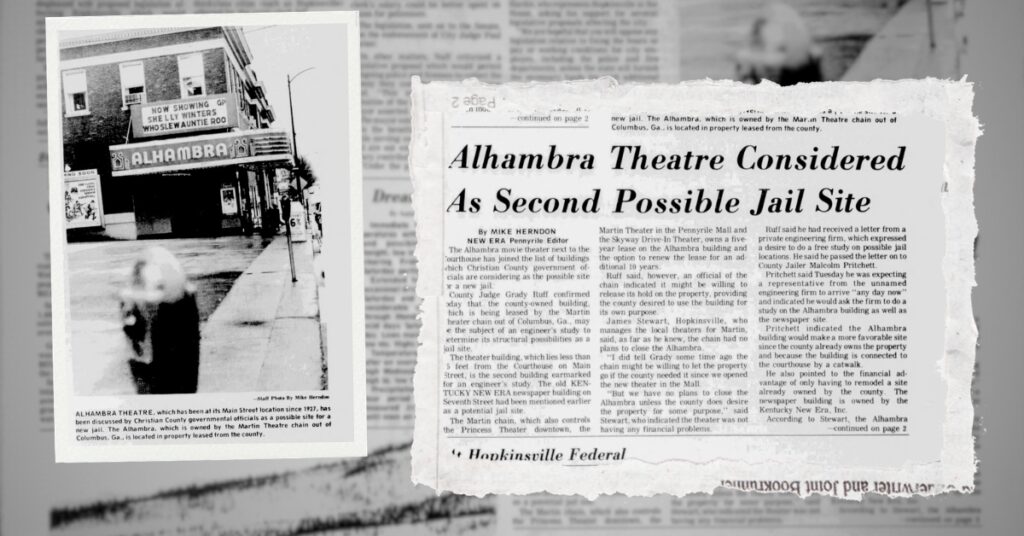
A photo of the Alhambra marquee advertising “Who Slew Auntie Roo” was published Jan. 20, 1972, on the front page of the Kentucky New Era. It ran next to a story headlined, “Alhambra Theatre Considered As Second Possible Jail Site” — proof that the theater almost did not survive as the cultural hub we know today.
I was also downtown Saturday to shoot photos of the parade honoring local veterans. Weather-wise, it was a beautiful day with a big crowd lining the streets from the Memorial Building to the Christian County Justice Center.
I am a sucker for a parade, and even though I complain every year that sirens should not be part of Hopkinsville’s Christmas parade, I go to every parade that passes through downtown.
So add a parade to my list of final experiences in Hopkinsville. And my magical option would be a return to the 1969 Christmas parade when I played an elf on the Western State Hospital float. Seven years old, I was the beneficiary of my dad’s friendship with the psychiatrist who was director of the mental hospital back then.
The third option on my list of last-chance-to-see places would be any locally owned gathering place — a bar, the brewery, a restaurant, the downtown bookstore or a coffeehouse. The loss of many independent businesses that have been muscled out by national chains is one of Hopkinsville’s worst trends — as it is in most communities. Small, locally owned restaurants and shops create stronger civic infrastructure and cultural identity. And they do not produce the kind of sprawl and poor land uses that chains generally do.
My last stop would be my church, Grace Episcopal. Interestingly, the downtown sanctuary is within walking distance to everything else on my list.
So what are your last stops in Hopkinsville? Email and let me know.

Jennifer P. Brown is co-founder, publisher and editor of Hoptown Chronicle. You can reach her at editor@hoptownchronicle.org. Brown was a reporter and editor at the Kentucky New Era, where she worked for 30 years. She is a co-chair of the national advisory board to the Institute for Rural Journalism and Community Issues, governing board past president for the Kentucky Historical Society, and co-founder of the Kentucky Open Government Coalition. She serves on the Hopkinsville History Foundation's board.