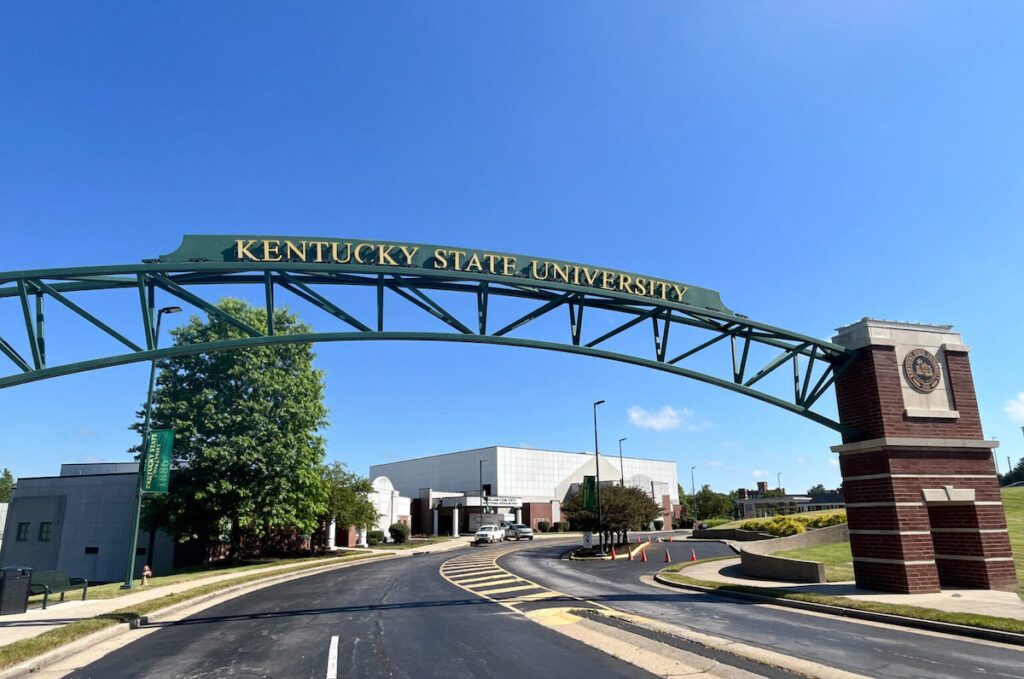
FRANKFORT — Kentucky State University would undergo a pruning of its academic offerings and be assigned a new polytechnic mission under legislation that moved out of a Senate committee Wednesday.
Senate Bill 185, sponsored by Rep. Chris McDaniel, chairman of the Senate budget committee, comes on the heels of intense private discussions by lawmakers of closing KSU, McDaniel said Wednesday.
Kentucky State, located in Frankfort, is Kentucky’s only public historically Black college or university (HBCU).
The measure was unveiled in a special-called meeting of the Senate Appropriations and Revenue Committee Wednesday afternoon and attached to a “shell bill” that already had two readings, making it ready for a final reading and a vote by the full Senate. Lawmakers use “shell bills,” which originally contain innocuous filler language, to swiftly move legislation late in the session.
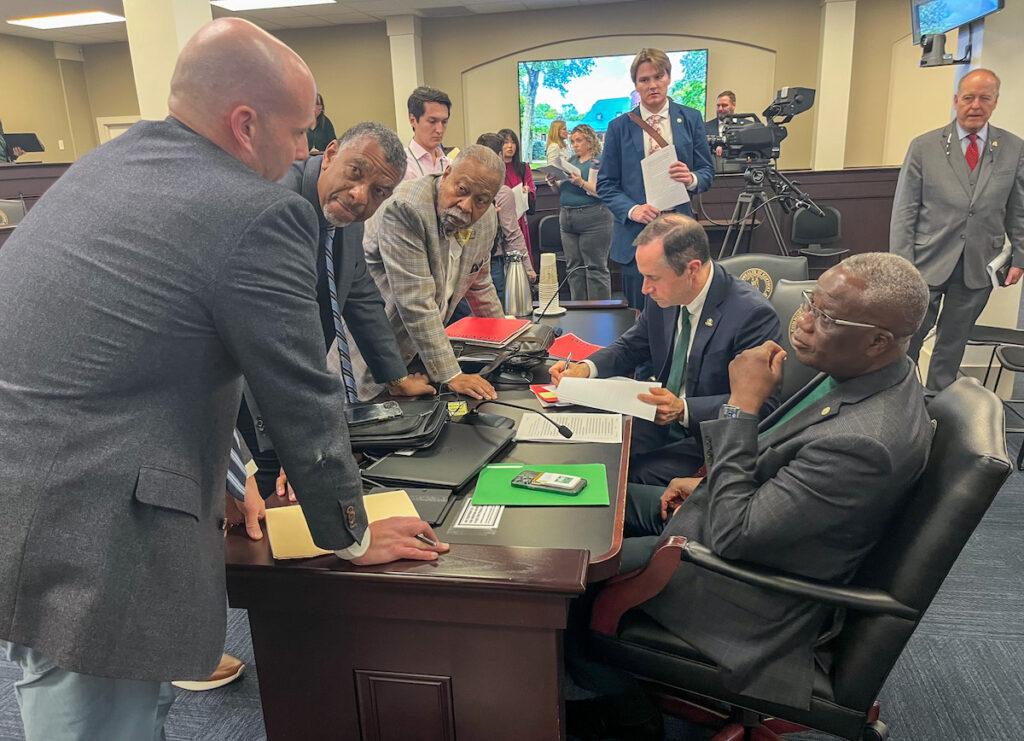
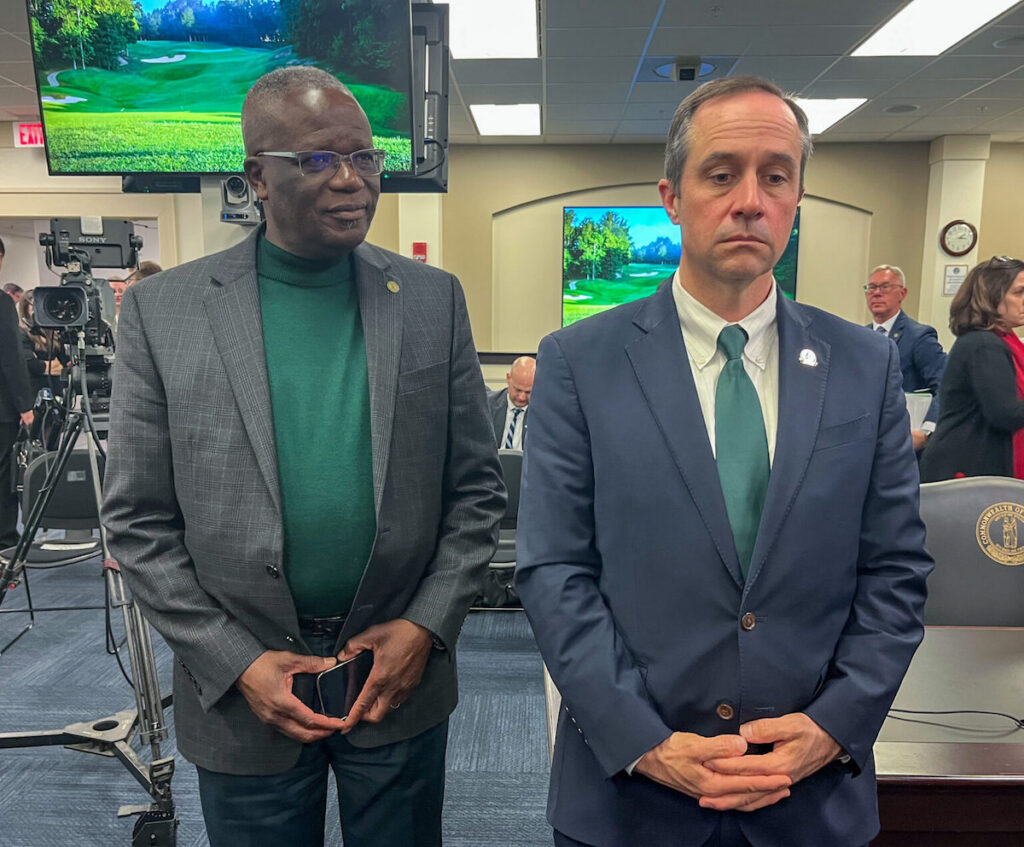
McDaniel, R-Ryland Heights, sat alongside KSU President Koffi C. Akakpo and Kentucky Council on Postsecondary Education President Aaron Thompson as he presented the bill to the committee.
Addressing the committee, McDaniel said that several lawmakers had discussed closing KSU after having “experienced great frustration with Kentucky State” especially “after the events of last winter.” But during the current legislative session, they felt hopeful about the university’s future under Akakpo’s leadership, the chairman added.
In December, a student was killed and another injured in a shooting on KSU’s campus. A grand jury later declined to indict the suspect, a parent of a student who had been the target of physical attacks on the campus. The parent, who was moving his son out of a KSU dorm when a group of people attacked them, said he fired in self defense. The December violence followed a shooting from a car on the campus in August in which the two injured were not students or employees.
McDaniel said SB 185 was the product of work between KSU, the Council on Postsecondary Education and lawmakers.
“This work is a recognition of the importance of a vibrant HBCU in the Commonwealth. It is a recognition that high standards will lead to great outcomes,” McDaniel said. “And it is a vote of confidence in Dr. Akakpo’s leadership of the university and our belief that with our partnership, the university can return to the glory for which it is known.”
Akakpo, who became KSU’s president in July 2023, said he understood that “discussion in the beginning was very heated, but we have found a way to move forward.”
“The job is not going to be possible without your support, so your continuous support is going to be needed as we position Kentucky State University to be one of the premier HBCUs in the country. I have no doubt,” Akakpo told the committee “The past two years have been really difficult, but I can tell you, we’re seeing the light at the end of the tunnel.”
If passed, SB 185 would declare a “state of financial exigency” at KSU for the next five years. It says that during that time, the president may terminate university employees — including tenured faculty — and the university must retain only the faculty and staff necessary to support the enrollment of 1,000 in-person students.
SB 185 would transition KSU into a polytechnic “that focuses on highly technical, industry-based applied learning and offers programs aligned with the workforce needs of the Commonwealth,” the latest version of the bill says. A polytechnic school is often centered around technical, engineering and science education.
McDaniel last week publicly criticized two contracts entered into by a previous KSU administration. He called on Republicans Attorney General Russell Coleman and Auditor Allison Ball to investigate the matter to determine “whether or not there was anything that was potentially improper.”
The bill requires KSU to provide monthly reports of its finances to CPE and comply with the council’s financial oversight, some of which began under a 2022 law enacted by the General Assembly.
KSU’s Board of Regents must consult with CPE on a “thorough review of all academic programs” for alignment with the university’s new mission and long-term viability and financial stability. By June 1, 2026, the board must submit to CPE a list of programs to maintain and another list of programs to be closed or undergo “substantive change.”
For the next five years starting in the 2026-27 academic year, KSU must not offer more than 10 academic areas of study, excluding any programs that are exclusively online, within the College of Education or determined to be necessary to the university’s new mission by CPE.
The bill also says that KSU may not admit or readmit students who owe an outstanding balance of $1,000 for more than 30 days. KSU must refer those with more than $1,000 in debt for more than 60 days to the Department of Revenue.
Another section of SB 185 would require KSU to only admit new students who have a GPA of 2.5 and an ACT composite score of 18, or another equivalent score on a college admissions test. KSU’s website currently says first-time freshmen must have a 2.0 GPA. Another provision says that all fraternities and sororities on the campus must reapply to the Board of Regents for its charter by July 1.
Before the committee meeting began, McDaniel and Senate Democratic Floor Leader Gerald Neal, of Louisville, held a minutes-long discussion in the hallway while other committee members took their seats. Neal is an alumnus of KSU.
Though Neal asked about possible additions to give more flexibility to Akakpo’s administration, he ultimately voted in favor of the bill during the committee. While explaining his vote, Neal said “we’re going to have to have some level of trust with each other and goodwill with each other to make this happen.”
Eleven committee members voted in favor of the bill Wednesday afternoon, but Democratic Whip Sen. Cassie Chambers Armstrong, of Louisville, passed her vote, saying she had less than an hour to read the bill.
“Even though I expect this bill will move quickly, I’d like to take every bit of time I have just to engage in conversations and educate myself more about it,” she said. “But this should not be taken as anything against anything in the bill, and I am really grateful for the collaboration.”
Asked after the meeting if KSU faculty and students should read this bill to mean that possible cuts could be coming to their programs, Akakpo said he would be talking to faculty, students and staff “and assure them that this is going to be done in a very methodical way.”
“We’re not going to just go in a hasty way and do something that will backfire, but we will make sure we’re very thoughtful,” he said.
McDaniel said that two appropriations are also being considered for KSU — $3 million for a polytechnic transition and $50 million for a health sciences building, which KSU has previously sought. KSU’s base state funding will remain constant, McDaniel added.
After the meeting, McDaniel told reporters that the funding could end up in a one-time spending bill, which has gone to a conference committee to be hashed out between the House and Senate, or another budget bill.
This article is republished under a Creative Commons license from Kentucky Lantern, which is part of States Newsroom, a network of news bureaus supported by grants and a coalition of donors as a 501c(3) public charity. Kentucky Lantern maintains editorial independence. Contact Editor Jamie Lucke for questions: info@kentuckylantern.com. Follow Kentucky Lantern on Facebook and Twitter.

McKenna Horsley covers state politics for the Kentucky Lantern. She previously worked for newspapers in Huntington, West Virginia, and Frankfort, Kentucky. She is from northeastern Kentucky.