Today on CBS News’ “Sunday Morning” program, broadcast journalist Ted Koppel took viewers on a tour of Seneca Falls, New York.
The town of roughly 7,000 residents claims to have been the inspiration for Bedford Falls in “It’s a Wonderful Life,” the 1946 Christmas movie about the selfless hometown hero George Bailey, who learns in his darkest hour that the true meaning of his life came from his loyalty to the community and its residents.
Koppel’s segment explores the message of this classic holiday film and questions whether civility is still alive in places like Seneca Falls. (There’s the pesky detail of a landfill towering at the edge of town.)
You should know that the connection between the real town and its fictional movie version is based on a belief that “Wonderful Life” producer, director and co-writer Frank Capra passed through Seneca Falls a year or so before making the movie.
A local barber, Tommy Bellissima, swore Capra came into his shop for a haircut while visiting an aunt in the area. In the barber’s chair or maybe out on the street, Capra would have picked up a dramatic story about a man who jumped from a steel truss bridge over a Seneca Falls canal in 1917 to save a woman intent on taking her own life. A plaque on the bridge says Antonio Varacalli “gave his life to save another.”
The bridge is strikingly similar to the bridge in “Wonderful Life,” where George Bailey, played by Jimmy Stewart, jumps into frigid waters on Christmas Eve to save a man who turns out to be his guardian angel, Clarence.
I stood on that bridge and shot photos of several Seneca Falls landmarks in 2004, when I visited for the “Wonderful Life” festival the town organizes every year. And because of a serendipitous meeting with two Seneca Falls couples, I returned to the area several times over the next 15 years.
That’s why I believe I am the Seneca Falls outsider who is uniquely qualified to tackle Koppel’s questions about the town’s true character.
I was charmed by the townspeople before I even stepped into their downtown.
Here’s how it happened: In the fall of 2004, I wrote a column for the Kentucky New Era newspaper about my plans to visit Seneca Falls in the coming weeks. Without my knowledge, someone at an online news outlet re-published my article — and suddenly numerous people in Seneca Falls were emailing me to say they looked forward to my arrival.
It was hard to be annoyed about having my article stolen when so many people seemed eager to say, “Hi.”
Then came the Hoptown connection. (You knew there had to be one.)
Sue Ellen Crego, a Seneca Falls woman originally from Hopkinsville, emailed and asked me and my traveling companion to join her and her husband, Peter, and their friends Jeb and Diana for a visit. After I learned that Peter was a minister, I warned my friend Janet that we should be on our best behavior and watch our language.
I told Janet it would be rude (and very un-Southern) of me to not stop in to meet Sue Ellen, and I said something like, “We’ll have a glass of tea and say ‘hey’ and be on our way.”
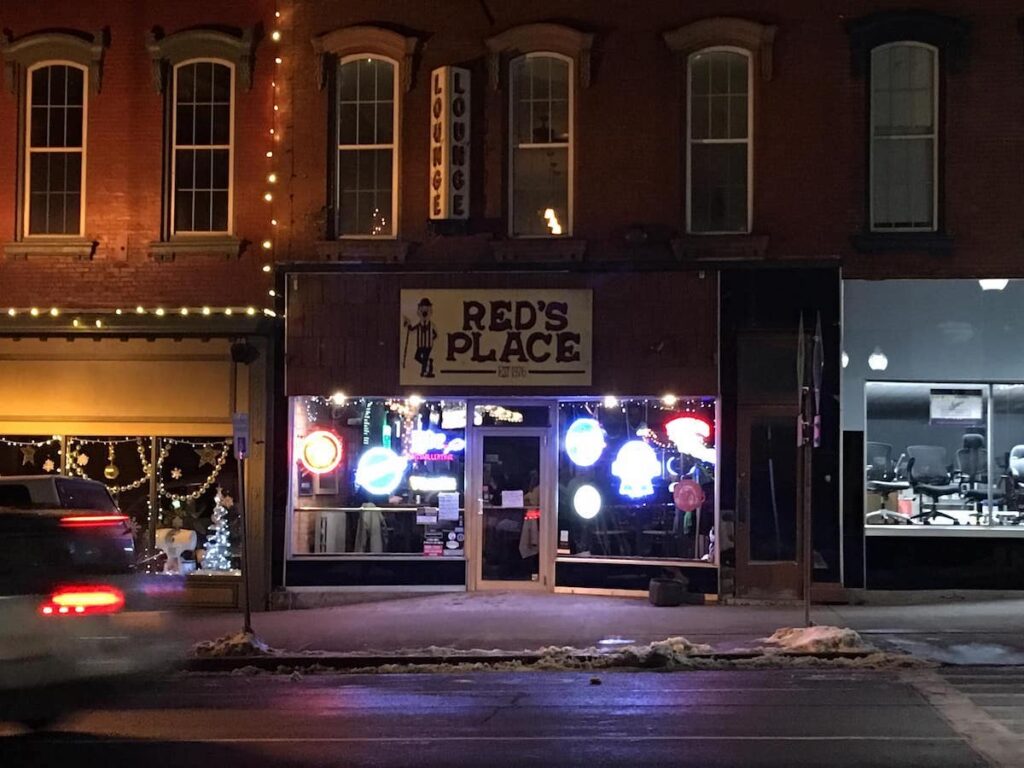
Then I heard they wanted to meet us at a local watering hole, Red’s Place. About five minutes after we sat down with the Cregos and their friends, two pitchers of beer came to the table.
It turned out that Sue Ellen and Peter both remembered my parents, and soon we were swapping old Hoptown stories.
And more pitchers of beer landed at our table.
Every time I was back in New York to visit Janet, who lived in the Rochester area, we found time to catch up with Sue Ellen, Peter, Diana and Jeb.
Once, we went to the Presbyterian Church where Peter preached. Other times we met at one of their homes in the historic district or at an area restaurant.
Sadly, Diana, the youngest of the four, died in 2015 of complications from an autoimmune disorder. An Englishwoman, she had fallen in love with America and became a U.S. citizen several years before her death.
Jeb, her husband, died two years later.
Janet and I last visited with the Cregos in 2019 at a restaurant up the street from Red’s Place. Before we left, Sue Ellen gave Janet and I wooden coins for a free drink at the restaurant bar the next time we visited.
In 2023 we learned that Sue Ellen had died. Three of our four Seneca Falls friends were gone.
It’s hard to explain how you could cherish a group of friends that you saw no more than five or six times in your life.
Unless you encounter them in a place like Seneca Falls.
I hated to hear about the landfill, but I know Seneca Falls is still a beautiful place.
And the people. You can’t beat them.
Monday evening I’ll probably be at Hopkinsville’s Alhambra Theatre to watch “It’s a Wonderful Life.”
I’ll be thinking about Bedford Falls’ alter ego and the people there who know something about friendship.
Maybe I’ll get back there someday.

Jennifer P. Brown is co-founder, publisher and editor of Hoptown Chronicle. You can reach her at editor@hoptownchronicle.org. Brown was a reporter and editor at the Kentucky New Era, where she worked for 30 years. She is a co-chair of the national advisory board to the Institute for Rural Journalism and Community Issues, governing board past president for the Kentucky Historical Society, and co-founder of the Kentucky Open Government Coalition. She serves on the Hopkinsville History Foundation's board.