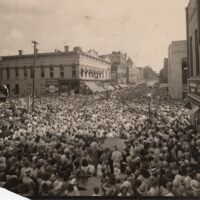
Historic buildings leave their fingerprints on a community’s psyche. They quietly instill a sense of continuity, identity and place over the years. Every historic building is a unique accumulation of the stories that have played out in and around it.
In my experience, when a building is destroyed, its collection of known stories goes with it. Maybe not immediately, but they fade away over time. And the stories that haven’t been discovered become almost irretrievable. The community loses a piece of itself. Those stories still exist, out in the ether, but their tangible link to reality and place is gone.

The only building I’m familiar with that defies this rule is the Hotel Latham. I’m shocked at the power its memory still exerts over Hopkinsville. Even though the Hotel Latham has been gone for 85 years, and it’s doubtful anyone living in Hopkinsville today ever saw the building firsthand, so many people here know about it in startling detail. For some reason, the Hotel Latham’s story is seared into Hopkinsville’s DNA.
This has intrigued me for a number of years. Fascination with the Hotel Latham isn’t just a modern nostalgia for the past. It’s something that existed historically, alongside the hotel.
A large part of the Hotel Latham’s continuing primacy today is due to Christian County Historian William T. Turner’s efforts to keep its memory alive. He has been the torchbearer for the building’s history for many years. I fully believe that he has picked up on the contemporary sentiment regarding the Hotel Latham.
From its inception in 1893, the Hotel Latham exerted significant power and pride of place over Hopkinsville. Visible proof is out there, if you pay attention to your surroundings.

The Hotel Latham
It’s hard for us to imagine downtown Hopkinsville at the turn of the 20th century. With entire blocks of buildings now replaced by parking lots, our downtown district contains vastly more open space than historic Hopkinsville ever did. In 1900, very few lots downtown were empty or abandoned. Most buildings were two to three stories tall with conjoined walls or narrow alleys in between. Parking lots did not exist. Hopkinsville was a dense urban center.
From its completion in 1895, the Hotel Latham was the jewel of Hopkinsville. John C. Latham conceived the plan for the hotel.
A Hopkinsville native, Latham had made millions in New York City over the previous three decades and continually sponsored projects in his hometown. It’s hard to know exactly how much money he poured into Hopkinsville over his lifetime, but he easily did more to transform the city than any other single person.
The Hotel Latham occupied the entire city block between Sixth and Seventh streets and Virginia and Liberty streets. At four stories, it towered over downtown. It wasn’t just bulky — it had style.
Built in the Renaissance Revival style so associated with the Gilded Age, the hotel was simply magnificent to look at. Buff-colored bricks were set off with molded terra cotta capitals and keystones. In architecture, a capital is the top portion of a column, pier or pilaster that serves as a transition, which is often decorative, between the vertical support and the horizontal structure above it.
The structure was capped with a red tile roof that ended in dramatic spires on its principal peaks. It had two dining rooms, a grand lobby, an elevator, plumbing, a barber shop, a hair salon, a telegraph office and even a cigar stand! This was a hotel that could have easily graced the streets of downtown St. Louis or Detroit.
But here it was, in Hopkinsville. No wonder it immediately made an impression on the community. And no wonder people in Hopkinsville are still proud of it, 85 years after its destruction.
Architectural Easter Eggs
Not being a native Christian Countian, I don’t have a factory-setting radar for detecting Hotel Latham paraphernalia. However, Alissa Keller, executive director of the Museums of Historic Hopkinsville-Christian County, immediately identified pieces of the Hotel Latham that were built into the Monroe Dalton house, which my husband and I purchased in March 2023.

We have a mantel that’s hodge-podged together from two capitals and a keystone from the hotel’s window surrounds, a fancy sill on a basement window of the ell, and the tripartite portico columns are built from buff bricks that look suspiciously similar to the Hotel Latham’s.
Alissa wasn’t the first to notice these pieces. The house’s 1982 National Register nomination identifies the fireplace and window sill as being from the Hotel Latham. Chris Hall and Tracey Calhoun owned the Monroe Dalton house then and seem to have known about the connection.
From the construction of the portico columns and ell masonry, I fully accept these elements as planned parts of the Dalton house’s construction. They’re cool architectural flourishes, but do they have a greater significance? Why did Monroe Dalton build his house with so many pieces from the Hotel Latham?

The Dalton Bros. Connection
Organized by John C. Latham, the group of investors that became the Hotel Latham Company met at Holland’s Opera House, on Main Street, throughout 1893 to plan Hopkinsville’s grand hotel. On Jan. 5, 1894, they selected the New York City architect Edward S. Child to design the hotel. Five days later, they opened sealed bids and selected contractors. The very first contract awarded, and the most expensive, was to the Dalton Bros. for brickwork at $8,061.

The Dalton Bros. masons began work on March 19, 1894. When they laid the first brick, they took the Hotel Latham from the world of ideas to a reality. Between 40 and 50 masons worked on the project, and the construction moved rapidly.
These masons were also responsible for laying the molded terra cotta elements that gave the building its distinctive Renaissance Revival style. Imported from Perth Amboy, New Jersey, they adorned every window and entry on the three main facades. The Perth Amboy Terra Cotta Company was one of the earliest companies of its kind in America. Started in 1879, it provided architectural elements for a number of noteworthy buildings, including the Flatiron and Woolworth buildings in New York City and the U.S. Supreme Court!
By mid-April of 1894, the Hopkinsville Kentuckian reported the walls were now up to the second floor and predicted the brickwork would be completed in just one more month. The Dalton Bros. finished at the end of June, which still seems very fast work for a building of such gigantic proportions.

The Hotel Latham Scavenger Hunt
Monroe Dalton must have been proud of his part in building the Hotel Latham. So proud that when he went to build his own house 13 years later, he decided to include leftover pieces from the Hotel Latham in it. William Turner visited the Dalton Bros. brickyard in the 1960s and noted then piles of surplus molded terra cotta from the Hotel Latham’s construction six decades earlier.
The Hotel Latham elements of the Dalton house are a special insight into the thoughts and feelings of someone who lived nearly 120 years ago. But the story doesn’t end here. Monroe Dalton wasn’t the only one in Hopkinsville who wanted his home to be associated with the city’s grand hotel.
Next door is the Lucien Davis house. If you recall the very first article in this series, you know the Davises and Daltons were related by marriage, and their houses on East Seventh Street went up side by side over the summer of 1907.
On the front façade of the Davis house, perched in the center bay of the second floor is a Hotel Latham keystone. And there’s more! A capital from the hotel windows sits atop the house’s entry. It seems that just like Monroe Dalton, Lucien Davis wanted his grand new house to conjure a mental connection with the Hotel Latham.
This discovery set my mind racing. If Monroe Dalton and Lucien Davis both included architectural pieces from the Hotel Latham in their homes, I bet other contemporary Hopkinsvillians did the same thing. Perhaps this is Hopkinsville’s version of “George Washington slept here.” You tell me — does your house have architectural pieces that look like these in it?
Why do we remember the Hotel Latham?
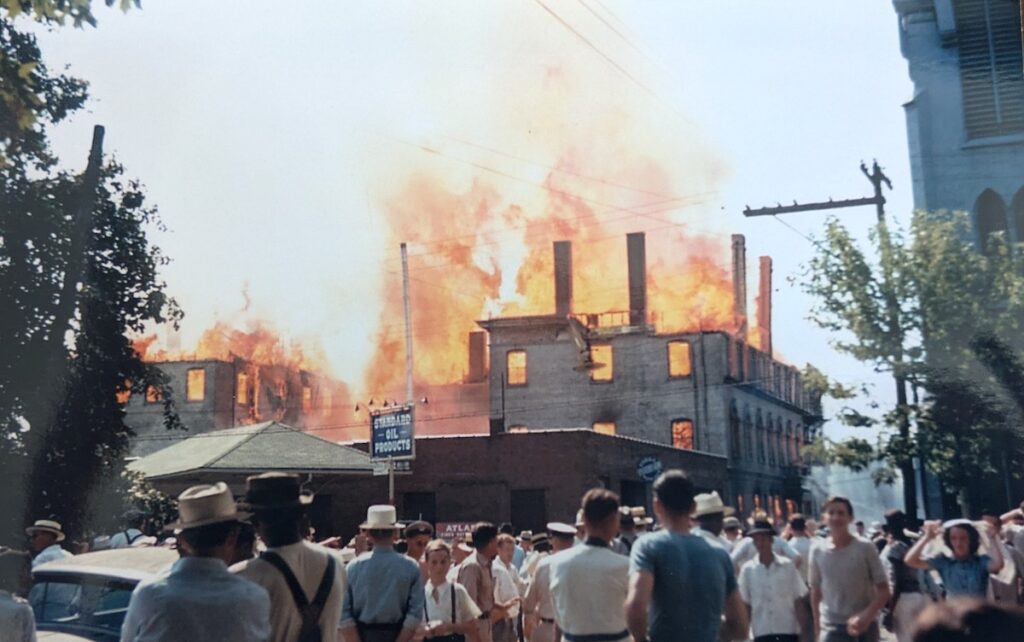
The Hotel Latham was destroyed by fire on Aug. 4, 1940. The blaze was so destructive it nearly razed the building to the ground. It’s well-documented, and both snapshots and a video of it exist. I think the shock and scale of the disaster are one reason why the Hotel Latham is so well-remembered. But I don’t think this is the main reason.
In building the Hotel Latham, John C. Latham, a successful millionaire who lived in the glamorous world of Gilded Age New York City, told the people of Hopkinsville that they were important and worth investing in. The affirmation and sense of self-worth that the Hotel Latham gave to Hopkinsville was so powerful that it transcended the hotel’s demise and carried on to generations that never even set eyes on the building.
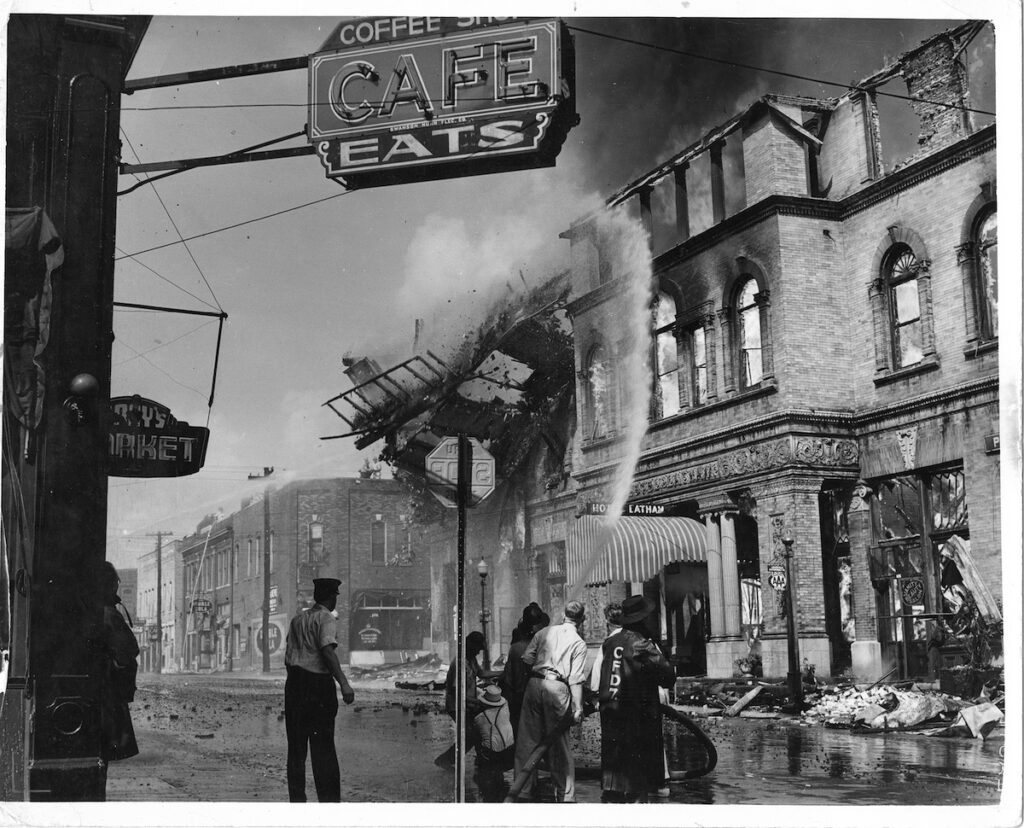
Hopkinsvillians like Lucien Davis and Monroe Dalton immediately picked up on what the hotel symbolized. By adding pieces from the Hotel Latham onto their own homes, they helped the hotel live on in the memory and identity of this place. Remembering the Hotel Latham is important because it’s a reminder of this community’s worth. Of all the gifts John C. Latham gave Hopkinsville, this affirmation has to be the most precious.

Grace Abernethy is a historic preservationist and artist who specializes in caring for and recreating historic architectural finishes. She earned her Master of Science in Historic Preservation from Clemson University in 2011 and has worked on historic buildings throughout the eastern United States. Abernethy was a recipient of the South Carolina Palmetto Trust for Historic Preservation Award in 2014 and won 2nd place in the Charles E. Peterson Prize for the Historic American Buildings Survey in 2011. She and her husband, Brendan, moved to Hopkinsville from Nashville in 2020. She works as an independent contractor and is a board member of the Hopkinsville History Foundation.